
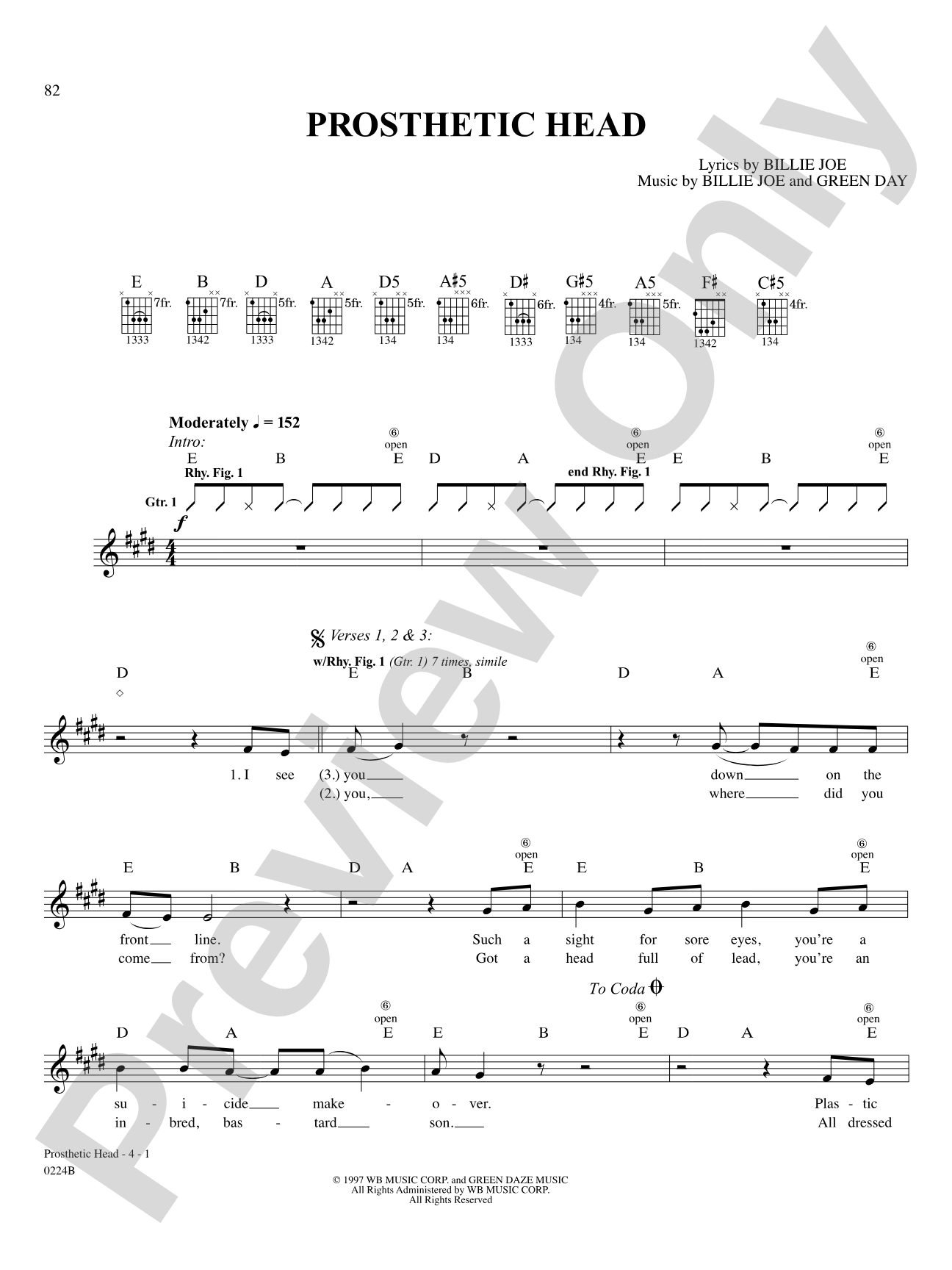

Prosthetic Head: Authentic Guitar TAB
Green Day
Item: 00-PS-0000051
$4.99
One moment…
Related Items
Nice Guys Finish Last: Authentic Guitar TAB |
$5.99
|
View | |
The Grouch: Authentic Guitar TAB |
$4.99
|
View | |
Redundant: Authentic Guitar TAB |
$5.99
|
View | |
Scattered: Authentic Guitar TAB |
$4.99
|
View | |
All The Time: Authentic Guitar TAB |
$4.99
|
View | |
Worry Rock: Authentic Guitar TAB |
$4.99
|
View | |
Platypus (I Hate You): Authentic Guitar TAB |
$4.99
|
View | |
Uptight: Authentic Guitar TAB |
$4.99
|
View | |
Last Ride In: Authentic Guitar TAB |
$4.99
|
View | |
Jinx: Authentic Guitar TAB |
$4.99
|
View | |
Haushinka: Authentic Guitar TAB |
$4.99
|
View | |
Walking Alone: Authentic Guitar TAB |
$4.99
|
View | |
Reject: Authentic Guitar TAB |
$4.99
|
View | |
Take Back: Authentic Guitar TAB |
$4.99
|
View | |
King For A Day: Authentic Guitar TAB |
$4.99
|
View | |
Good Riddance (Time Of Your Life): Authentic Guitar TAB |
$4.99
|
View |
Description
Titles are: Nice Guys * Hitchin' a Ride * The Grouch * Redundant * Scattered * All the Time * Worry Rock * Platypus (I Hate You) * Uptight * Last Ride In * Jinx * Haushinka * Walking Alone * Reject * Take Back * King for a Day * Good Riddance (Time of Your Life) * Prosthetic Head.


Prosthetic Head: Authentic Guitar TAB isn't in MakeMusic Cloud just yet...but it could be. Let us know you'd like to see it, and you'll help shape what comes next. In the meantime, start a free trial and dive into thousands of interactive titles your students can play along with today.
Request This Title
Tell us you want it.
Start Your Free Trial
Explore everything that's ready to play right now.
Sample Audio
No sample audio found.
Sample Video
No sample videos found.
Additional Details
Publisher:
Alfred Music
Page Count:
88
SKU:
00-PS-0000051
More about this title
About the Composer: Billie Joe
Billie Joe Armstrong is the vocalist, guitarist, and primary songwriter of Green Day, the band that defined pop-punk for generations of rock musicians. His songwriting spans intimate acoustic reflections and explosive anthems, often marked by sharp melodic hooks and direct emotional language. Armstrong's influence on guitar-driven rock education extends far beyond his commercial success; his work appears in countless guitar curricula because his songs reward serious study of rhythm, dynamics, and the relationship between vocal melody and instrumental texture.
Why we love this
This collection captures 18 tracks from Green Day's most formative albums in authentic tab, giving guitarists direct access to the exact voicings and techniques that shaped modern rock guitar playing. The range spans from the sparse picking of "Good Riddance (Time of Your Life)" to the aggressive power chord work that defines songs like "Hitchin' a Ride," making it a genuinely useful resource for players developing both technical control and stylistic versatility. Students working through this material will encounter real songwriting decisions that serious musicians study, not simplified approximations.
What to expect
These songs pulse with controlled energy and emotional directness. You'll encounter sharp rhythmic precision balanced against moments of vulnerability, power chords that hit hard in a fully realized band context, and melodic lines that live in the space between sung melody and instrumental color. The overall character is intensely present and unpretentious, demanding both technical command and interpretive sensitivity.
Who it's for
Intermediate to advanced guitarists who want to understand how Green Day's catalog was actually recorded and performed. Players studying contemporary rock songwriting will find direct examples of effective riff construction, rhythm section coordination, and the craft of pop-punk composition. This resource works equally well for self-taught musicians filling gaps in their education and for students in guitar curricula seeking authentic transcriptions of songs they care about.
How to get the most out of it
- Lock the rhythmic subdivisions in songs like "The Grouch" and "Uptight" by isolating the kick drum pattern first, then layering guitar rhythm on top; this reinforces how Armstrong's parts mesh with the band's tightness.
- Pay close attention to muting and palm-mute notation throughout; the dynamics between open strumming and controlled mute work carry enormous expressive weight in these songs.
- Study the lead guitar passages separately from rhythm parts, especially in "Walking Alone" and "King for a Day"; tab notation shows you what to play, but listening reveals how those lines sit in the mix relative to vocals and drums.
- Work through the fingerpicking patterns in "Platypus (I Hate You)" and "Reject" at half-speed until the muscle memory is automatic; these passages demand precision before they sound convincing at performance tempo.
How to use it
Use this collection to build a modern rock repertoire unit that connects contemporary songwriting to serious musicianship. These pieces work well alongside classical and jazz studies as a way to demonstrate how rhythm, harmony, and melody function across different genres. You might assign individual songs as performance projects or pull specific tracks as technical studies (fingerpicking, muting, power chord efficiency) that advance guitar facility in practical contexts.
Skills your students will build
- Reading and executing power chord rhythms with precise muting and dynamics
- Translating tab notation to fretboard execution across varying tempos and styles
- Coordinating rhythm guitar parts with melodic vocal lines and band arrangement
- Developing fingerpicking techniques for acoustic passages and clean electric riffs
- Understanding how rhythm guitar shapes song structure and energy arc
- Playing with rhythmic precision in contemporary rock contexts