
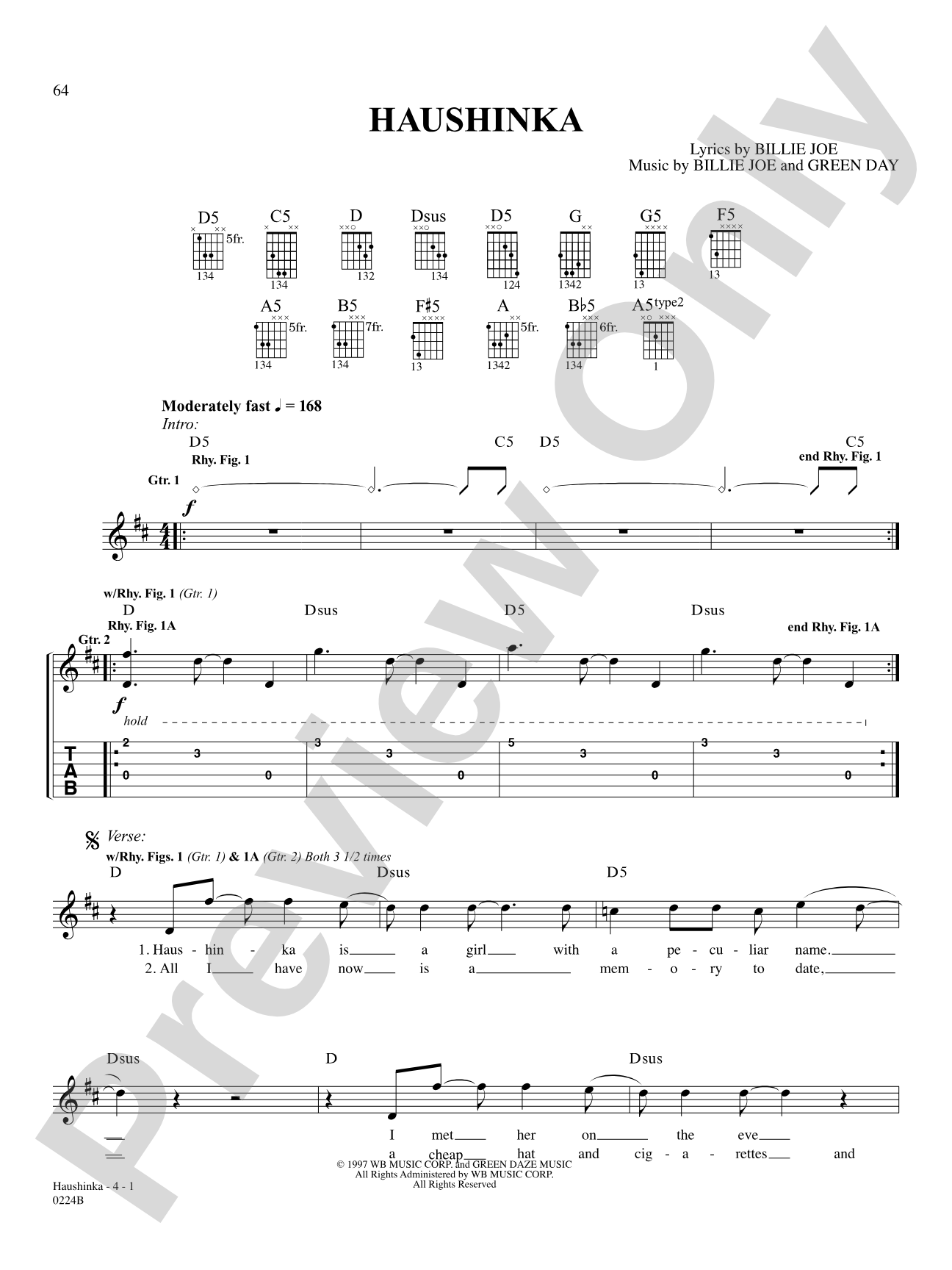

Haushinka: Authentic Guitar TAB
Green Day
Item: 00-PS-0000044
$4.99
One moment…
Related Items
Nice Guys Finish Last: Authentic Guitar TAB |
$5.99
|
View | |
The Grouch: Authentic Guitar TAB |
$4.99
|
View | |
Redundant: Authentic Guitar TAB |
$5.99
|
View | |
Scattered: Authentic Guitar TAB |
$4.99
|
View | |
All The Time: Authentic Guitar TAB |
$4.99
|
View | |
Worry Rock: Authentic Guitar TAB |
$4.99
|
View | |
Platypus (I Hate You): Authentic Guitar TAB |
$4.99
|
View | |
Uptight: Authentic Guitar TAB |
$4.99
|
View | |
Last Ride In: Authentic Guitar TAB |
$4.99
|
View | |
Jinx: Authentic Guitar TAB |
$4.99
|
View | |
Walking Alone: Authentic Guitar TAB |
$4.99
|
View | |
Reject: Authentic Guitar TAB |
$4.99
|
View | |
Take Back: Authentic Guitar TAB |
$4.99
|
View | |
King For A Day: Authentic Guitar TAB |
$4.99
|
View | |
Prosthetic Head: Authentic Guitar TAB |
$4.99
|
View | |
Good Riddance (Time Of Your Life): Authentic Guitar TAB |
$4.99
|
View |
Description
Titles are: Nice Guys * Hitchin' a Ride * The Grouch * Redundant * Scattered * All the Time * Worry Rock * Platypus (I Hate You) * Uptight * Last Ride In * Jinx * Haushinka * Walking Alone * Reject * Take Back * King for a Day * Good Riddance (Time of Your Life) * Prosthetic Head.


Haushinka: Authentic Guitar TAB isn't in MakeMusic Cloud just yet...but it could be. Let us know you'd like to see it, and you'll help shape what comes next. In the meantime, start a free trial and dive into thousands of interactive titles your students can play along with today.
Request This Title
Tell us you want it.
Start Your Free Trial
Explore everything that's ready to play right now.
Sample Audio
No sample audio found.
Sample Video
No sample videos found.
Additional Details
Publisher:
Alfred Music
Page Count:
88
SKU:
00-PS-0000044
More about this title
About the Composer: Billie Joe
Billie Joe Armstrong is the lead singer, guitarist, and primary songwriter of Green Day, the punk rock band that emerged from the East Bay scene in the early 1990s. His songwriting combines sharp social observation with memorable melodic hooks, creating music that resonates across generations of guitarists. Armstrong's approach to the instrument balances power chord simplicity with rhythmic sophistication, making his work accessible to intermediate players while offering depth for those seeking nuance.
Why we love this
This collection captures eighteen defining Green Day tracks in authentic TAB, giving guitarists direct access to the exact voicings, rhythmic figures, and techniques that shaped modern rock guitar playing. The material spans two decades of the band's catalog, from breakthrough hits to deep cuts, so students encounter consistent stylistic DNA across a substantial repertoire. For teachers building rock curriculum or for students who learn best through songs they already love, this is a substantial resource that rewards repeated study.
What to expect
Raw, driving, and emotionally direct. These songs pulse with the energy of punk and alternative rock, built on clean power chords and propulsive rhythms that feel urgent even at moderate tempos. There's a balance between accessibility and attitude: the guitar work is straightforward enough to learn quickly but distinctive enough to feel rewarding as your execution sharpens.
Who it's for
Intermediate to advanced guitarists who want to master songs from one of rock music's most influential bands. This collection works well for students in private lessons, self-directed learners, or ensemble players building their foundational repertoire in contemporary rock styles. Teachers can also draw from these arrangements for rock history units or for motivating students who connect strongly with punk and alternative rock.
How to get the most out of it
- Lock into the rhythmic precision of the rhythm guitar parts; Green Day's power and punch come from tight, deliberate strumming patterns rather than loose energy
- Pay attention to palm muting cues in the TAB; this technique defines the texture of many tracks and requires consistent hand position to execute cleanly
- Use the recorded versions as your reference for tempo and feel, especially on songs with driving eighth-note patterns or syncopated verse rhythms
- Focus on the transitions between verse and chorus shapes; Armstrong often shifts voicing rather than moving to entirely new chords, which creates the songs' forward momentum
How to use it
Assign individual tracks as solo repertoire for students working through rock styles, or use the collection as a semester-long resource where students rotate through different songs to build stylistic fluency. The range of song types (energetic rockers, quieter verses, acoustic-style pieces) means you can find material suited to different technical levels and moods. Programs emphasizing contemporary music or student-centered repertoire selection will find this especially useful for maintaining engagement.
Skills your students will build
- Power chord voicing and consistency across multiple positions
- Palm muting technique for rhythmic definition
- Reading and executing syncopated strumming patterns in 4/4
- Transitions between open and barre chord shapes
- Maintaining rhythmic lock with driving eighth-note and sixteenth-note figures
- Playing clean, defined single-note passages within rock contexts