
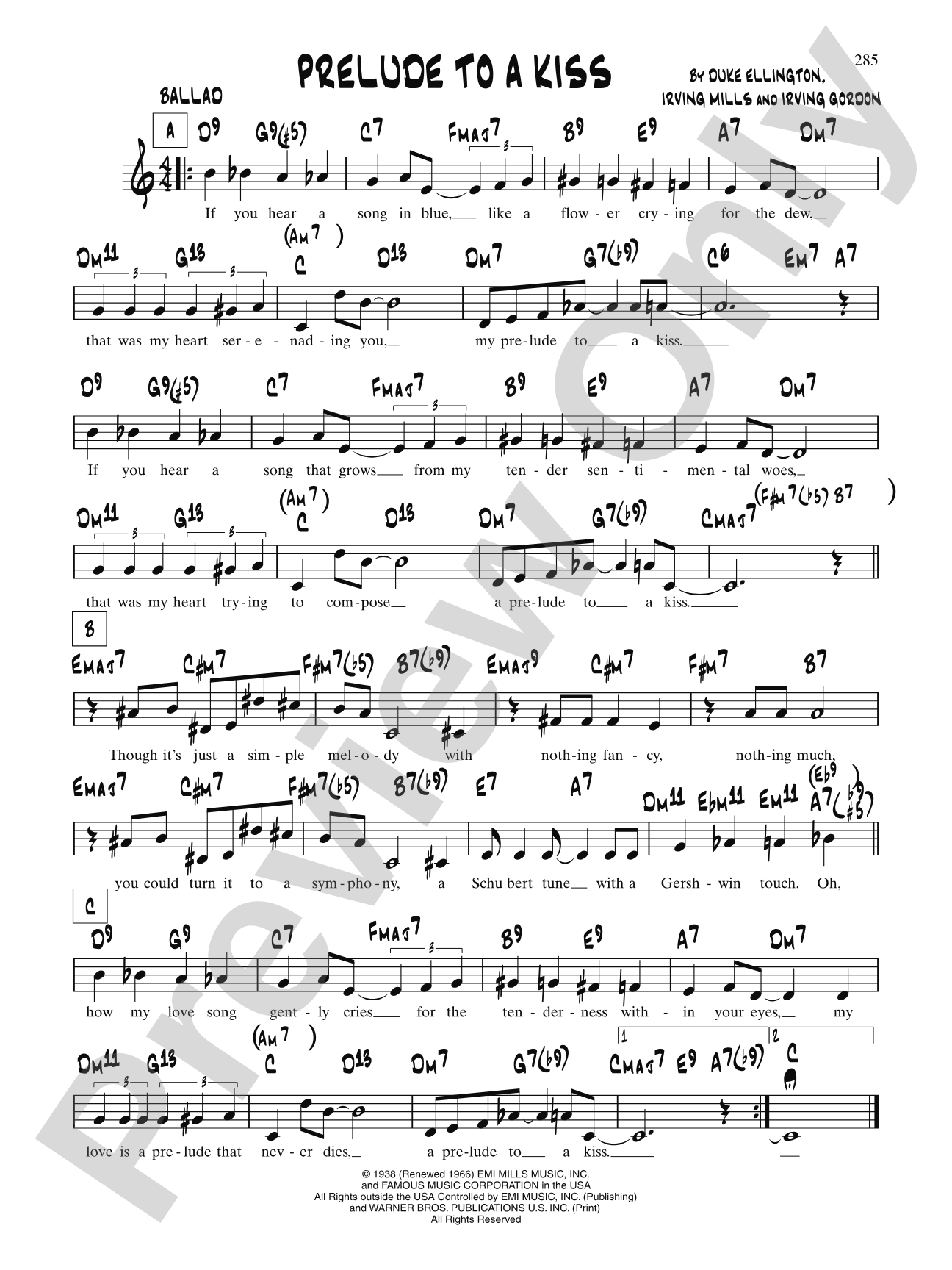

Prelude To A Kiss: Lead Sheet
Duke Ellington / arr. Howard Morgen
Item: 00-PSL-000193
$4.99
One moment…
Description
Twelve of the "Duke's" most memorable compositions arranged in standard notation and tablature. Includes: Do Nothin' Till You Hear from Me * Don't Get Around Much Anymore * In a Sentimental Mood * It Don't Mean a Thing (If It Ain't Got That Swing) * Mood Indigo * Satin Doll * Sophisticated Lady * Take the "A" Train.


Prelude To A Kiss: Lead Sheet isn't in MakeMusic Cloud just yet...but it could be. Let us know you'd like to see it, and you'll help shape what comes next. In the meantime, start a free trial and dive into thousands of interactive titles your students can play along with today.
Request This Title
Tell us you want it.
Start Your Free Trial
Explore everything that's ready to play right now.
Sample Audio
1
Caravan
--:--
2
In A Sentimental Mood
--:--
3
Satin Doll
--:--
Caravan
0:00
0:00
Sample Video
No sample videos found.
Additional Details
Series:
The Howard Morgen Fingerstyle Jazz Series
Publisher:
Alfred Music
Page Count:
32
SKU:
00-PSL-000193
More about this title
About the Artist: Tony Bennett
Tony Bennett stands as one of the most enduring voices in American popular music, with a career spanning over seven decades. His interpretations of jazz standards and Great American Songbook compositions have set the gold standard for phrasing, taste, and emotional authenticity, making him a trusted guide for musicians learning to swing with elegance and restraint.
Why we love this
This collection pairs Duke Ellington's immortal melodies with fingerstyle guitar arrangements that honor both the composer's sophistication and the instrument's lyrical potential. The dual notation (standard and tablature) makes these sophisticated jazz standards accessible to guitarists at various reading levels, while the Tony Bennett connection ensures every tune in the book carries proven interpretive weight.
What to expect
These arrangements capture the unhurried elegance of Bennett's interpretive style; they breathe. Whether you're playing the swinging syncopation of 'It Don't Mean a Thing' or the lush introspection of 'Mood Indigo,' you'll find room for nuance, dynamics, and the kind of understated sophistication that only comes from truly understanding a melody.
Who it's for
Intermediate to advanced fingerstyle guitarists who want to explore jazz repertoire with accessible yet sophisticated arrangements. This collection works equally well for those building a recital program of standards and for players looking to deepen their understanding of Ellington's harmonic language through the guitar.
How to get the most out of it
- Study the phrasing in Bennett's original recordings before finalizing your fingering choices; the way he shapes a melody often suggests where to breathe and where to sustain across the fretboard.
- Pay attention to the harmonic movement in Ellington's voicings rather than rushing the chord changes; these standards reward patient, deliberate voice leading.
- Use the tablature to explore alternative fingerings that allow you to maintain consistent tone across longer melodic lines, especially in ballads like 'In a Sentimental Mood.'
- Develop touch control to differentiate between melody notes (which should sit slightly forward) and accompanying figures (which should recede).
How to use it
These arrangements work beautifully as a coherent set in a recital exploring the Great American Songbook, or scattered throughout a program to offer jazz interludes between classical or contemporary works. Their approachability also makes them ideal for demonstrating how jazz guitar technique and harmonic understanding develop; you might feature one or two in a student recital before moving to longer jazz suites.
Skills your students will build
- Reading jazz voicings and harmonic substitutions from standard notation
- Fingerstyle technique with emphasis on independence between bass line and melody
- Swing interpretation and rhythmic phrasing across jazz standards
- Connecting tablature reading to standard notation literacy
- Melodic phrasing and dynamic shaping in jazz interpretation