
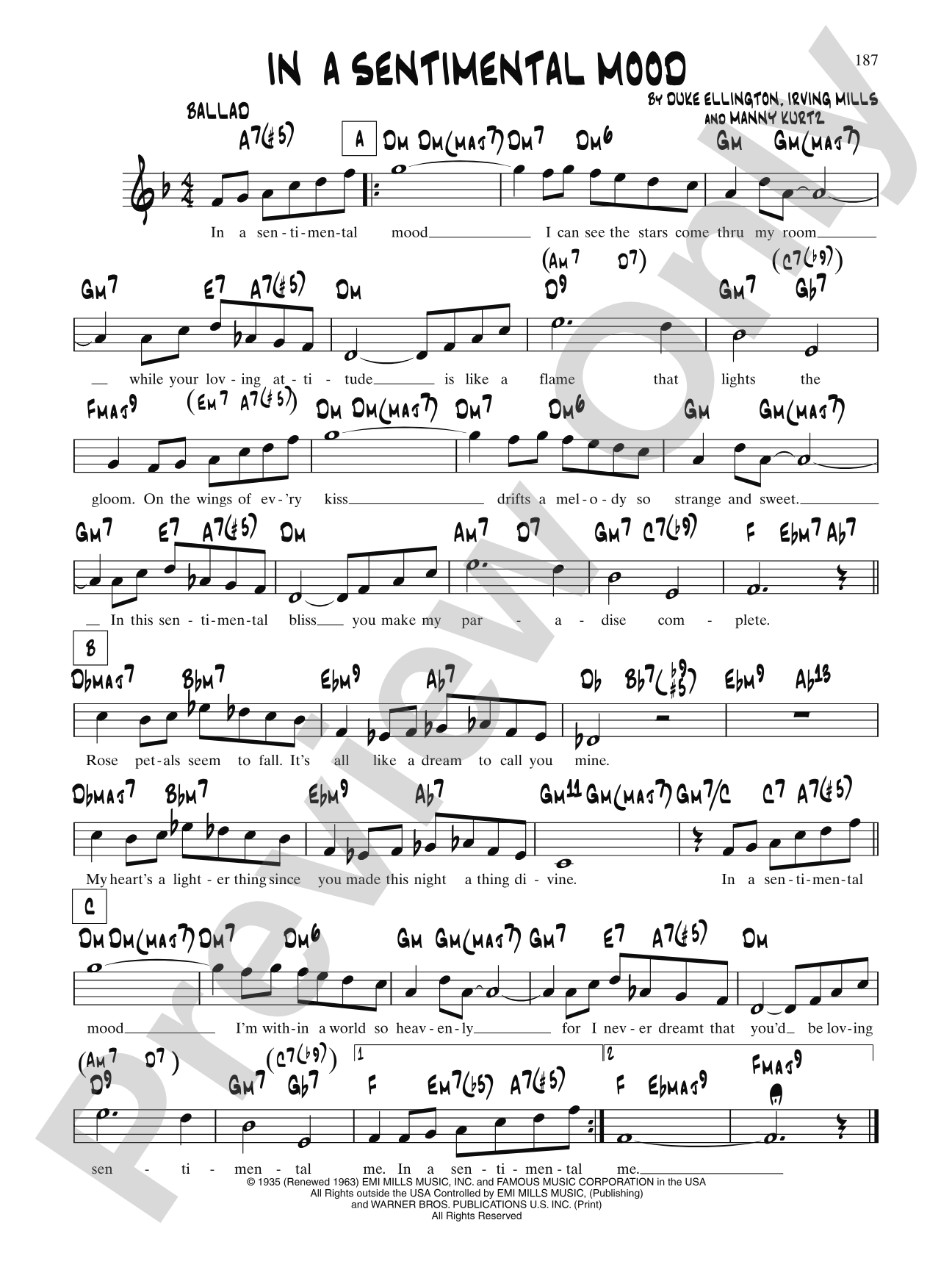

In A Sentimental Mood (Vocal Version): Lead Sheet
Duke Ellington / arr. Howard Morgen
Item: 00-PSL-000189
$4.99
One moment…
Description
Twelve of the "Duke's" most memorable compositions arranged in standard notation and tablature. Includes: Do Nothin' Till You Hear from Me * Don't Get Around Much Anymore * In a Sentimental Mood * It Don't Mean a Thing (If It Ain't Got That Swing) * Mood Indigo * Satin Doll * Sophisticated Lady * Take the "A" Train.


In A Sentimental Mood (Vocal Version): Lead Sheet isn't in MakeMusic Cloud just yet...but it could be. Let us know you'd like to see it, and you'll help shape what comes next. In the meantime, start a free trial and dive into thousands of interactive titles your students can play along with today.
Request This Title
Tell us you want it.
Start Your Free Trial
Explore everything that's ready to play right now.
Sample Audio
1
Caravan
--:--
2
In A Sentimental Mood
--:--
3
Satin Doll
--:--
Caravan
0:00
0:00
Sample Video
No sample videos found.
Additional Details
Series:
The Howard Morgen Fingerstyle Jazz Series
Publisher:
Alfred Music
Page Count:
32
SKU:
00-PSL-000189
More about this title
About the Artist: Tony Bennett
Tony Bennett stands as one of jazz and popular music's most enduring vocalists, with a career spanning more than seven decades. His interpretations of American standards are marked by impeccable phrasing, emotional depth, and an unwavering commitment to musical integrity. Though known primarily as a singer, Bennett's influence on jazz interpretation and his collaborations with instrumentalists have shaped how standards are understood across all musical disciplines.
Why we love this
This collection pairs Duke Ellington's most iconic compositions with a lead sheet approach that respects both the harmonic sophistication of the originals and the flexibility guitarists need for genuine jazz interpretation. The inclusion of tablature alongside standard notation makes these essential standards accessible to players at different reading levels, while the vocal version context grounds each melody in its most celebrated form. Programmers appreciate having authentic Duke arrangements that work equally well as solo features or ensemble foundations.
What to expect
Stepping into these compositions feels like entering a room where elegance and sophistication are assumed. The melodies sing with a timeless quality that Bennett's voice made legendary, and the harmonic structures underneath reward careful listening and thoughtful interpretation. There's both intimacy and polish here—pieces that work in a quiet jazz club and equally well on a concert stage.
Who it's for
Jazz guitarists seeking authentic arrangements of canonical American standards, particularly those developing their comping and soloing vocabulary through Duke Ellington's harmonic language. Intermediate to advanced players who read both standard notation and tablature will find this collection immediately useful for recitals, ensemble work, or personal study. Music educators can use these arrangements to teach jazz harmony and phrasing in a context shaped by one of jazz singing's greatest interpreters.
How to get the most out of it
- Treat the melody line as a starting point rather than a boundary. Jazz lead sheets invite rubato and phrasing choices; listen to Bennett's recordings to understand how he bends and reshapes the line.
- Work the harmonic changes beneath the melody with intentionality. These Duke compositions reward chord voicing choices that reflect your own voice on the instrument.
- Pay attention to the swing feel indicated in the original arrangements. The rhythmic language here demands a relaxed, behind-the-beat sensibility rather than metronomic precision.
- Use the tablature as a reference for fingering possibilities, but don't let it limit your explorations of these chords across different positions on the neck.
How to use it
Feature one or two pieces from this collection in a jazz recital alongside standards from other composers to show how Duke's harmonic language shapes American songwriting. Build a full solo guitar jazz program around this collection if you're exploring vocal jazz from an instrumental angle. Use individual pieces as reference materials when teaching jazz standards to ensemble players who need to understand the original melody and changes.
Skills your students will build
- Reading lead sheets with standard notation and tablature together
- Understanding Duke Ellington's harmonic vocabulary and jazz chord changes
- Phrasing and rubato in the context of jazz standards
- Chord voicing choices and reharmonization possibilities
- Swing feel and jazz rhythmic interpretation on guitar