

Plaisir d'Amour (The Joys of Love): SATB Choral Octavo
(The Joys of Love)
Words by J. Jason Charnesky, music by Jean Paul Martini / arr. Bruce Trinkley
Item: 00-PO-0004127
$2.25
Minimum order quantity: 20 copies
Pickup currently not available
Description
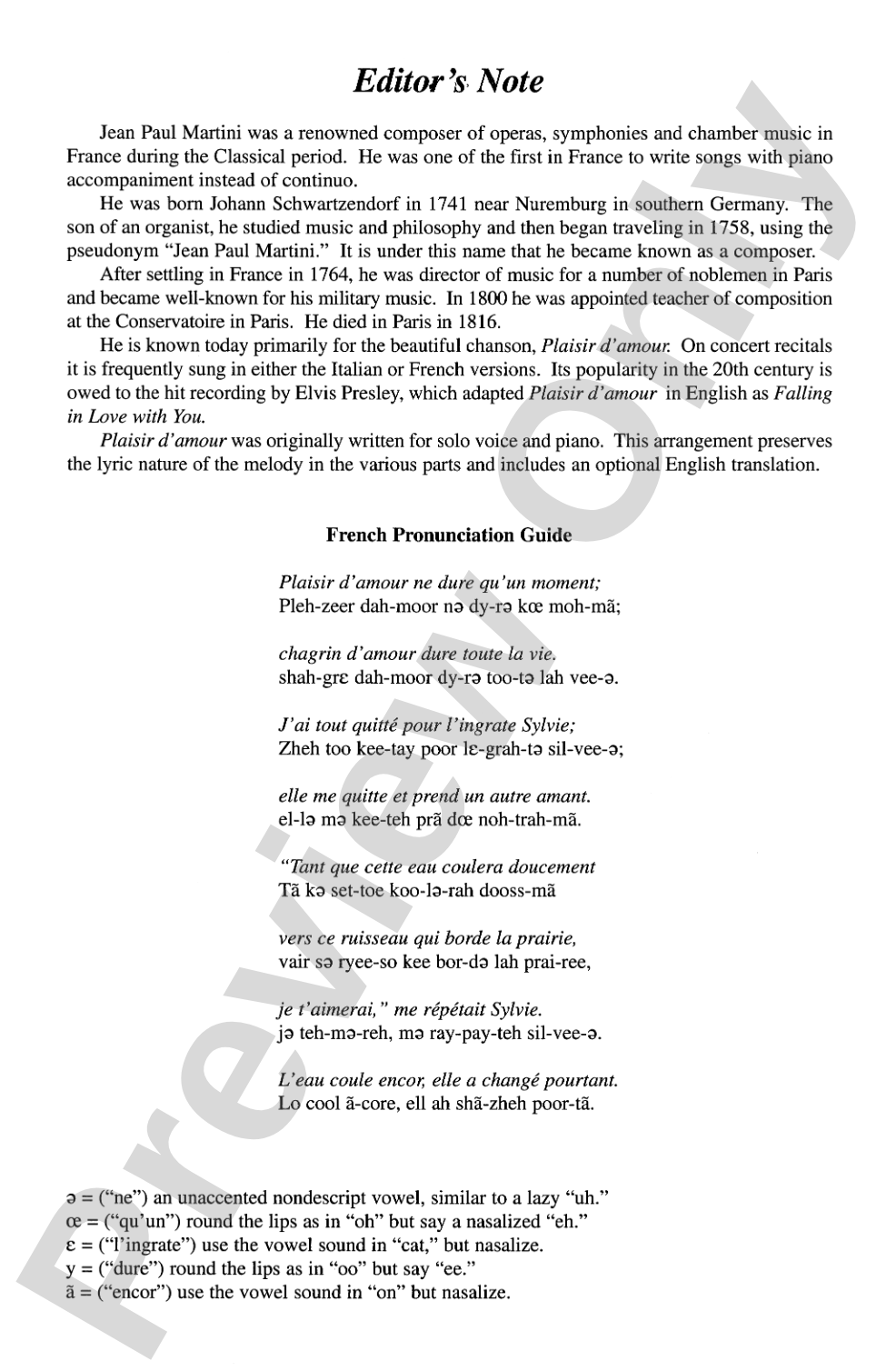
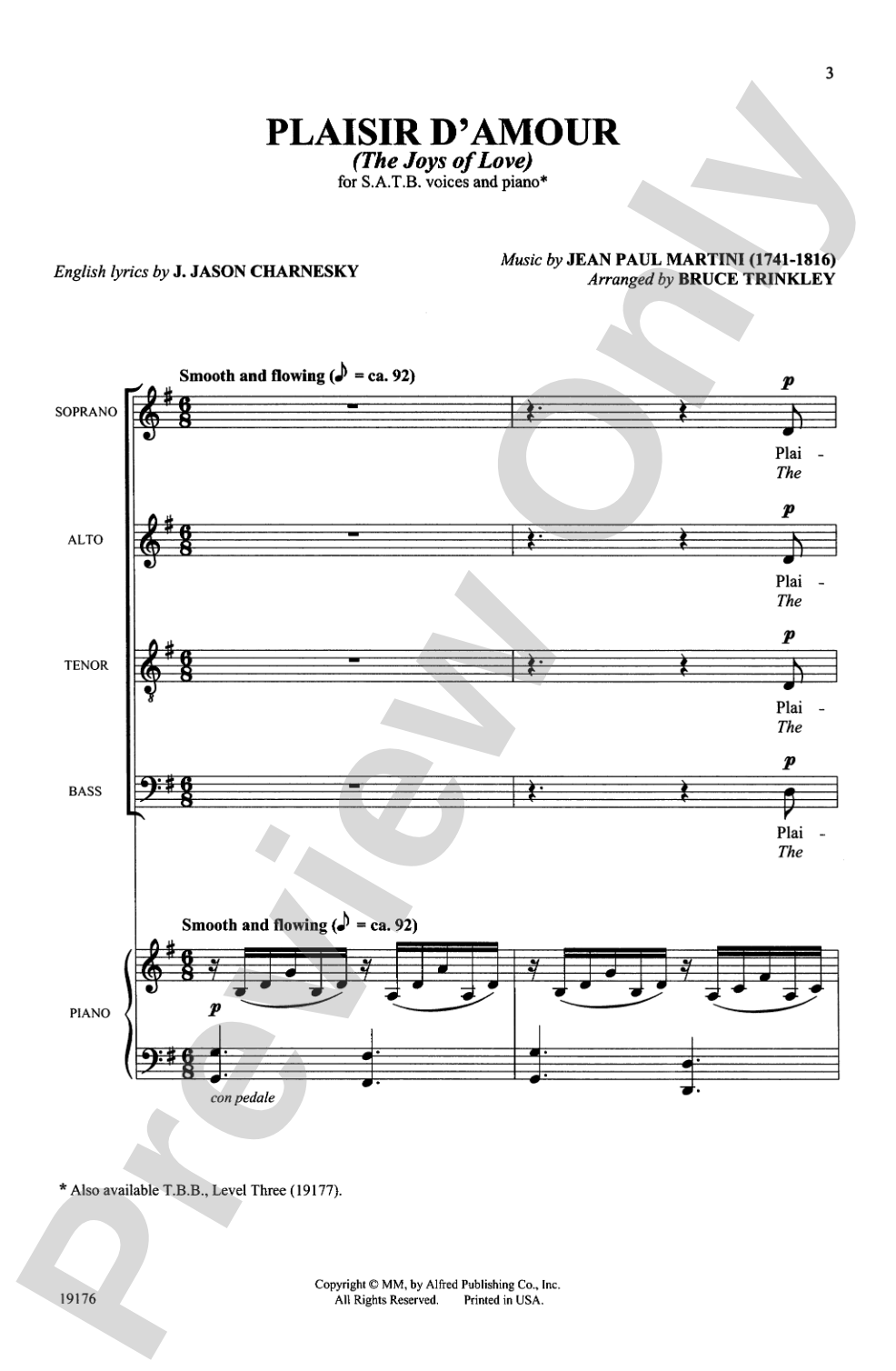
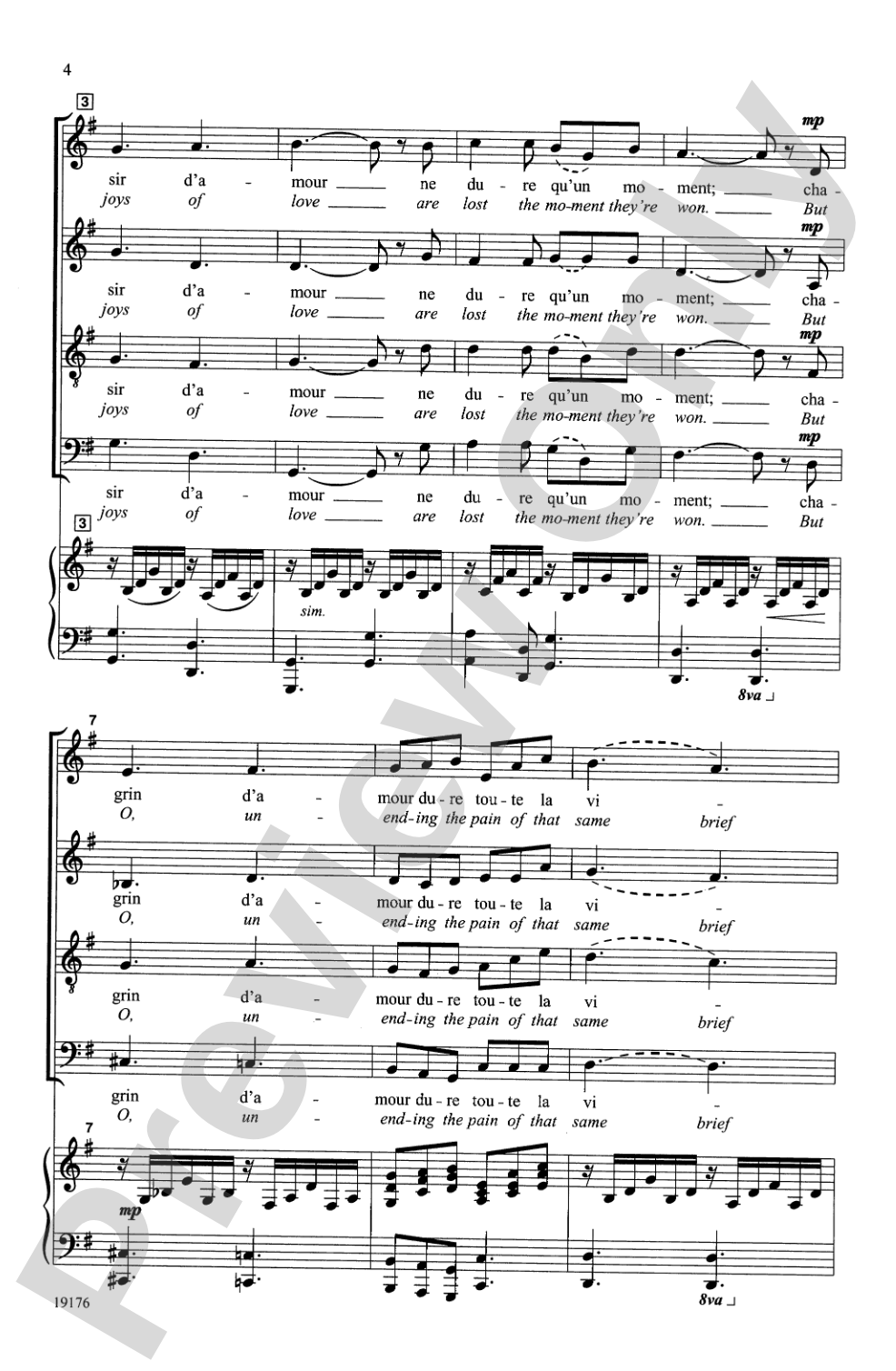
You'll instantly recognize this beautiful melody by Jean Paul Martini. Arranged for today's choirs, this well-crafted work may be sung in French (a pronunciation guide is included) or in an excellent, sensitive English translation. The piano part is smooth and flowing . . . a true accompaniment. Great vocal writing, with open score for easy reading. Editor's notes, useful for programs, are included in the publication. Note: the TBB edition is a classic; an exceptional selection for male groups


Plaisir d'Amour (The Joys of Love): SATB Choral Octavo isn't in MakeMusic Cloud just yet...but it could be. Let us know you'd like to see it, and you'll help shape what comes next. In the meantime, start a free trial and dive into thousands of interactive titles your students can play along with today.
Request This Title
Tell us you want it.
Start Your Free Trial
Explore everything that's ready to play right now.
Sample Audio
1
Audio File
--:--
0:00
0:00
Sample Video
No sample videos found.
Additional Details
Series:
Alfred Archive Edition: Alfred Choral Designs
Publisher:
Alfred Music
Page Count:
12
SKU:
00-PO-0004127
More about this title
About the Composer: Jean Paul Martini
Jean Paul Martini (1741-1816) was an Italian composer and singing teacher who spent most of his career in Paris, where he became known for vocal music of immediate appeal and genuine musicality. His songs and romances were celebrated in French salons for their graceful melodies and emotional directness, qualities that made his work accessible to amateur musicians while remaining satisfying to trained performers.
Plaisir d'Amour stands as his most enduring composition. First published in the late 18th century, the song's elegant simplicity and memorable tune have ensured its place in choral and vocal literature for over two centuries. It remains a standard repertoire choice for choirs seeking repertoire that combines historical substance with genuine musical warmth.
Why we love this
This arrangement captures everything that makes the original memorable while giving modern choirs practical, singable voicing. The open score layout and inclusion of both French and English texts (complete with pronunciation guidance) eliminate the usual friction points, letting singers focus on the music rather than deciphering notation or struggling with language. Bruce Trinkley's piano part serves the voices generously, creating an accompaniment that supports without overwhelming.
What to expect
This is music that breathes with 18th-century refinement. The melody unfolds with unhurried elegance, and the harmonic language, while economical, conveys genuine tenderness. Performing it creates a moment of intimate beauty in any program, inviting audiences into a world of genuine feeling expressed through perfect proportions.
Who it's for
Any SATB choir seeking graceful, historically grounded repertoire suitable for concert or recital programming. The dual-language option makes it equally accessible to choirs that prioritize French repertoire and those that prefer English texts. The moderate difficulty and elegant simplicity appeal to high school through community-level ensembles.
How to get the most out of it
- Shape the phrase around the natural arc of the melody rather than treating each line as a separate unit. The beauty lies in the song's continuity.
- If performing in French, have singers mark the pronunciation guide throughout their parts well before performance. A run-through with an accompanist who can model the vowels is invaluable.
- Balance the parts so the soprano line is clearly heard; this melody is the heart of the arrangement, and inner voices should enhance rather than obscure it.
- Keep the accompaniment transparent and fluid. The piano part thrives on gentle, consistent forward motion rather than percussive articulation.
How to use it
Program this work on a concert exploring French vocal traditions, or use it as a sophisticated transition piece between contrasting selections. Its brevity and emotional directness make it particularly effective as a concert opener or closer, and it pairs naturally with other Classical-era secular repertoire.
Skills your students will build
- Singing with French vowel shapes and diction (or English lyricism depending on language choice)
- Balancing part independence with melodic cohesion in SATB voicing
- Following open-score notation layout
- Sustaining long, connected phrases with expressive control