
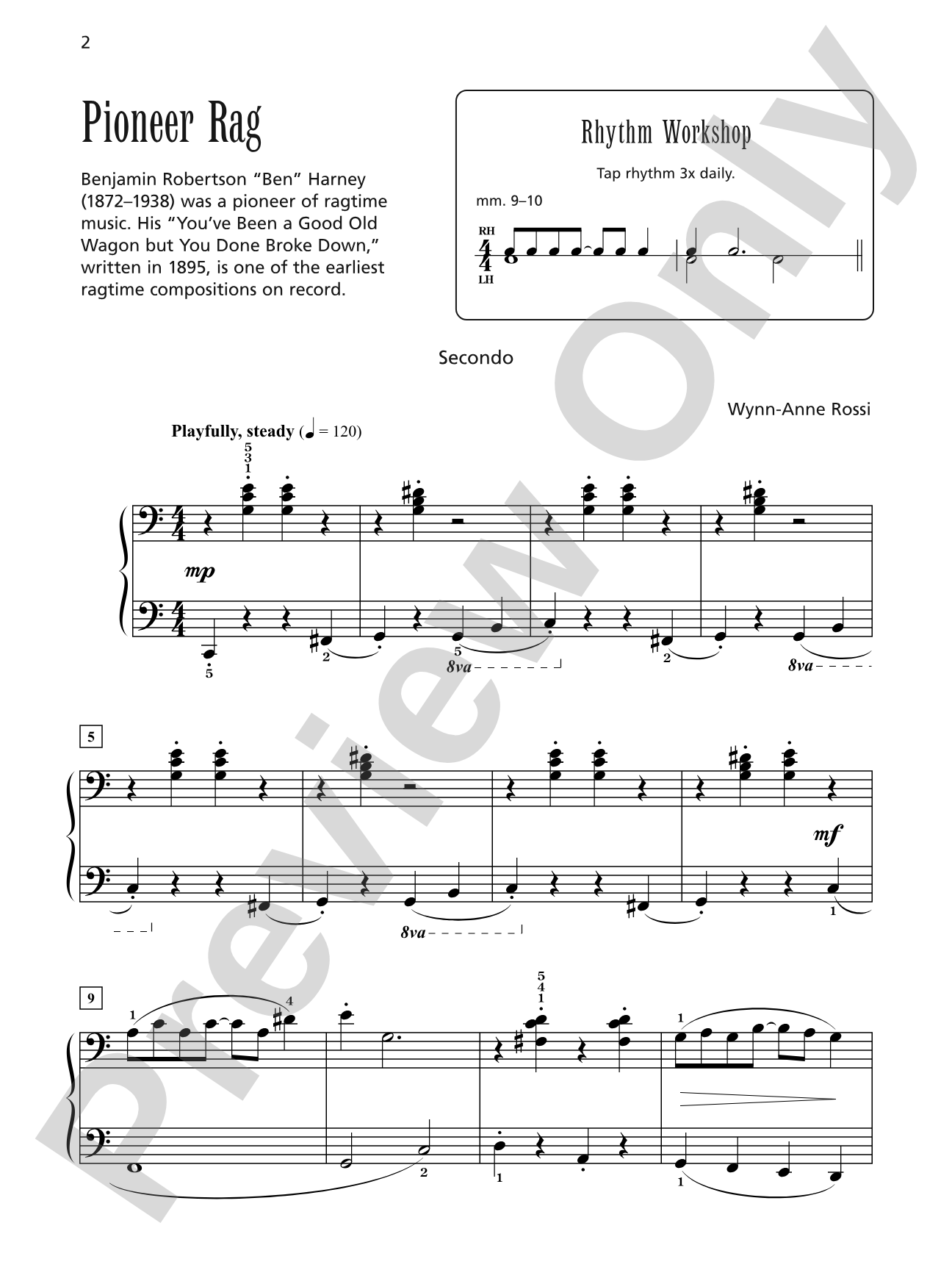

Pioneer Rag - Piano Duet (1 Piano, 4 Hands): Piano Duet (1 Piano, 4 Hands)
5 Late Elementary to Early Intermediate Piano Duets That Celebrate American Jazz
By Wynn-Anne Rossi
Level: Late Elementary / Early Intermediate
Item: 00-PS-0017625
$4.99
Pickup currently not available
Related Items
Crazy Chops - Piano Duet (1 Piano, 4 Hands): Piano Duet (1 Piano, 4 Hands) |
$4.99
|
View | |
Hancock Rock - Piano Duet (1 Piano, 4 Hands): Piano Duet (1 Piano, 4 Hands) |
$5.99
|
View | |
Royal Blue for Mary Lou - Piano Duet (1 Piano, 4 Hands): Piano Duet (1 Piano, 4 Hands) |
$4.99
|
View | |
Welcome to the Savoy - Piano Duet (1 Piano, 4 Hands): Piano Duet (1 Piano, 4 Hands) |
$7.99
|
View | |
Jazzin' Americana for Two, Book 1: Piano Duet (1 Piano, 4 Hands) Book |
$7.99
|
View |
Description
Wynn-Anne Rossi's Jazzin' Americana for Two series is a journey through the jazz genre, honoring the history, the diverse styles, and the fabulous musicians who made this music great. Students will become familiar with the names of famous musicians such as Mary Lou Williams, Charlie Parker, and Duke Ellington while learning different jazz styles, from blues and bebop to boogie and rock. Each evenly-leveled duet (for one piano, four hands) is enhanced with interesting facts that will awaken curiosity and strengthen the musical experience. Titles: Crazy Chops * Hancock Rock * Pioneer Rag * Royal Blue for Mary Lou * Welcome to the Savoy. A Federation Festivals 2024-2028 selection.


Discover MakeMusic Cloud: thousands of interactive titles your students can play along with today.
Sample Audio
No sample audio found.
Sample Video
1 / 3
Additional Details
Series:
Jazzin' Americana
Publisher:
Alfred Music
Page Count:
24
SKU:
00-PS-0017625
More about this title
About the Composer: Wynn-Anne Rossi
Wynn-Anne Rossi is a composer and educator whose work bridges classical training with contemporary American vernacular music. Her arrangements and original compositions consistently appear on state and national music festivals, and she has built a body of work specifically designed to engage students in the history and diversity of American musical traditions.
Why we love this
Rossi pairs authentic jazz idioms with evenly matched duet writing, so both primo and secondo players feel equally engaged rather than one carrying the piece. The embedded historical context transforms what could be rote repertoire into genuine musical inquiry, helping students connect names like Mary Lou Williams and Duke Ellington to the actual sounds and styles they pioneered.
What to expect
Pioneer Rag pulses with the energy of early jazz idioms: syncopated rhythms that push against a steady pulse, call-and-response textures between the hands, and a sense of playful exploration. The piece captures that moment when jazz was still finding its voice, combining ragtime precision with blues flexibility.
Who it's for
This duet works for two students of similar ability at the late elementary to early intermediate level who are ready to experience jazz phrasing and swing rhythms in a structured ensemble setting. It suits studio partnerships, small group classes, or festival preparation where exposure to American jazz history strengthens the musical learning.
How to get the most out of it
- Establish the swing feel early by having both players practice the rhythmic pocket together before adding melodic layers; the groove matters more than perfect ensemble timing.
- Let the secondo player own the harmonic foundation and comping rhythms rather than playing it as pure accompaniment; this duet works best when both hands are thinking like bandmates.
- Explore the dynamic arc of each section independently first, then bring the parts together so the musical dialogue feels conversational rather than stacked.
- Use the historical notes included with the piece as a springboard for discussion during rehearsal about the musicians and styles being referenced.
How to use it
Program this alongside other selections from the Jazzin' Americana series to create a thematic concert segment that illuminates different jazz eras and styles in a single sitting. It also serves well as an encore or educational component at a family concert where the historical notes can be shared with the audience.
Skills your students will build
- swing rhythm and syncopation
- jazz comping and harmonic accompaniment
- call-and-response ensemble listening
- ensemble balance in a duet texture
- recognition of jazz blues and ragtime stylistic elements