
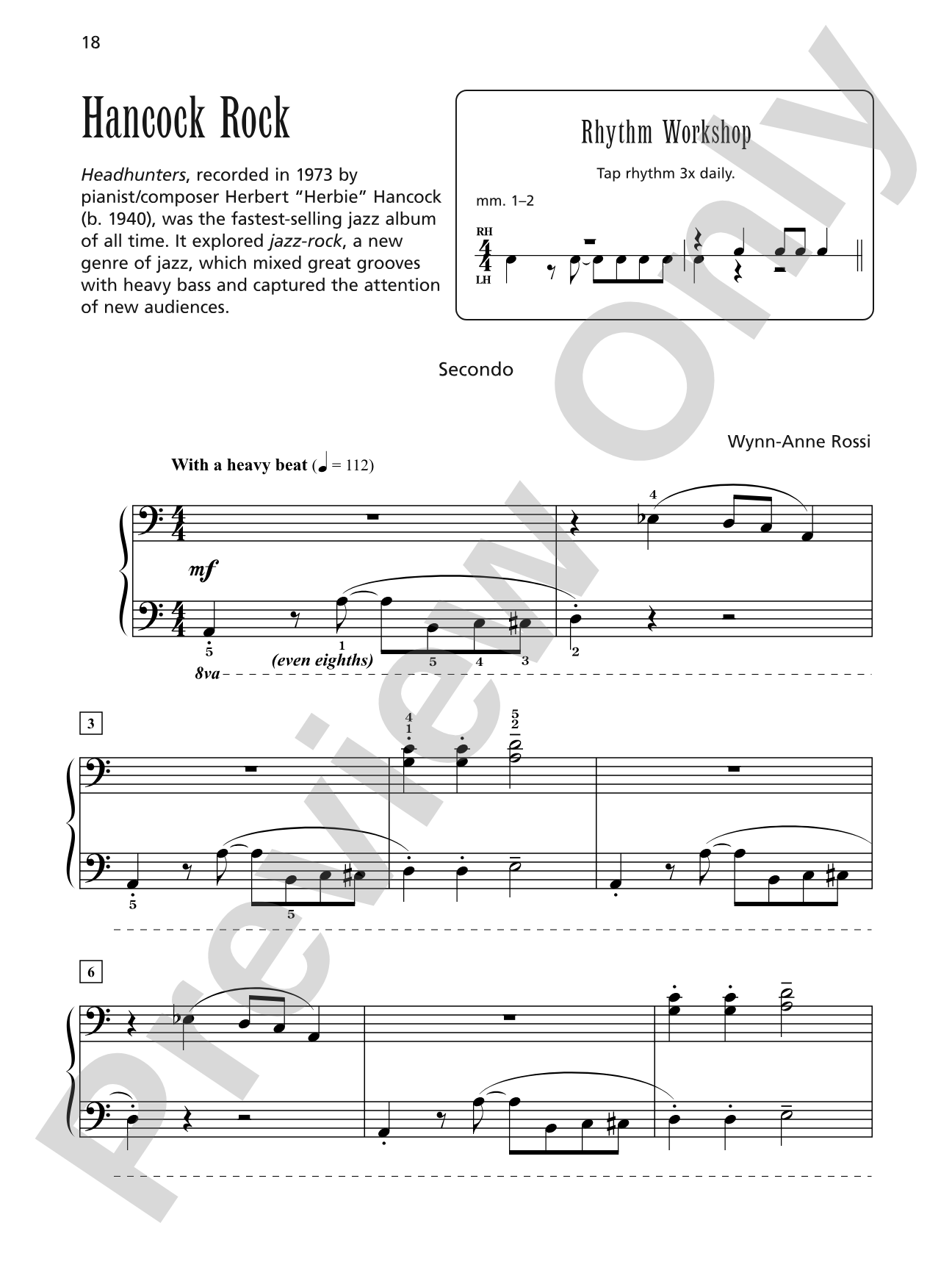
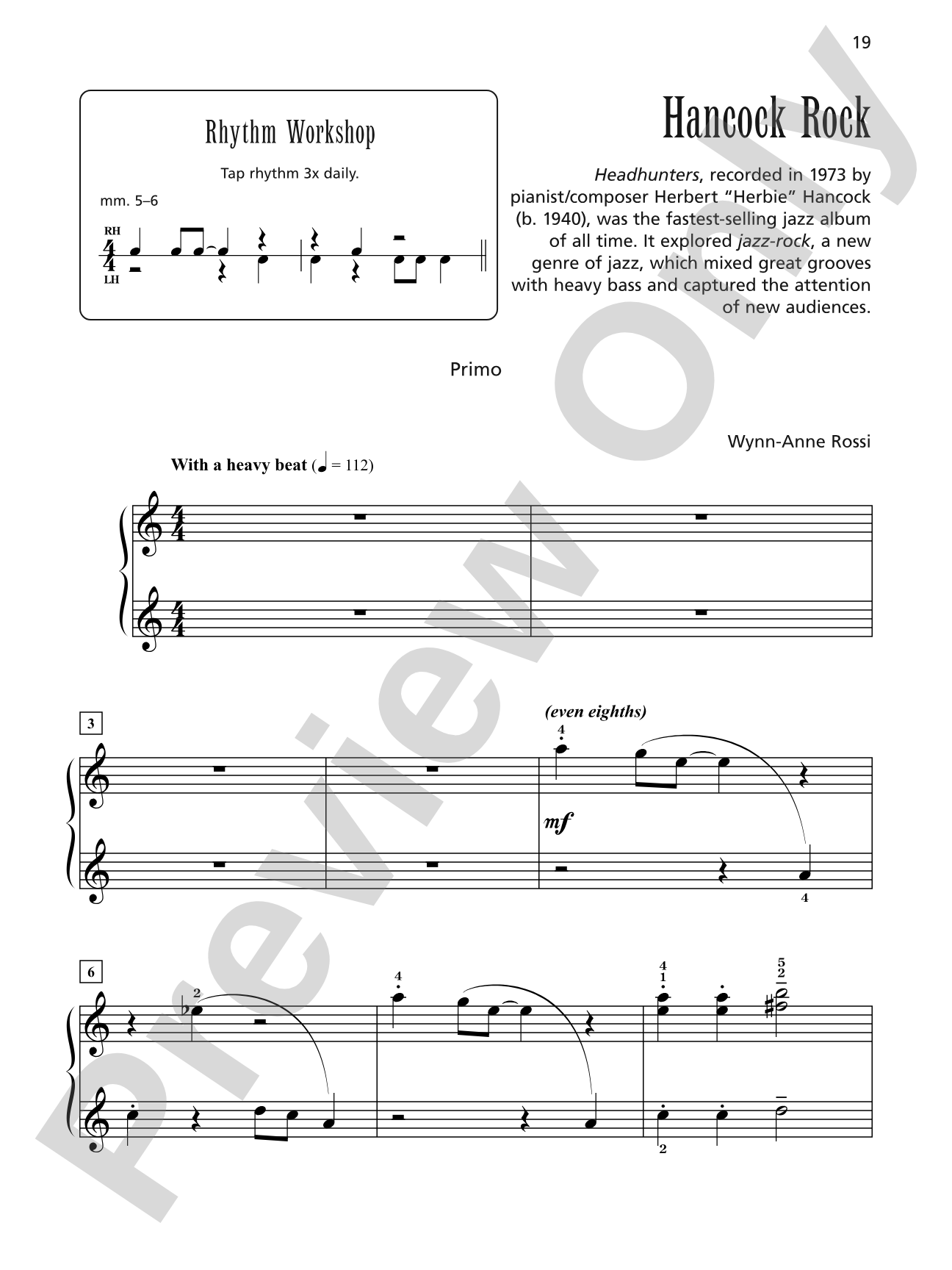

Hancock Rock - Piano Duet (1 Piano, 4 Hands): Piano Duet (1 Piano, 4 Hands)
5 Late Elementary to Early Intermediate Piano Duets That Celebrate American Jazz
By Wynn-Anne Rossi
Level: Late Elementary / Early Intermediate
Item: 00-PS-0017624
$5.99
Pickup currently not available
Related Items
Crazy Chops - Piano Duet (1 Piano, 4 Hands): Piano Duet (1 Piano, 4 Hands) |
$4.99
|
View | |
Pioneer Rag - Piano Duet (1 Piano, 4 Hands): Piano Duet (1 Piano, 4 Hands) |
$4.99
|
View | |
Royal Blue for Mary Lou - Piano Duet (1 Piano, 4 Hands): Piano Duet (1 Piano, 4 Hands) |
$4.99
|
View | |
Welcome to the Savoy - Piano Duet (1 Piano, 4 Hands): Piano Duet (1 Piano, 4 Hands) |
$7.99
|
View | |
Jazzin' Americana for Two, Book 1: Piano Duet (1 Piano, 4 Hands) Book |
$7.99
|
View |
Description
Wynn-Anne Rossi's Jazzin' Americana for Two series is a journey through the jazz genre, honoring the history, the diverse styles, and the fabulous musicians who made this music great. Students will become familiar with the names of famous musicians such as Mary Lou Williams, Charlie Parker, and Duke Ellington while learning different jazz styles, from blues and bebop to boogie and rock. Each evenly-leveled duet (for one piano, four hands) is enhanced with interesting facts that will awaken curiosity and strengthen the musical experience. Titles: Crazy Chops * Hancock Rock * Pioneer Rag * Royal Blue for Mary Lou * Welcome to the Savoy. A Federation Festivals 2024-2028 selection.


Discover MakeMusic Cloud: thousands of interactive titles your students can play along with today.
Sample Audio
No sample audio found.
Sample Video
1 / 3
Additional Details
Series:
Jazzin' Americana
Publisher:
Alfred Music
Page Count:
24
SKU:
00-PS-0017624
More about this title
About the Composer: Wynn-Anne Rossi
Wynn-Anne Rossi is a composer and pianist whose work centers on making jazz accessible and engaging for young musicians. Her compositions blend rigorous musicianship with clear pedagogical purpose, introducing students to real jazz history and style through repertoire they can actually play at their level.
Rossi's Jazzin' Americana series reflects her commitment to honoring jazz traditions while building technical confidence in ensemble settings. Her duets are carefully constructed to give both partners equally rewarding material, avoiding the common trap of relegating one player to simple accompaniment.
Why we love this
This duet teaches jazz idiom through immediate musical payoff. Both primo and secondo parts have genuine melodic content and rhythmic interest, which means neither student feels like a supporting player. Pairing a rock-influenced piece with embedded musician bios creates natural conversation starters about jazz history without derailing rehearsal.
What to expect
Hancock Rock pulses with the energy of modern jazz-rock fusion. The piece captures the confident, forward-moving quality of the musicians who pioneered this crossover sound, blending bluesy vocabulary with rock rhythms in a way that feels both approachable and undeniably cool to perform.
Who it's for
This duet works for late elementary and early intermediate pianists ready to explore jazz beyond classical repertoire. It's ideal for students learning four-hand playing for the first time, since both parts are evenly matched in difficulty and musical interest.
How to get the most out of it
- Establish the groove first. Before worrying about note accuracy, lock the rhythm with your partner. The swing feel is foundational to making the rock jazz style land.
- Let each player own their melodic line. When both hands are playing distinct material, clarity between the parts makes the piece swing rather than sound cluttered.
- Use the historical context provided. Knowing which musicians and styles inspired the piece helps students interpret articulation, dynamics, and phrasing with intention.
How to use it
Feature this duet in a concert or recital celebrating American music styles, perhaps pairing it with another selection from the Jazzin' Americana series to show how different jazz idioms developed. It also works as a engaging incentive in group piano study when students are learning about ensemble balance.
Skills your students will build
- Jazz comping and groove playing
- Four-hand ensemble coordination and listening
- Swing feel and syncopated rhythm patterns
- Articulation and phrasing in jazz style
- Reading and executing dynamics across both parts simultaneously