
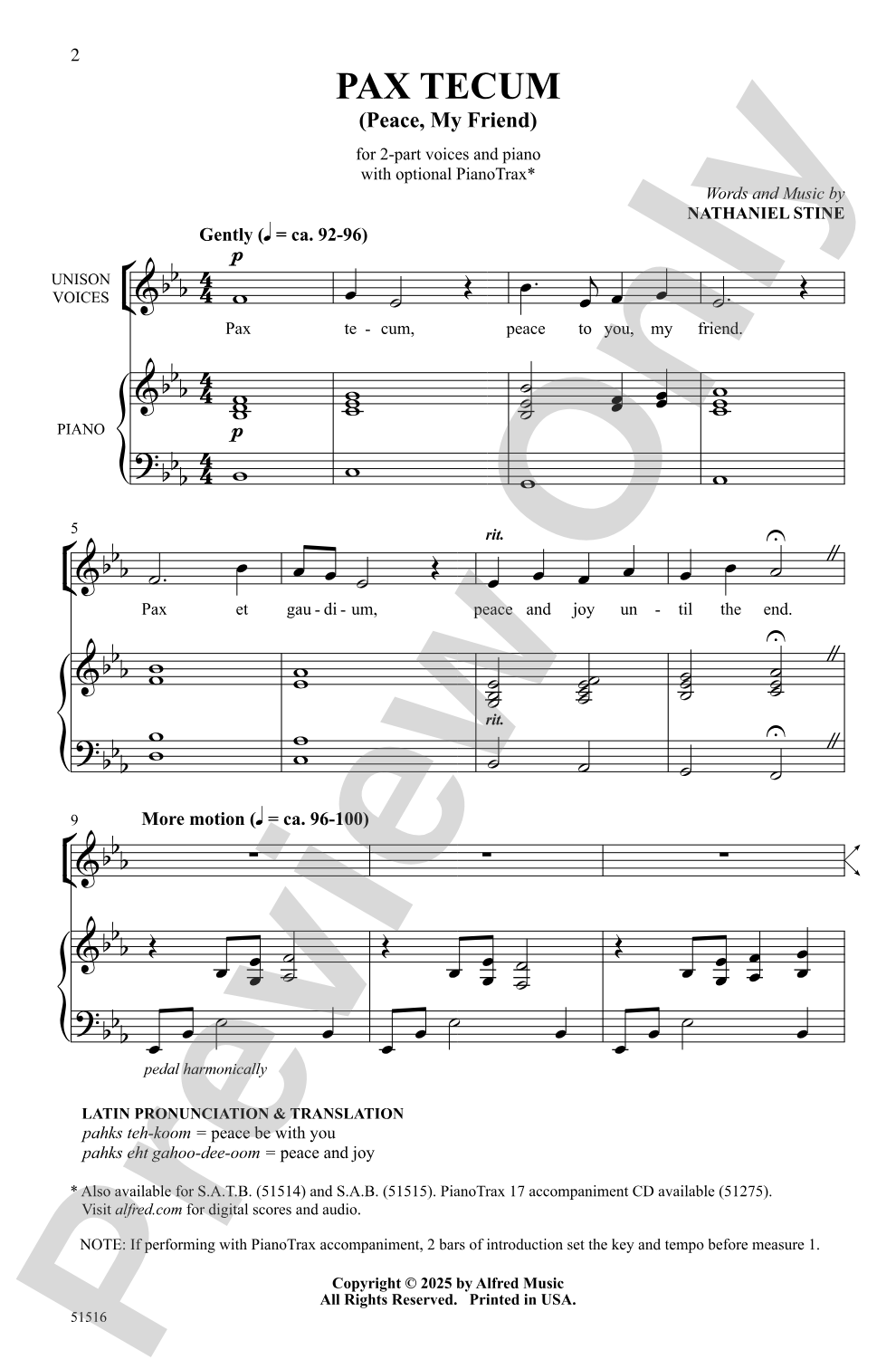

Pax Tecum: 2-Part Choral Octavo
(Peace, My Friend)
Words and music by Nathaniel Stine
Item: 00-PO-0007498
$2.30
Minimum order quantity: 20 copies
Pickup currently not available
Description
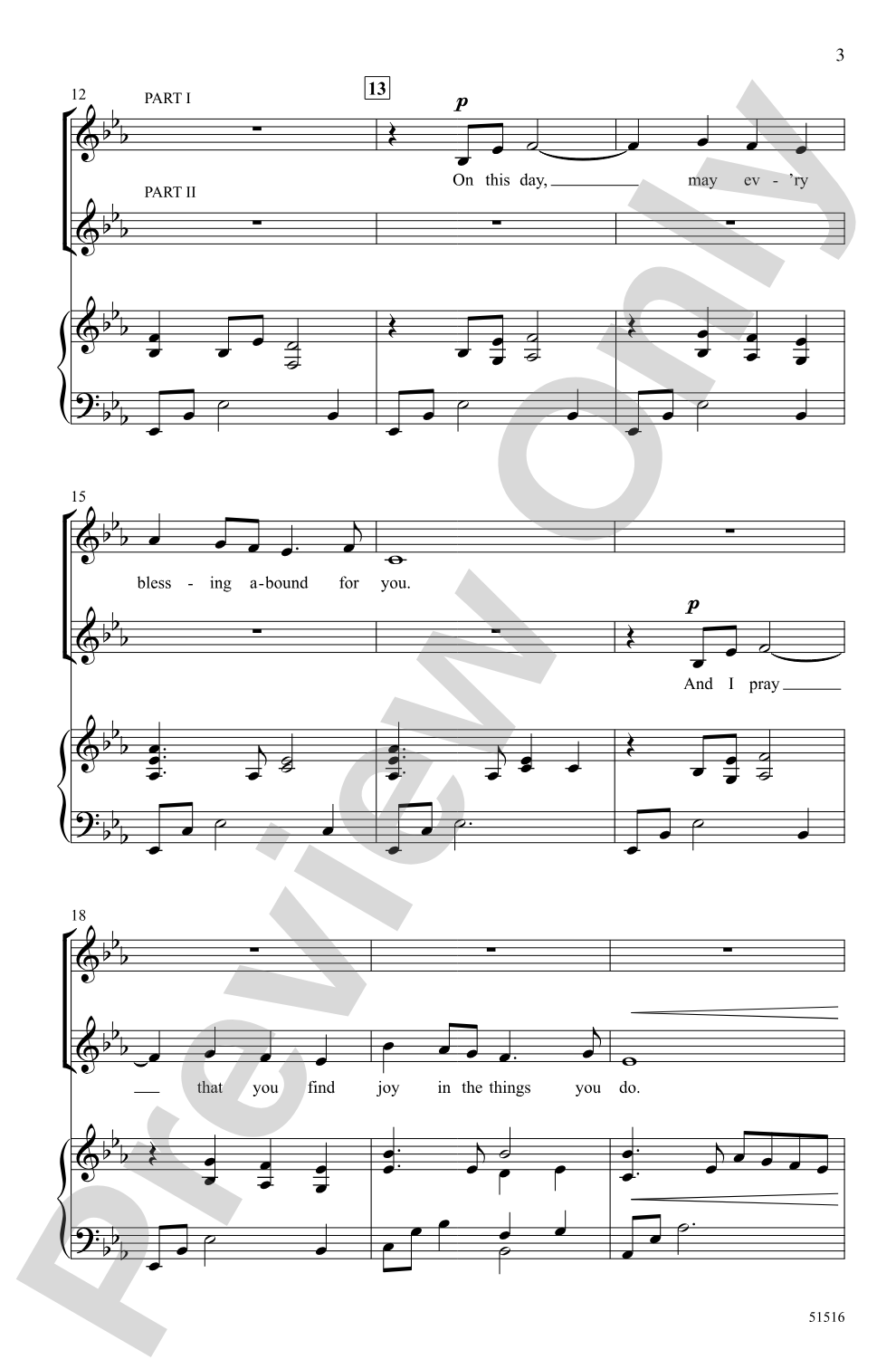
A pensive, chorale-style opening (supported by minimal accompaniment) sets a tone of reverence for this gentle song of peace. After the piano part blossoms, a variety of choral textures and harmonic high points make the mostly English text resonate. Assign a few sopranos on the lovely descant, which appears just before the piece tapers to its soft final chord.


Pax Tecum: 2-Part Choral Octavo isn't in MakeMusic Cloud just yet...but it could be. Let us know you'd like to see it, and you'll help shape what comes next. In the meantime, start a free trial and dive into thousands of interactive titles your students can play along with today.
Request This Title
Tell us you want it.
Start Your Free Trial
Explore everything that's ready to play right now.
Sample Audio
1
Audio File
--:--
0:00
0:00
Sample Video
Additional Details
Series:
Alfred Choral Designs
Publisher:
Alfred Music
Page Count:
12
SKU:
00-PO-0007498
More about this title
About the Composer: Nathaniel Stine

Nathaniel Stine grew up on Boston's North Shore and earned his Bachelor of Music in Vocal Performance from Gordon College in Massachusetts, followed by a Master of Music in Choral Music from USC. His career has bridged performance, composition, and education across multiple roles and ensembles. He has appeared as pianist and arranger with the Tim Janis Ensemble at Carnegie Hall, working alongside artists including Sarah McLachlan, James Galway, and Tori Kelly.
Stine currently serves as Chorus and Orchestra Director at Rogers-Herr Middle School in Durham, North Carolina, a position he has held since 2019. He is also the Choir Director at Blacknall Presbyterian Church in Durham. A multi-instrumentalist since elementary school, he brings experience on piano, guitar, and saxophone to his work as composer, conductor, and educator. His approach to music education centers on connecting musicians of all ages to the art form he is deeply passionate about.
Why we love this
Stine writes with clarity and purpose for young singers, avoiding over-complexity while delivering genuine musical substance. The descant offers a elegant solution for mixed ability within a 2-part voicing, allowing singers at different skill levels to participate meaningfully in the same rehearsal. This piece works as both a concert selection and a festival entry, making it versatile programming across the school year.
What to expect
The opening feels hushed and contemplative, like entering a quiet space of reflection. As the piano part unfolds, the texture gradually opens up, inviting the singers into richer harmonic moments that feel earned rather than sudden. The final descent to the soft closing chord leaves a sense of calm completion.
Who it's for
Young choirs in middle school through early high school who are ready to handle simple but meaningful part-singing. This piece suits singers developing their ability to balance with others while learning to sing with musical intention rather than technical display.
How to get the most out of it
- Bring out the gentle piano accompaniment in rehearsal without overwhelming the voices; the minimal opening support sets the piece's reverent character, so accompany singers through that section with restraint.
- Assign your strongest sopranos to the descant and rehearse them separately at first to establish security before blending back with the full choir.
- Shape the harmonic high points through subtle dynamic swelling rather than sudden increases; this piece breathes best when transitions feel organic.
- Attend carefully to the final soft chord; singers often rush or stiffen at the end, so work toward a sustained, calm release that lets the peace theme linger.
How to use it
This sits comfortably in a winter or spring concert focused on peace, community, or reflection. It also works well as a graduation program selection, especially when the graduation theme touches on unity or moving forward together. The moderate length and accessible voicing make it viable for both concert and festival contexts without consuming excessive rehearsal time.
Skills your students will build
- Singing sustained lines with consistent tone in a homophonic texture
- Blending two independent voice parts while maintaining musical independence
- Responding to subtle dynamic shaping and harmonic direction
- Singing optional descant with security while maintaining awareness of the main melody below
- Interpreting text with appropriate phrasing and reverence