
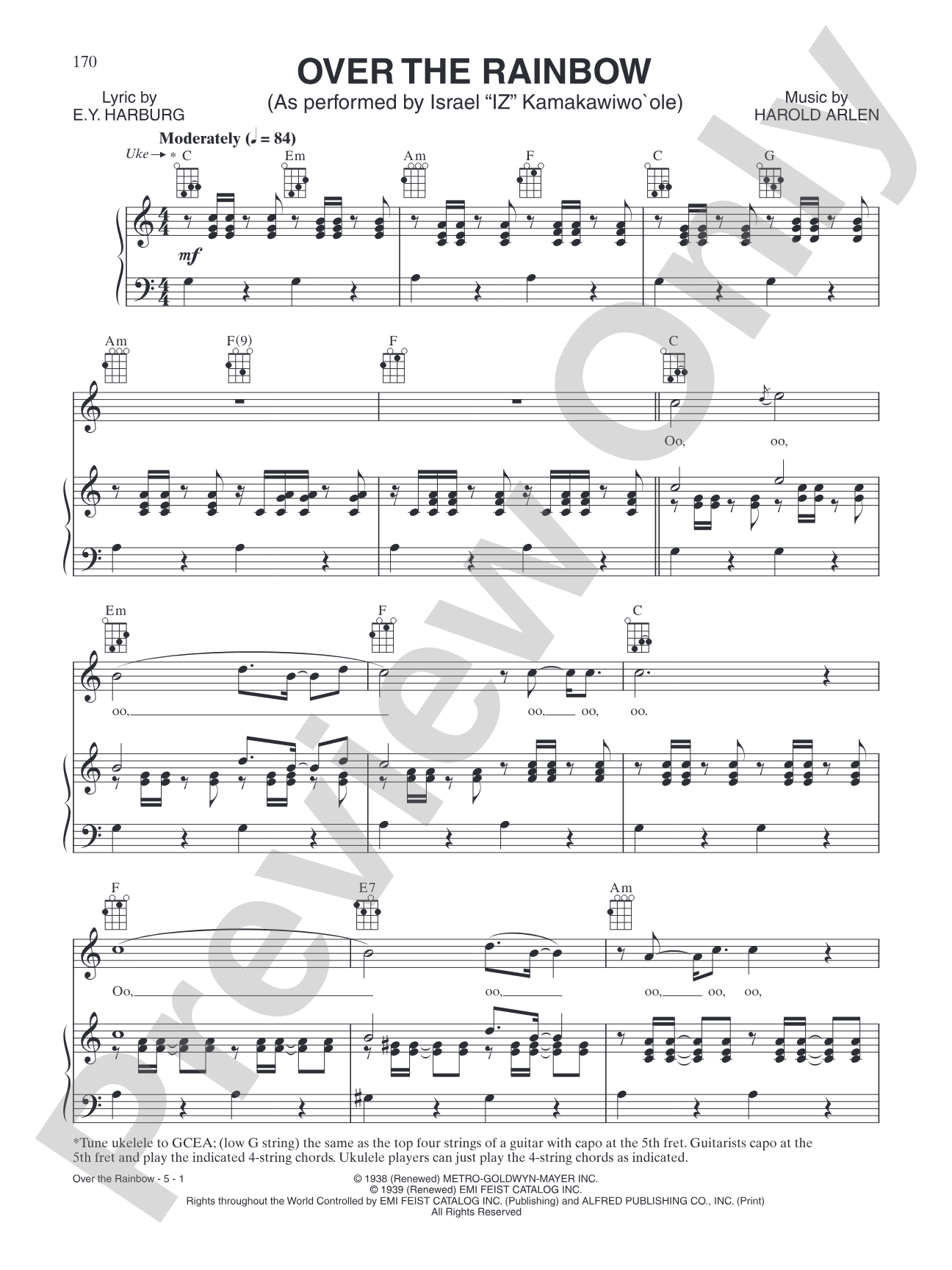

Over the Rainbow: Piano/Vocal/Chords
Israel "Iz" Kamakawiwo'Ole
Item: 00-PS-0000066
$4.99
One moment…
Related Items
What a Wonderful World: Piano/Vocal/Chords |
$5.99
|
View | |
Twinkle, Twinkle Little Star: Piano/Vocal/Chords |
$4.99
|
View | |
White Sandy Beach: Piano/Vocal/Chords |
$4.99
|
View | |
Henehene Kou 'Aka: Piano/Vocal/Chords |
$5.99
|
View | |
'Ama 'Ama: Piano/Vocal/Chords |
$5.99
|
View | |
Ka Huila Wai: Piano/Vocal/Chords |
$5.99
|
View | |
A Hawaiian Like Me: Piano/Vocal/Chords |
$4.99
|
View | |
Israel "Iz" Kamakawiwo'Ole: Wonderful World: Piano/Vocal/Chords Book |
$19.95
|
View |
Description
A decade after his death at age 38 in 1997, Israel "IZ" Kamakawiwo'ole remains Hawaii's best-known and most beloved singer. His breathtaking version of "Over the Rainbow" is an international hit and is widely thought to be the only interpretation that could possibly stand up to Judy Garland's original. On this new release, IZ's inspiring vocal tracks and ukulele accompaniment are lovingly surrounded by lush orchestrations. These beautiful interpretations are faithfully captured in these piano arrangements for all to enjoy.
Songs: A Hawaiian Like Me * 'Ama 'Ama * E Ku'u Morning Star * Henehene Kou 'Aka * Ka Huila Wai * Kaleohano * Ke Alo O Iesu * 'Opae E * Twinkle Twinkle Little Star * 'Ulili E * What a Wonderful World * White Sandy Beach * Plus a special bonus arrangement of Over the Rainbow.


Songs: A Hawaiian Like Me * 'Ama 'Ama * E Ku'u Morning Star * Henehene Kou 'Aka * Ka Huila Wai * Kaleohano * Ke Alo O Iesu * 'Opae E * Twinkle Twinkle Little Star * 'Ulili E * What a Wonderful World * White Sandy Beach * Plus a special bonus arrangement of Over the Rainbow.
Over the Rainbow: Piano/Vocal/Chords isn't in MakeMusic Cloud just yet...but it could be. Let us know you'd like to see it, and you'll help shape what comes next. In the meantime, start a free trial and dive into thousands of interactive titles your students can play along with today.
Request This Title
Tell us you want it.
Start Your Free Trial
Explore everything that's ready to play right now.
Sample Audio
No sample audio found.
Sample Video
No sample videos found.
Additional Details
Publisher:
Alfred Music
Page Count:
76
SKU:
00-PS-0000066
More about this title
About the Composer: Harold Arlen
Harold Arlen (1905-1986) composed some of the most enduring melodies in American popular music, with a gift for writing songs that bridge theatrical ambition and accessibility. His partnership with lyricist E.Y. Harburg produced the score for The Wizard of Oz, including "Over the Rainbow," a song that has become a cultural touchstone across generations and genres. Arlen's harmonic sophistication and memorable melodic lines continue to draw musicians of all levels to his work.
Why we love this
This collection captures the warmth and intimacy of IZ's interpretations while offering pianists a chance to engage with arrangements that honor both the original songs and Kamakawiwo'ole's deeply personal treatment of them. The piano-vocal-chords format makes these pieces accessible for accompanying singers or performing solo, and the inclusion of Hawaiian standards alongside reimagined classics creates programming flexibility for recitals, community events, or educational settings exploring world music traditions.
What to expect
Warm, unhurried, and reflective. These arrangements breathe with the ease of someone singing from the heart rather than performing for applause. The combination of piano and the harmonic framework creates an intimate space where each song feels personal, whether you're accompanying a vocalist or playing through these pieces alone.
Who it's for
Pianists who accompany singers will find reliable, singable arrangements that respect the vocal line. Solo pianists looking to expand their repertoire with accessible popular standards and Hawaiian music will appreciate the blend of familiar material and cultural depth. Teachers and students interested in exploring how the same song can be interpreted across different musical traditions will find rich material here.
How to get the most out of it
- Balance the vocal line with the piano accompaniment so the lyrics remain clearly audible; these arrangements are voice-forward, and the piano's role is to support and color rather than dominate.
- Pay attention to the specific chord voicings provided; they often reflect IZ's laid-back, spacious approach to harmony, so resist the urge to add unnecessary embellishments or overfill the texture.
- If performing these pieces with a vocalist, allow flexibility in rubato and phrasing to match the intimate quality these songs capture; rigid tempo will work against their character.
- Explore the dynamic range within each arrangement; many of these pieces build gradually, and careful attention to shifting dynamics will reveal their emotional architecture.
How to use it
Include these arrangements in a recital exploring American popular song, world music traditions, or the cultural significance of reinterpretation and cover versions. The special "Over the Rainbow" arrangement works particularly well as a closing number that honors both Arlen's original vision and Kamakawiwo'ole's legacy. For educational contexts, these pieces can anchor a unit on how great melodies travel across cultures and generations.
Skills your students will build
- Reading and interpreting chord symbols in a piano-vocal format
- Accompanying a vocalist while maintaining independence in the piano part
- Understanding harmonic movement in popular song structures
- Recognizing and performing the melodic and rhythmic characteristics of Hawaiian music traditions
- Balancing vocal projection with instrumental support