
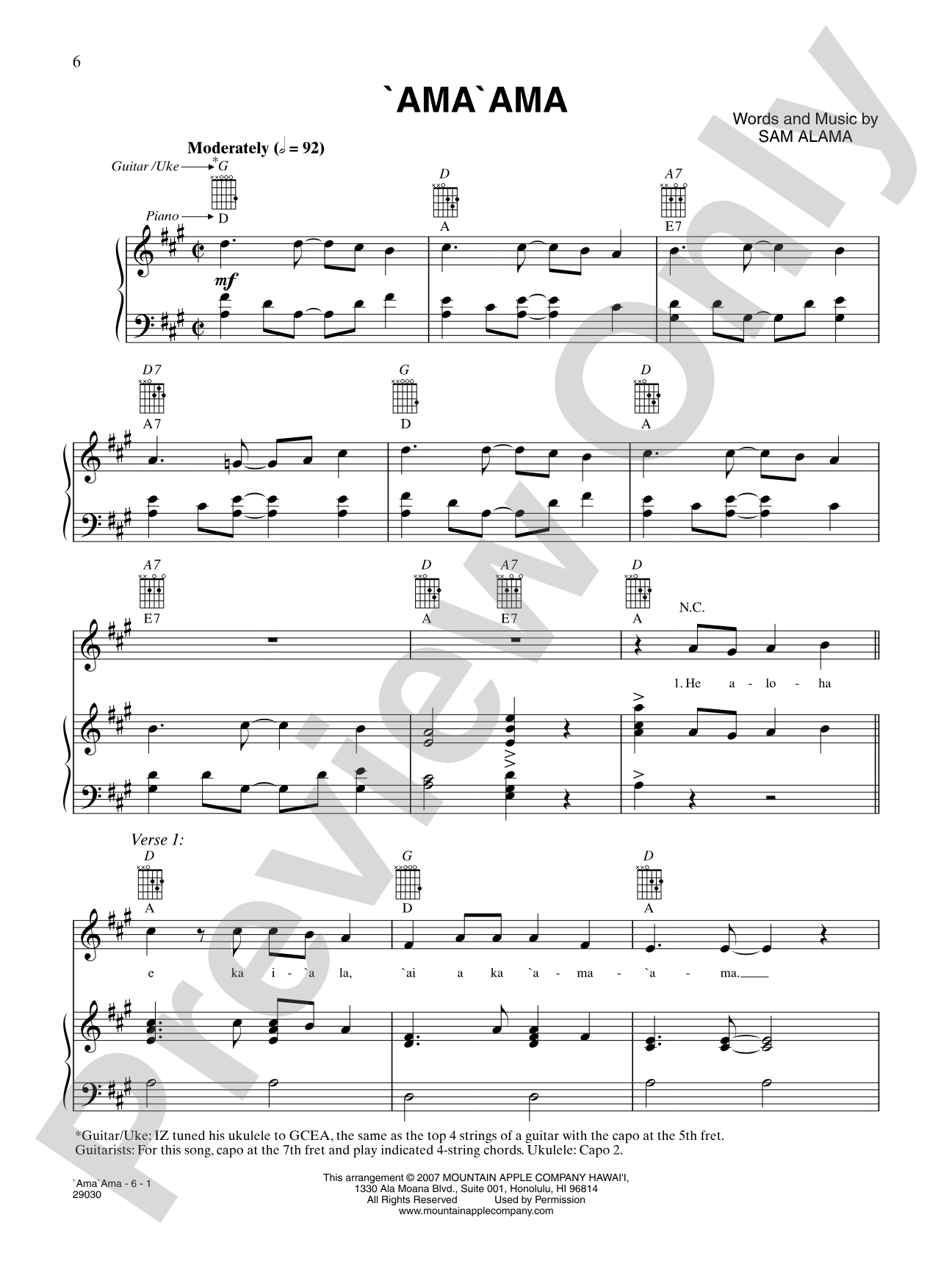
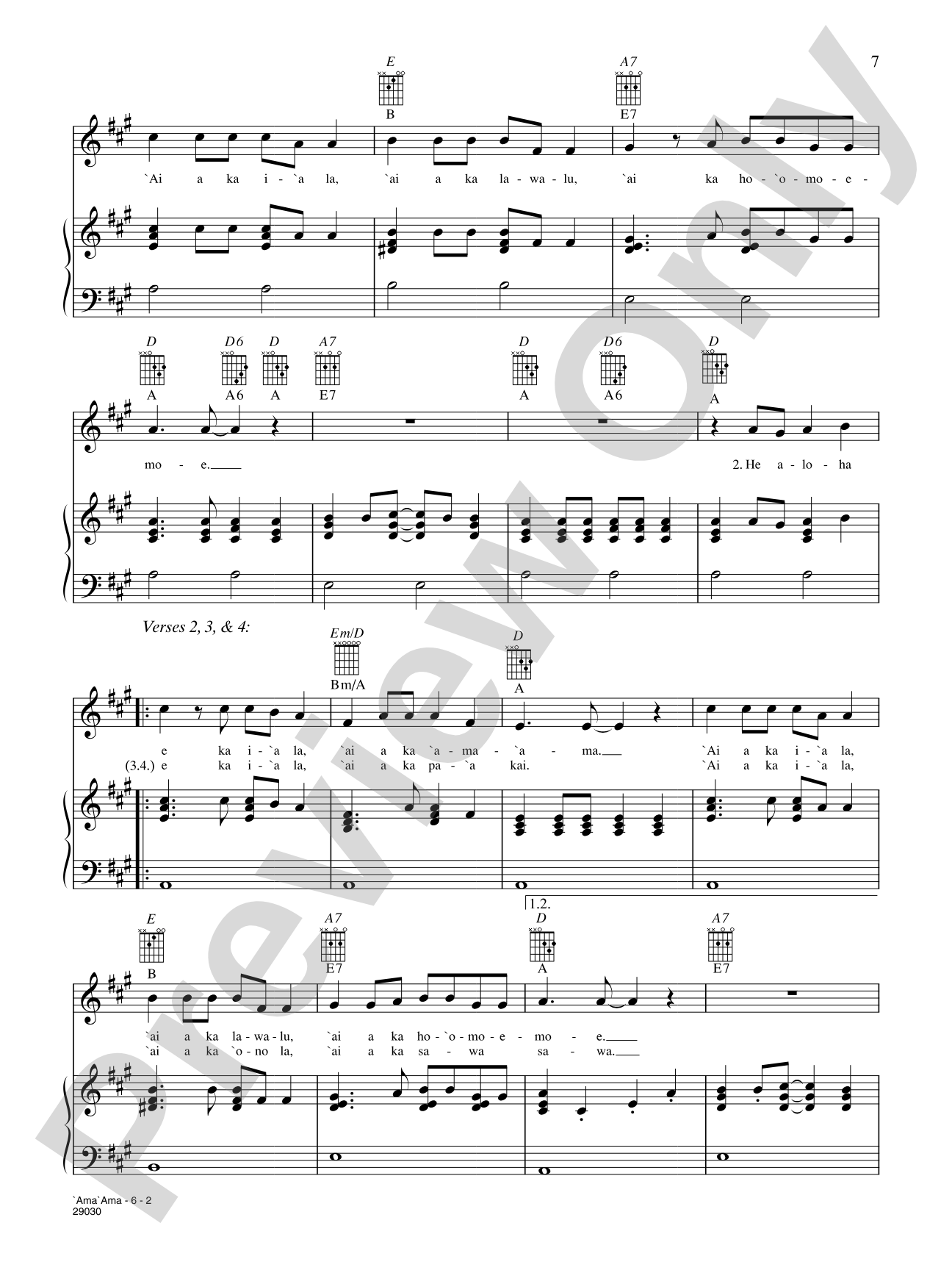

'Ama 'Ama: Piano/Vocal/Chords
Israel "Iz" Kamakawiwo'Ole
Item: 00-PS-0013110
$5.99
Pickup currently not available
Related Items
Over the Rainbow: Piano/Vocal/Chords |
$4.99
|
View | |
What a Wonderful World: Piano/Vocal/Chords |
$5.99
|
View | |
Twinkle, Twinkle Little Star: Piano/Vocal/Chords |
$4.99
|
View | |
White Sandy Beach: Piano/Vocal/Chords |
$4.99
|
View | |
Henehene Kou 'Aka: Piano/Vocal/Chords |
$5.99
|
View | |
Ka Huila Wai: Piano/Vocal/Chords |
$5.99
|
View | |
A Hawaiian Like Me: Piano/Vocal/Chords |
$4.99
|
View | |
Israel "Iz" Kamakawiwo'Ole: Wonderful World: Piano/Vocal/Chords Book |
$19.95
|
View |
Description
A decade after his death at age 38 in 1997, Israel "IZ" Kamakawiwo'ole remains Hawaii's best-known and most beloved singer. His breathtaking version of "Over the Rainbow" is an international hit and is widely thought to be the only interpretation that could possibly stand up to Judy Garland's original. On this new release, IZ's inspiring vocal tracks and ukulele accompaniment are lovingly surrounded by lush orchestrations. These beautiful interpretations are faithfully captured in these piano arrangements for all to enjoy.
Songs: A Hawaiian Like Me * 'Ama 'Ama * E Ku'u Morning Star * Henehene Kou 'Aka * Ka Huila Wai * Kaleohano * Ke Alo O Iesu * 'Opae E * Twinkle Twinkle Little Star * 'Ulili E * What a Wonderful World * White Sandy Beach * Plus a special bonus arrangement of Over the Rainbow.


Songs: A Hawaiian Like Me * 'Ama 'Ama * E Ku'u Morning Star * Henehene Kou 'Aka * Ka Huila Wai * Kaleohano * Ke Alo O Iesu * 'Opae E * Twinkle Twinkle Little Star * 'Ulili E * What a Wonderful World * White Sandy Beach * Plus a special bonus arrangement of Over the Rainbow.
'Ama 'Ama: Piano/Vocal/Chords isn't in MakeMusic Cloud just yet...but it could be. Let us know you'd like to see it, and you'll help shape what comes next. In the meantime, start a free trial and dive into thousands of interactive titles your students can play along with today.
Request This Title
Tell us you want it.
Start Your Free Trial
Explore everything that's ready to play right now.
Sample Audio
No sample audio found.
Sample Video
No sample videos found.
Additional Details
Publisher:
Alfred Music
Page Count:
76
SKU:
00-PS-0013110
More about this title
Why we love this
Sam Alama's arrangements honor IZ's legacy by translating his iconic ukulele and vocal sound into idiomatic piano writing that preserves the warmth and intimacy of the originals. These are not simplified versions; they're reimaginings that respect both the source material and the capabilities of pianists at the intermediate level and beyond. The collection spans IZ's most recognizable songs, making it a natural choice for recitals, community events, and anyone drawn to Hawaiian music with genuine cultural grounding.
What to expect
Warm, reflective, and deeply rooted in Hawaiian sensibility. The arrangements capture IZ's unhurried, soulful delivery—there's spaciousness in the writing and a sense of generosity in the harmonies. You'll feel the connection between ukulele fingerpicking and piano voicing, and the lush orchestrations create an intimate sense of listening to a beloved recording translated into a personal, playable form.
Who it's for
Pianists and vocalists at the intermediate to advanced level who want to explore Hawaiian repertoire with cultural authenticity and emotional depth. Teachers seeking performance material that honors a significant figure in contemporary Hawaiian music while offering genuine musical substance for student or adult recitals.
How to get the most out of it
- Lean into the rubato that the vocal melody naturally suggests. These arrangements are built around IZ's phrasing, so allow yourself freedom in the tempo rather than playing metronomically.
- Let the chord voicings breathe. The lush orchestrations in the original recordings are captured through generous use of space and resonance; avoid overpedaling or crowding the texture.
- Balance the melody line with the accompaniment so that the vocal part (if sung) or the piano's primary melody can emerge clearly without the harmony eclipsing it.
- Pay attention to the harmonic color changes between verses and choruses. Alama uses voicing shifts to suggest the orchestral arrangements, so slight dynamic adjustments can highlight these transitions.
How to use it
Feature individual songs in recitals celebrating world music or Hawaiian culture, or program several together as a thematic set that builds familiarity with IZ's catalog. This collection works equally well as solo piano material for teachers introducing students to non-Western music traditions or as accompaniment for a vocalist honoring IZ's artistry. The inclusion of familiar songs like 'Over the Rainbow' and 'What a Wonderful World' alongside deeper cuts makes it flexible for programming across different audience contexts.
Skills your students will build
- Playing jazz-influenced chord voicings and substitutions in a non-classical idiom
- Balancing melody and accompaniment in arrangements designed around vocal phrasing
- Interpreting rubato and flexibility within a harmonic framework
- Understanding how orchestral textures translate to keyboard writing
- Sight-reading and performing music rooted in Hawaiian and folk traditions