
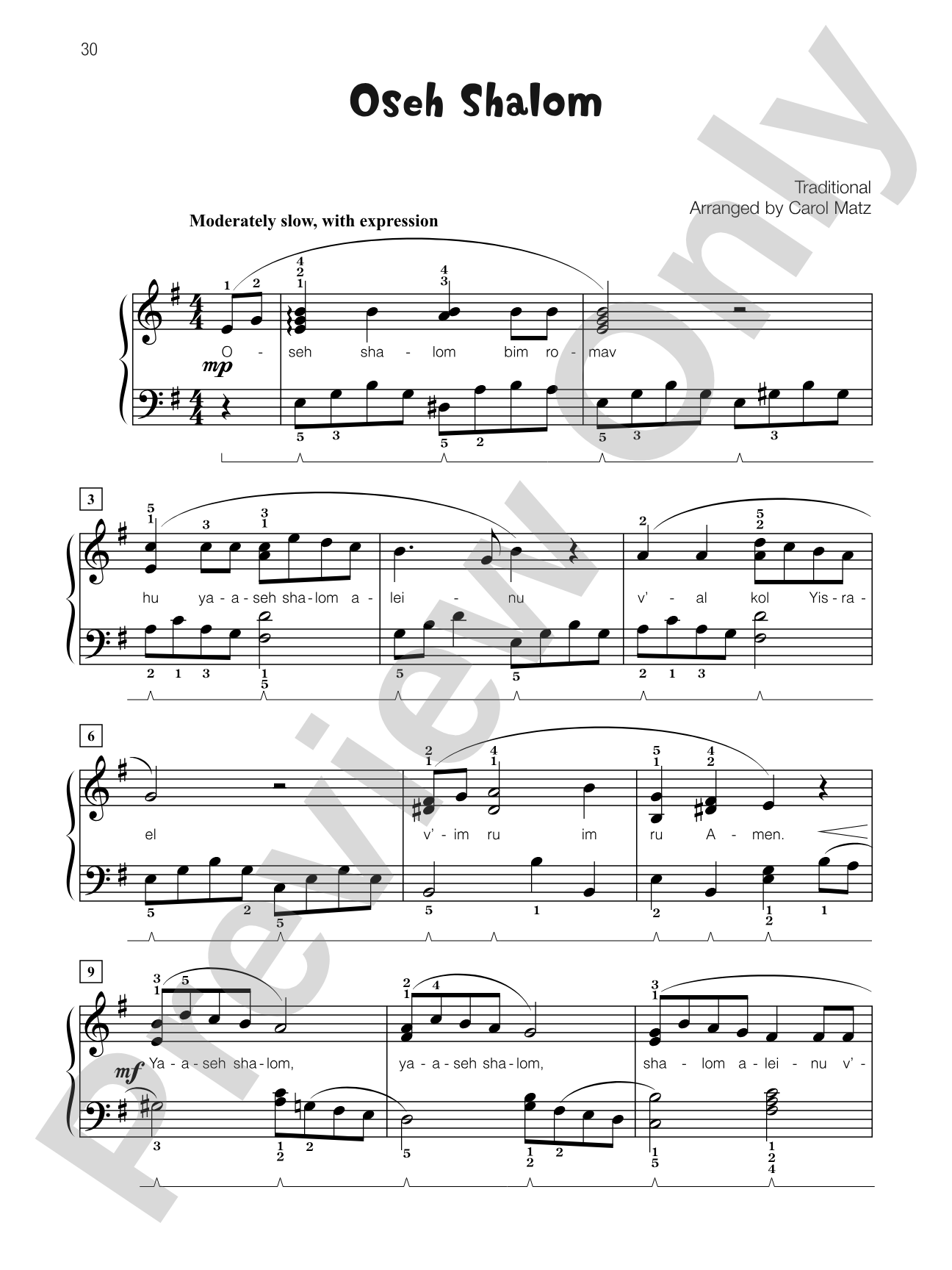

Oseh Shalom - Piano Solo with Lyrics: Piano Solo with Lyrics
15 Appealing Piano Arrangements
Arranged by Carol Matz
Level: Early Intermediate
Item: 00-PS-0017360
$4.99
Pickup currently not available
Related Items
Adir Hu - Piano Solo with Lyrics: Piano Solo with Lyrics |
$4.99
|
View | |
Ani Purim - Piano Solo with Lyrics: Piano Solo with Lyrics |
$4.99
|
View | |
Chag Purim - Piano Solo with Lyrics: Piano Solo with Lyrics |
$4.99
|
View | |
Chanukah Candle Blessings - Piano Solo with Lyrics: Piano Solo with Lyrics |
$4.99
|
View | |
Dayeinu - Piano Solo with Lyrics: Piano Solo with Lyrics |
$4.99
|
View | |
Dodi Li - Piano Solo with Lyrics: Piano Solo with Lyrics |
$4.99
|
View | |
Heveinu Shalom Aleichem - Piano Solo with Lyrics: Piano Solo with Lyrics |
$4.99
|
View | |
L'Shana Tova - Piano Solo with Lyrics: Piano Solo with Lyrics |
$4.99
|
View | |
My Dreidel - Piano Solo with Lyrics: Piano Solo with Lyrics |
$4.99
|
View | |
Raisins and Almonds - Piano Solo with Lyrics: Piano Solo with Lyrics |
$4.99
|
View | |
S'vivon - Piano Solo with Lyrics: Piano Solo with Lyrics |
$4.99
|
View | |
Shabbat Shalom (Bim Bam) - Piano Solo with Lyrics: Piano Solo with Lyrics |
$4.99
|
View | |
Siman Tov - Piano Solo with Lyrics: Piano Solo with Lyrics |
$4.99
|
View | |
V'Taheir Libeinu - Piano Solo with Lyrics: Piano Solo with Lyrics |
$8.99
|
View | |
Famous & Fun Jewish Songs, Book 4: Piano Book |
$8.99
|
View |
Description
Carol Matz's Famous & Fun Jewish Songs, Book 4 is filled with well-known, beloved Hebrew melodies. The collection contains songs for various Jewish holidays, Israeli and Yiddish folk songs, as well as treasured traditional pieces. The arrangements can be used to supplement any method. Titles: Adir Hu * Ani Purim * Chanukah Candle Blessings * Chag Purim * Dayeinu * Dodi Li * Heveinu Shalom Aleichem * L'Shana Tova * My Dreidel * Oseh Shalom * Raisins and Almonds * Shabbat Shalom (Bim Bam) * Siman Tov * S'vivon * V'Taheir Libeinu. A Federation Festivals 2024-2028 selection.


Oseh Shalom - Piano Solo with Lyrics: Piano Solo with Lyrics isn't in MakeMusic Cloud just yet...but it could be. Let us know you'd like to see it, and you'll help shape what comes next. In the meantime, start a free trial and dive into thousands of interactive titles your students can play along with today.
Request This Title
Tell us you want it.
Start Your Free Trial
Explore everything that's ready to play right now.
Sample Audio
No sample audio found.
Sample Video
No sample videos found.
Additional Details
Series:
Famous & Fun
Publisher:
Alfred Music
Page Count:
32
SKU:
00-PS-0017360
More about this title
About the Arranger: Carol Matz
Carol Matz brings three decades of piano pedagogy into every arrangement she creates. As both a composer and arranger with over 300 published works, she has shaped how early intermediate students encounter repertoire across the United States, Canada, and internationally through workshops and clinics. Her compositions span orchestral, jazz, and chamber settings, grounded in her background in composition and orchestration from the University of Miami.
The Famous & Fun series, her signature achievement with Alfred Music, demonstrates her gift for taking beloved melodies and making them accessible without sacrificing musical substance. Her experience in studio arrangement work in Miami recording studios informs how she voices material for maximum teaching impact.
Why we love this
Matz captures the warmth and spiritual depth of Hebrew melodies while keeping the piano writing transparent enough for early intermediate hands to navigate with confidence. The collection respects the source material rather than trivializing it, making these songs equally valuable as festival repertoire and as moments of cultural connection in your studio or recital.
What to expect
These arrangements invite quiet reverence alongside gentle joy. Whether you're approaching a blessing, a celebration, or a folk melody, the piano writing creates space for the text and tune to shine with their own dignity while offering pianists satisfying harmonic color.
Who it's for
Early intermediate pianists preparing for recitals or festivals, especially those exploring repertoire rooted in their own cultural and religious traditions. Teachers seeking Jewish holiday music and folk songs that respect their source material while remaining playable at this level will find immediate use for this collection.
How to get the most out of it
- Balance the melody with the accompaniment so lyrics feel supported, not buried. The piano should enhance the sung or spoken text, not compete with it.
- Honor the phrasing implied by the original melodies, which often follow prayer-like or folk singing traditions. Listen to recordings of these songs in their traditional contexts to internalize the natural breath points.
- Use the left hand voicings to establish harmonic warmth without muddying the texture. These arrangements work best when there's clarity between the vocal line and harmonic support.
How to use it
Program individual songs from this collection during holiday recitals or cultural celebration concerts. The variety of occasions (Chanukah, Purim, Shabbat) means you can build a thematic program around Jewish traditions, or weave selections throughout a season to mark observances. This book's Federation Festivals recognition makes it particularly valuable for competition preparation.
Skills your students will build
- Balancing melody and accompaniment in arrangements with lyrics
- Interpreting folk melodies with cultural authenticity
- Reading and executing left-hand voicings that support rather than dominate
- Sight-reading arrangements that accommodate both instrumental and vocal performance
- Understanding harmonic context in traditional melodies