
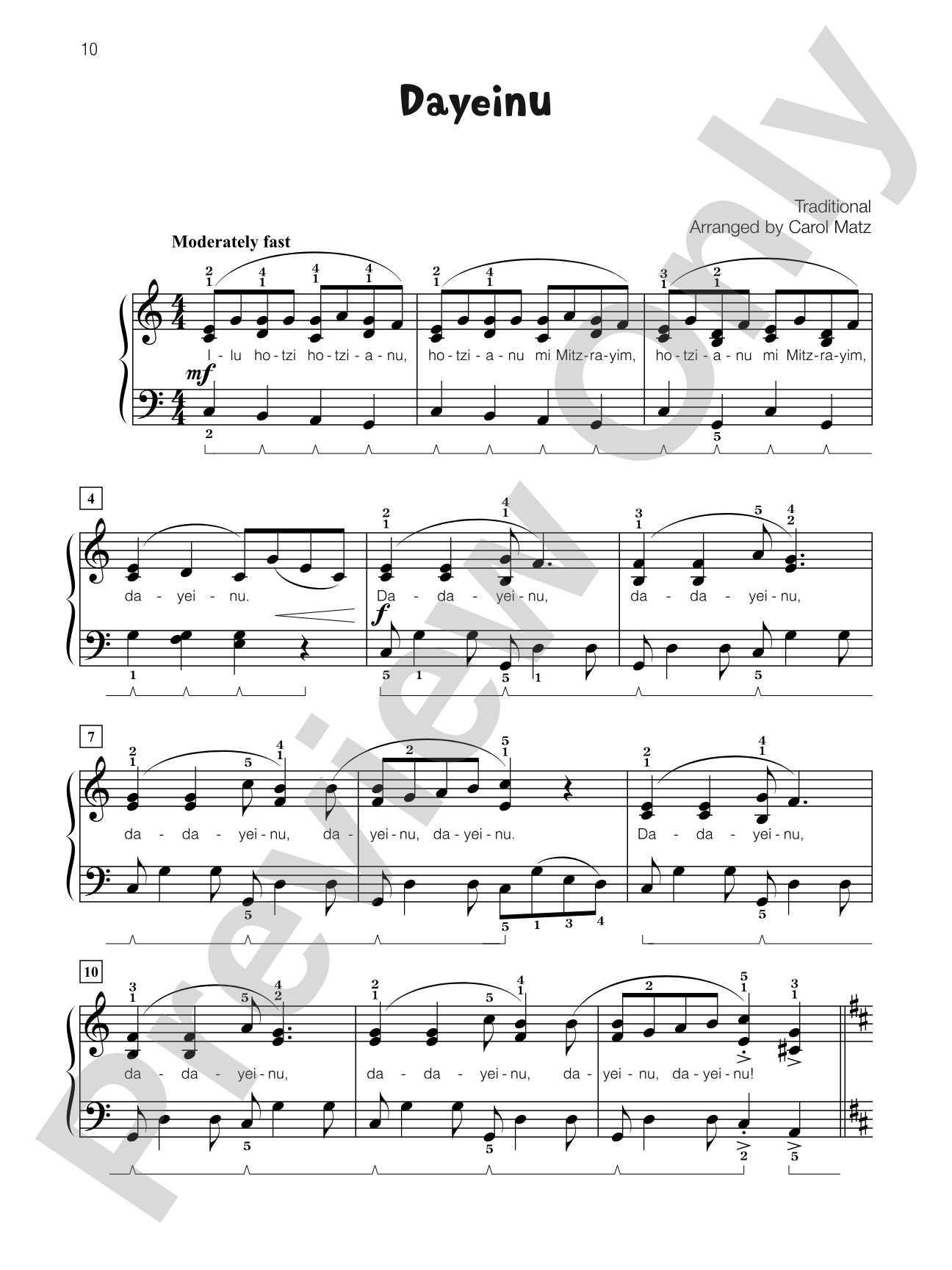

Dayeinu - Piano Solo with Lyrics: Piano Solo with Lyrics
15 Appealing Piano Arrangements
Arranged by Carol Matz
Level: Early Intermediate
Item: 00-PS-0017355
$4.99
Pickup currently not available
Related Items
Adir Hu - Piano Solo with Lyrics: Piano Solo with Lyrics |
$4.99
|
View | |
Ani Purim - Piano Solo with Lyrics: Piano Solo with Lyrics |
$4.99
|
View | |
Chag Purim - Piano Solo with Lyrics: Piano Solo with Lyrics |
$4.99
|
View | |
Chanukah Candle Blessings - Piano Solo with Lyrics: Piano Solo with Lyrics |
$4.99
|
View | |
Dodi Li - Piano Solo with Lyrics: Piano Solo with Lyrics |
$4.99
|
View | |
Heveinu Shalom Aleichem - Piano Solo with Lyrics: Piano Solo with Lyrics |
$4.99
|
View | |
L'Shana Tova - Piano Solo with Lyrics: Piano Solo with Lyrics |
$4.99
|
View | |
My Dreidel - Piano Solo with Lyrics: Piano Solo with Lyrics |
$4.99
|
View | |
Oseh Shalom - Piano Solo with Lyrics: Piano Solo with Lyrics |
$4.99
|
View | |
Raisins and Almonds - Piano Solo with Lyrics: Piano Solo with Lyrics |
$4.99
|
View | |
S'vivon - Piano Solo with Lyrics: Piano Solo with Lyrics |
$4.99
|
View | |
Shabbat Shalom (Bim Bam) - Piano Solo with Lyrics: Piano Solo with Lyrics |
$4.99
|
View | |
Siman Tov - Piano Solo with Lyrics: Piano Solo with Lyrics |
$4.99
|
View | |
V'Taheir Libeinu - Piano Solo with Lyrics: Piano Solo with Lyrics |
$8.99
|
View | |
Famous & Fun Jewish Songs, Book 4: Piano Book |
$8.99
|
View |
Description
Carol Matz's Famous & Fun Jewish Songs, Book 4 is filled with well-known, beloved Hebrew melodies. The collection contains songs for various Jewish holidays, Israeli and Yiddish folk songs, as well as treasured traditional pieces. The arrangements can be used to supplement any method. Titles: Adir Hu * Ani Purim * Chanukah Candle Blessings * Chag Purim * Dayeinu * Dodi Li * Heveinu Shalom Aleichem * L'Shana Tova * My Dreidel * Oseh Shalom * Raisins and Almonds * Shabbat Shalom (Bim Bam) * Siman Tov * S'vivon * V'Taheir Libeinu. A Federation Festivals 2024-2028 selection.


Dayeinu - Piano Solo with Lyrics: Piano Solo with Lyrics isn't in MakeMusic Cloud just yet...but it could be. Let us know you'd like to see it, and you'll help shape what comes next. In the meantime, start a free trial and dive into thousands of interactive titles your students can play along with today.
Request This Title
Tell us you want it.
Start Your Free Trial
Explore everything that's ready to play right now.
Sample Audio
No sample audio found.
Sample Video
No sample videos found.
Additional Details
Series:
Famous & Fun
Publisher:
Alfred Music
Page Count:
32
SKU:
00-PS-0017355
More about this title
About the Arranger: Carol Matz
Carol Matz brings three decades of piano pedagogy into every arrangement she creates. A composer and arranger with formal training in composition, orchestration, and arranging from the University of Miami, she has published over 300 works for piano students and taught countless workshops across North America, Europe, and Australia. Her Famous & Fun series has become a staple in studios and classrooms worldwide, known for pairing musical substance with genuine engagement.
Beyond piano, Matz's compositional experience spans orchestral, jazz, and chamber settings. She spent years creating studio arrangements for recording artists in Miami, bringing that professional sensibility to every piece she writes for students. Her work as an active piano teacher means she understands exactly what students need to stay motivated while building real musicianship.
Why we love this
Dayeinu stands out in this collection because the melody is instantly recognizable to Jewish families while remaining fresh and singable for pianists who may be encountering it for the first time. The early intermediate setting respects the piece's cultural significance without burying the tune under unnecessary technical complexity. Including lyrics on the page invites meaningful connection to the text, making this far more than a technical exercise.
What to expect
Dayeinu carries the warmth of gratitude and celebration. The melody unfolds with a natural singing quality that feels both ancient and immediate, supported by harmonies that add depth without sacrificing accessibility. There is dignity here, along with genuine joy.
Who it's for
Early intermediate pianists preparing holiday recitals, especially those with connections to Jewish traditions or families seeking culturally relevant repertoire. This arrangement also works beautifully for piano students in diverse communities exploring world music and religious traditions through performance.
How to get the most out of it
- Balance the melody clearly so the lyrics' meaning comes through; this isn't background music but a song that should land emotionally
- The harmonic language in Matz's arrangement supports the melody without overshadowing it; keep your accompaniment texture clean and supportive
- If performing with a singer or small group, play the piano part as written first to establish the foundation, then shape dynamics to complement voices when added
How to use it
Slot this into a winter recital or holiday concert as a standalone piece, or pair it with other selections from the Famous & Fun Jewish Songs collection to create a thematic program. It also fits naturally into Chanukah celebrations, interfaith community events, or curriculum units exploring cultural music traditions. The early intermediate level means it won't crowd a program of mixed difficulties.
Skills your students will build
- Legato melody playing with clear phrasing
- Reading and interpreting lyrics as a guide to musical expression
- Coordinating melody and accompaniment at moderate tempos
- Sustaining longer phrases without rushing
- Navigating Jewish musical idioms and cultural context