
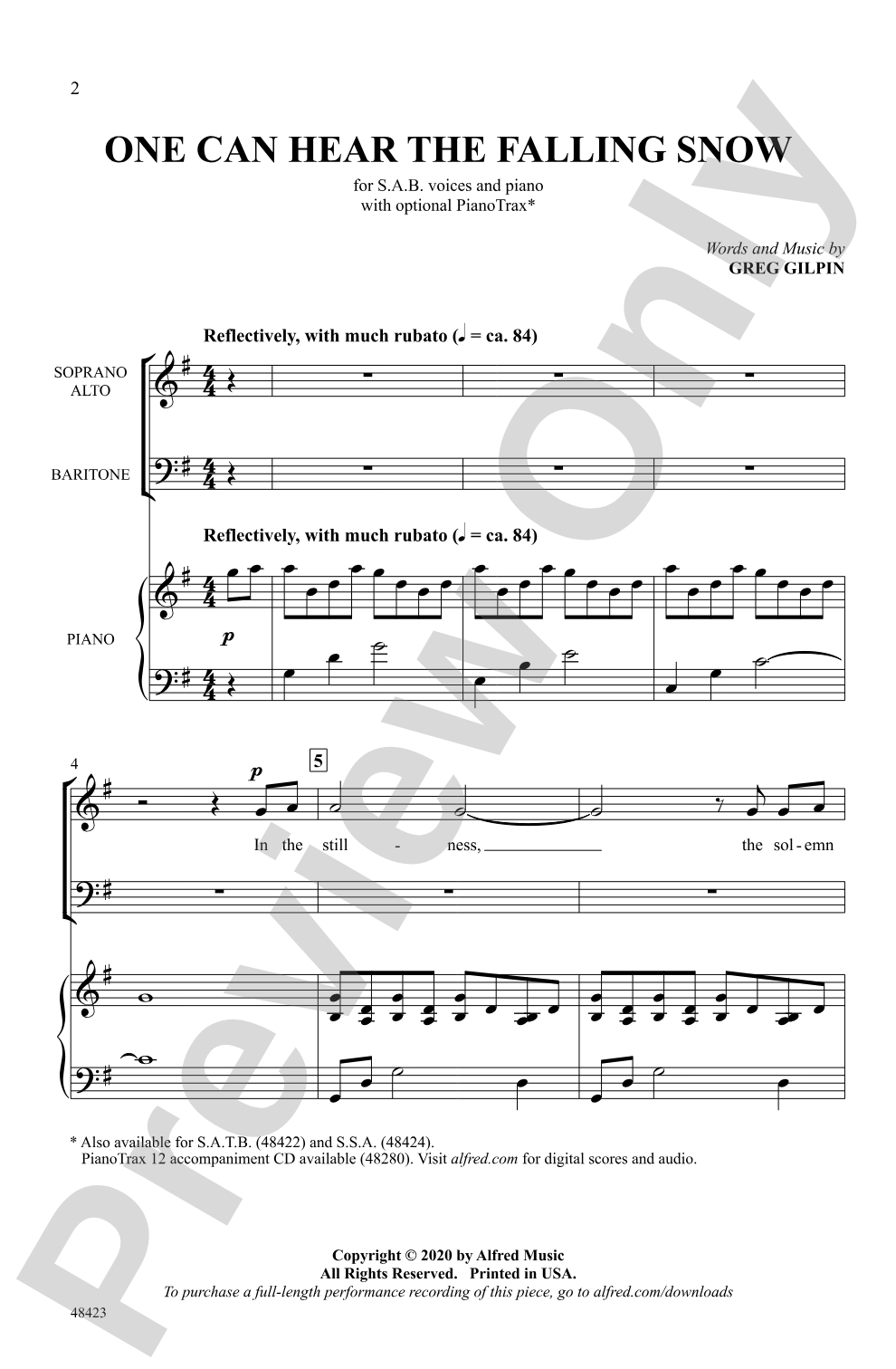
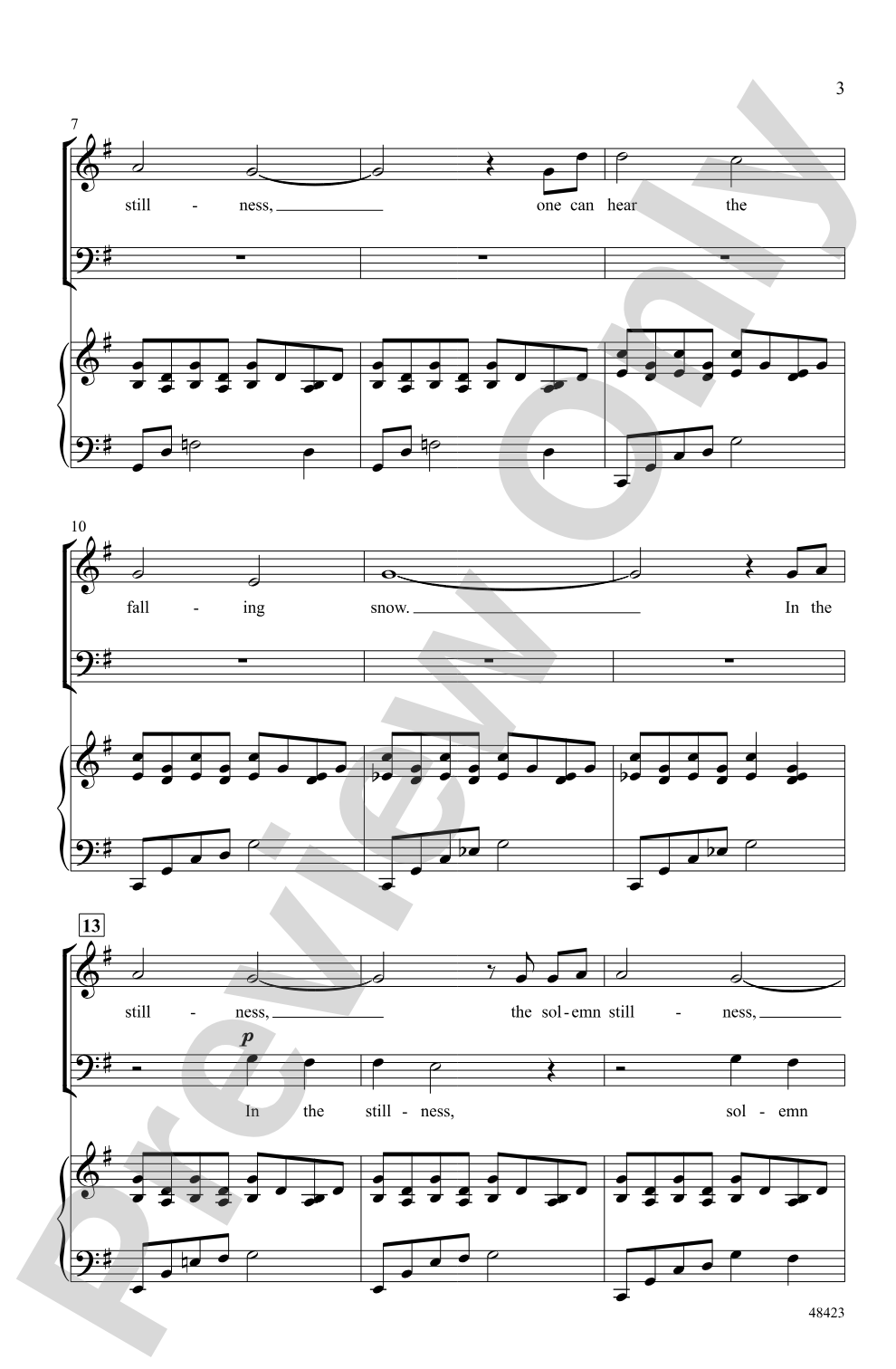

One Can Hear the Falling Snow: SAB Choral Octavo
Words and music by Greg Gilpin
Item: 00-PO-0006362
$2.05
Minimum order quantity: 20 copies
Pickup currently not available
Related Items
One Can Hear the Falling Snow: PianoTrax Digital Audio Download |
$9.99
|
View | |
One Can Hear the Falling Snow: SATB Choral Octavo |
$2.05
|
View | |
One Can Hear the Falling Snow: SSA Choral Octavo |
$2.05
|
View | |
One Can Hear the Falling Snow: SATB Choral Octavo |
$2.05
|
View | |
One Can Hear the Falling Snow: SAB Choral Octavo |
$2.05
|
View | |
One Can Hear the Falling Snow: SSA Choral Octavo |
$2.05
|
View |
Description
Few things are as tranquil as snowfall lit by the silvery moon. An evocative original text captures all the nuances of just such a moment, while the subtle movement of rich chords conveys a deep sense of wonder. "In the stillness, . . . 'neath the moonlight, . . . one can hear the falling snow."


One Can Hear the Falling Snow: SAB Choral Octavo isn't in MakeMusic Cloud just yet...but it could be. Let us know you'd like to see it, and you'll help shape what comes next. In the meantime, start a free trial and dive into thousands of interactive titles your students can play along with today.
Request This Title
Tell us you want it.
Start Your Free Trial
Explore everything that's ready to play right now.
Sample Audio
1
Audio File
--:--
0:00
0:00
Sample Video
No sample videos found.
Additional Details
Series:
Alfred Choral Designs
Publisher:
Alfred Music
Page Count:
12
SKU:
00-PO-0006362
More about this title
About the Composer: Greg Gilpin

Greg Gilpin brings decades of experience as both a composer and conductor to his choral writing. His works have been performed at major venues including Carnegie Hall, Lincoln Center, the Sydney Opera House, and Royal Festival Hall, and he serves as Director of Educational Choral Publications for Shawnee Press. As an ASCAP award-winning composer, Gilpin understands the balance between artistic integrity and practical classroom needs.
Beyond the concert hall, Gilpin has expanded his creative reach into film scoring and has become known for arranging beloved standards for contemporary performances. His involvement with major arts organizations and educational publishers positions him as a trusted voice in choral music pedagogy, consistently crafting pieces that engage singers while remaining accessible to directors working with mixed ability levels.
Why we love this
Gilpin's gift for atmospheric writing shines here. The piece balances poetic imagery with singable lines that don't require advanced vocal technique, making it genuinely rewarding for SAB choirs of varying experience. The rich harmonic language and restrained orchestration create a moment of genuine beauty that singers will feel in their bodies and audiences will hear in the room.
What to expect
The piece evokes the hush of a winter night where the world feels both still and alive. Gilpin's harmonies shimmer with quiet wonder, moving like falling snow itself—soft, deliberate, and hypnotic. Singers and listeners alike enter a reflective space where every note matters and silence becomes part of the music.
Who it's for
Directors programming for mixed SAB choirs who want a sophisticated yet accessible piece that doesn't require advanced vocal ranges or technique. This works especially well for choirs with limited rehearsal time or developing singers who benefit from singable voicing without sacrificing musical substance.
How to get the most out of it
- Shape the phrase arcs with subtle dynamic swells rather than obvious crescendos; the piece's power lies in its understatement, so resist the urge to push for volume.
- Balance the three parts carefully so no single line dominates; the harmonic colors emerge only when all voices share equal weight.
- Allow silence to settle between phrases. The evocative text about stillness and moonlight works against rushing; give each thought time to land.
- If using the recorded accompaniment, rehearse with it multiple times before performance to ensure your ensemble's tempo and phrasing align naturally with the recording.
How to use it
Position this as a centerpiece of a winter concert, perhaps surrounding it with contrasting repertoire that celebrates or questions the season in different ways. The piece's meditative quality makes it ideal as the closing number of a longer program, leaving audiences in a contemplative mood. It also pairs well with other works by Gilpin or similar composers in the Alfred Choral Designs series.
Skills your students will build
- Singing in close harmony within SAB voicing
- Sustaining pure vowel sounds across longer phrases
- Responding to subtle dynamic shaping and phrasing cues
- Blending voices to create unified harmonic sonority
- Interpreting text expressively without overstating emotional content