
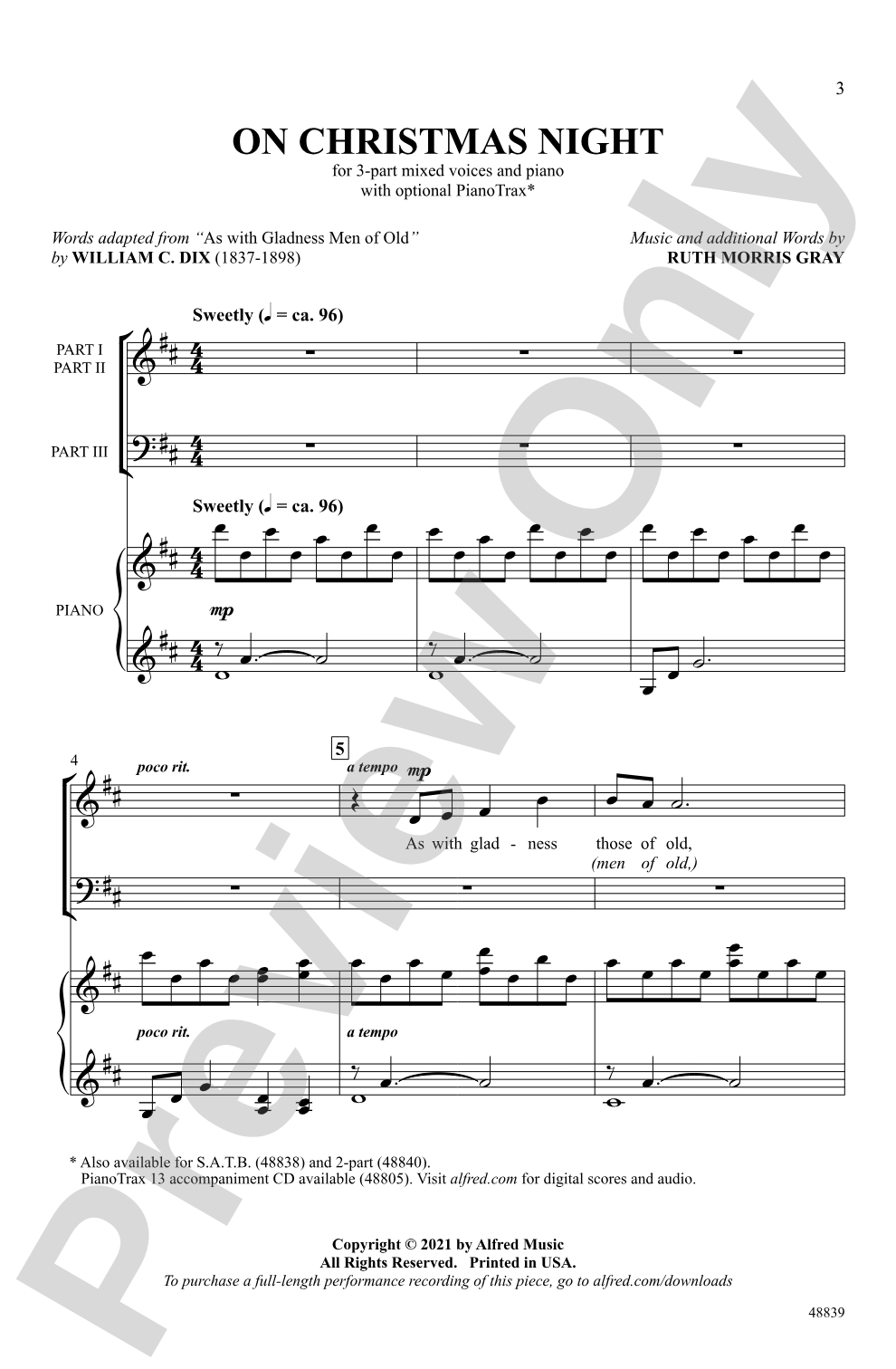

On Christmas Night: 3-Part Mixed Choral Octavo
Words adapted from "As With Gladness Men of Old" by William C. Dix / music, and additional words, by Ruth Morris Gray
Item: 00-PO-0006638
$2.05
Minimum order quantity: 20 copies
Pickup currently not available
Related Items
On Christmas Night: PianoTrax Digital Audio Download |
$9.99
|
View | |
On Christmas Night: SATB Choral Octavo |
$2.05
|
View | |
On Christmas Night: 2-Part Choral Octavo |
$2.05
|
View | |
On Christmas Night: SATB Choral Octavo |
$2.05
|
View | |
On Christmas Night: 3-Part Mixed Choral Octavo |
$2.05
|
View | |
On Christmas Night: 2-Part Choral Octavo |
$2.05
|
View |
Description
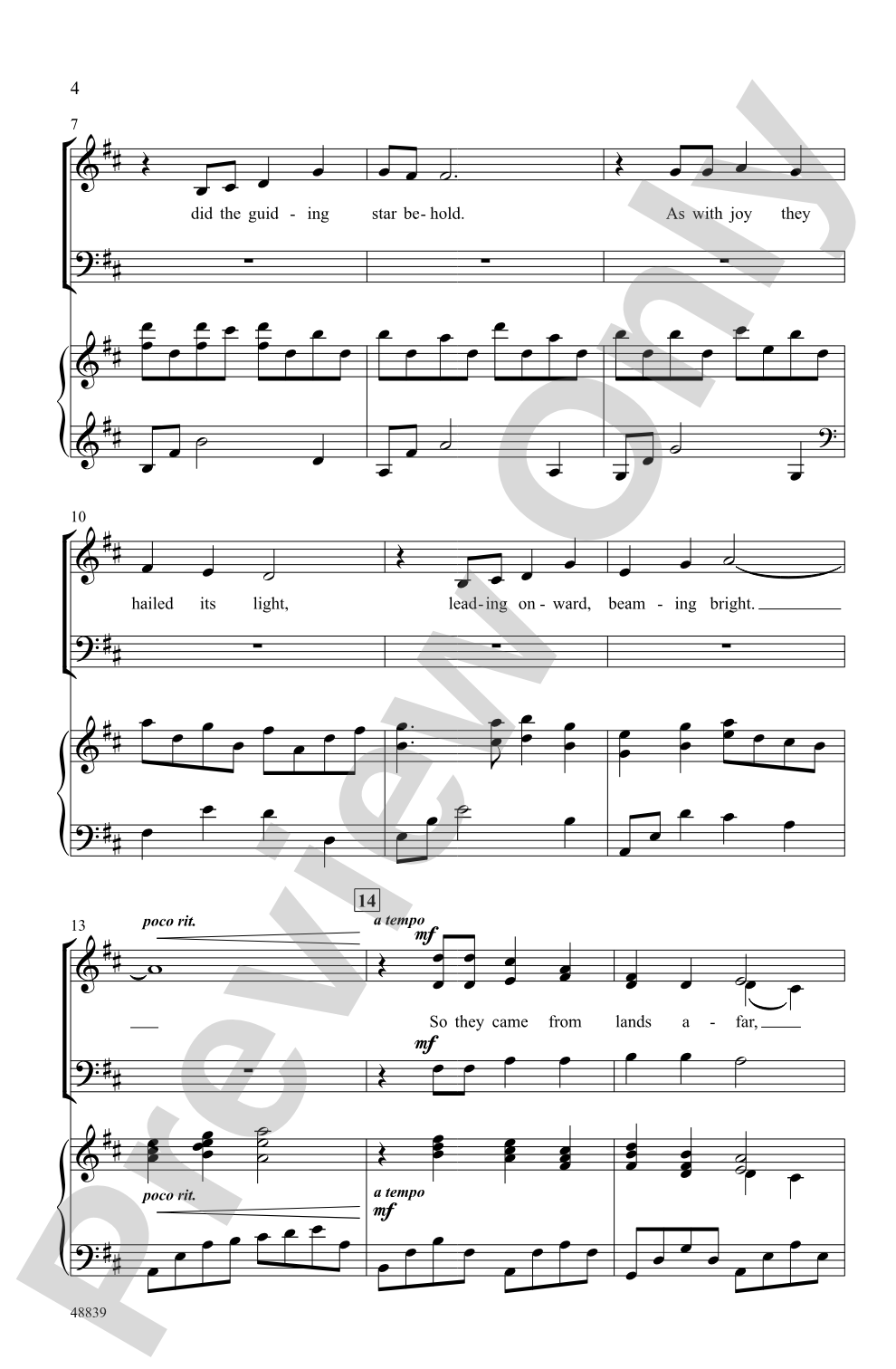
This sweet setting is an adaptation of the "As with Gladness Men of Old" text about those who followed the star. Concise vocal ranges, sensible phrasing, and a naturally flowing poetic meter make for manageable preparation during the busiest time of year. Ruth's ability to construct a lyrical melody, memorable piano motives, and logical voice parts shines clearly through. Several satisfying suspensions and a momentary tonal shift provide a warm harmonic backdrop. Be sure to observe the expressive dynamic and tempo markings to shape the most musical performance. A lovely selection for both concert and worship.


On Christmas Night: 3-Part Mixed Choral Octavo isn't in MakeMusic Cloud just yet...but it could be. Let us know you'd like to see it, and you'll help shape what comes next. In the meantime, start a free trial and dive into thousands of interactive titles your students can play along with today.
Request This Title
Tell us you want it.
Start Your Free Trial
Explore everything that's ready to play right now.
Sample Audio
1
Audio File
--:--
0:00
0:00
Sample Video
Additional Details
Series:
Alfred Choral Designs
Publisher:
Alfred Music
Page Count:
12
SKU:
00-PO-0006638
More about this title
About the Composer: Ruth Morris Gray

Ruth Morris Gray directs choirs at Rosemead High School in California, where she has shaped the program since 2004. Her compositional output exceeds 100 published works, reflecting her deep understanding of both choral writing and vocal pedagogy. She holds degrees in Piano Performance and Composition from Biola University and a Master of Arts in Music Composition from UC Santa Barbara, complemented by her California Single Subject Music Credential from Cal State Northridge.
Beyond the rehearsal room, Gray pursues a full creative life that includes piano performance, travel, reading, and cycling. Her multifaceted musicianship consistently informs her approach to choral composition, yielding works that are both musically substantial and practical for school and community ensembles.
Why we love this
Gray's gift for lyrical melody and logical voice construction shines throughout this setting. The piece respects your preparation timeline during December while offering enough harmonic sophistication—suspensions and a strategic tonal shift—to keep singers engaged and audiences moved.
What to expect
Warm and contemplative, this arrangement carries the reverence of those who journeyed to see the star. The melody flows with genuine lyricism rather than artifice, and the harmonic language—enhanced by those strategic suspensions—feels earned and expressive without becoming overwrought.
Who it's for
This octavo works equally well in the high school choir, the church choir with mixed voices, and the community ensemble looking for accessible yet substantive Christmas literature. Singers appreciate the natural phrasing and manageable ranges; directors value the clear voice writing and relatively quick learning curve.
How to get the most out of it
- Shape the dynamic arc carefully through the middle section; the expressive markings Gray provides are essential to revealing the harmonic warmth of those suspensions.
- Let the piano motives breathe slightly during the tonal shift; they anchor the emotional pivot and deserve clear articulation.
- Keep vowel uniformity across the three parts, particularly in the concise upper range, so the SAB balance stays open and blended.
How to use it
Pair this with a more robust, jubilant Christmas selection to create liturgical balance in your December concert or service. Its concise 12-page score makes it ideal for ensembles building a holiday program alongside other commitments; it seats comfortably between an opening processional and a finale.
Skills your students will build
- Sustained lyrical phrasing in SAB texture
- Recognition and execution of harmonic suspensions
- Tonal center stability through key area changes
- Dynamic shaping to highlight harmonic movement
- Blend and balance in three-part mixed voicing