
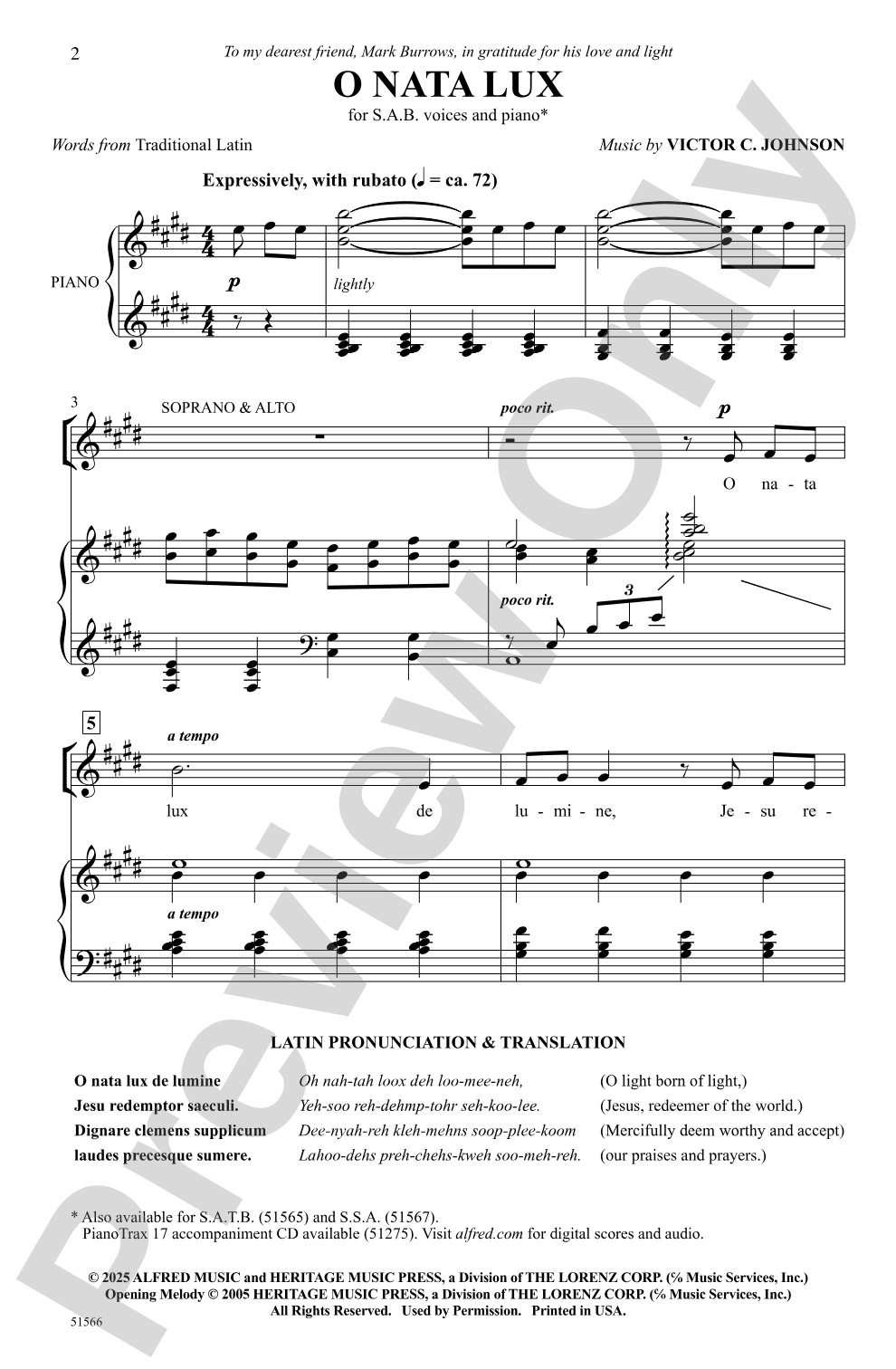
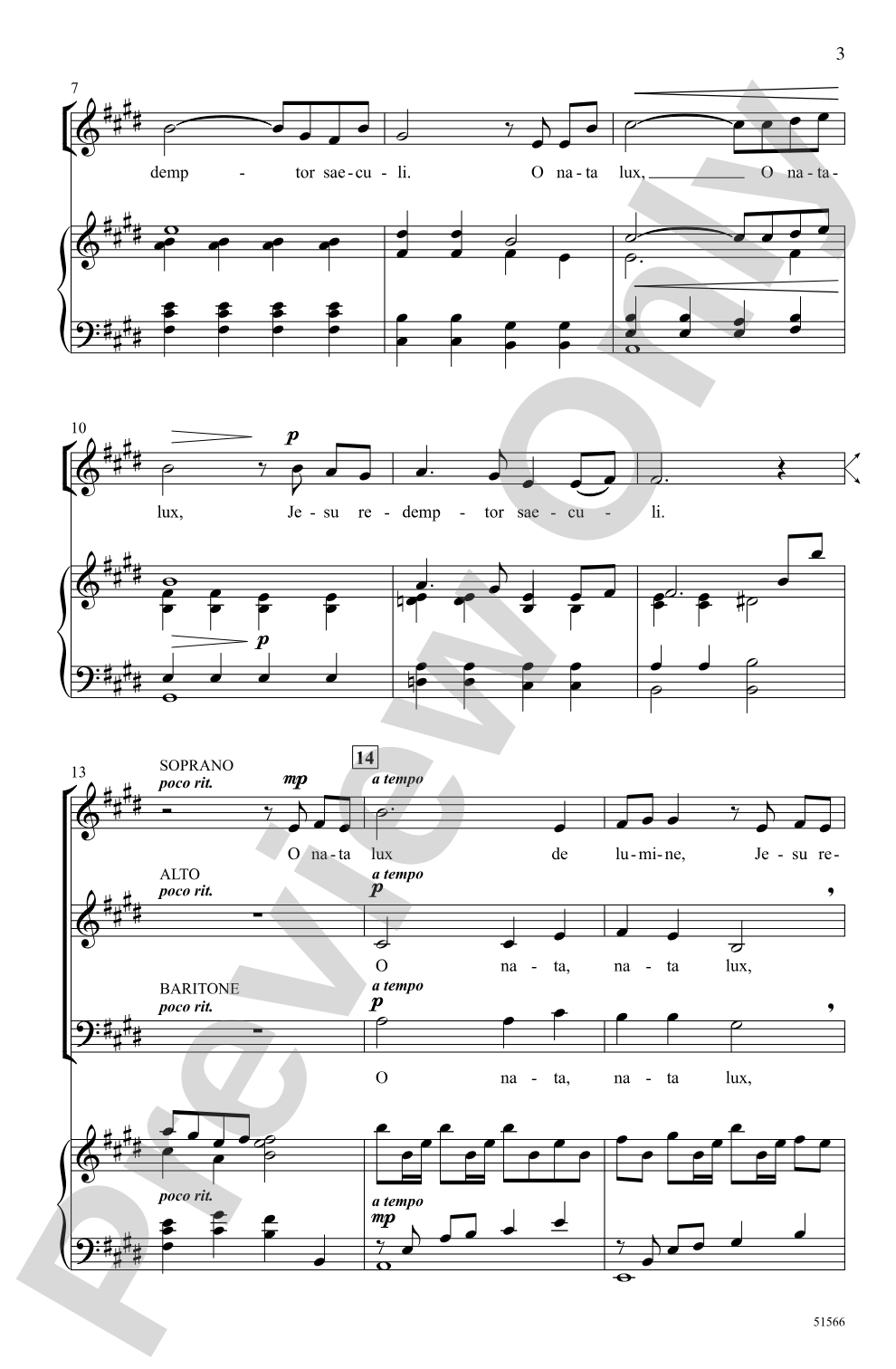
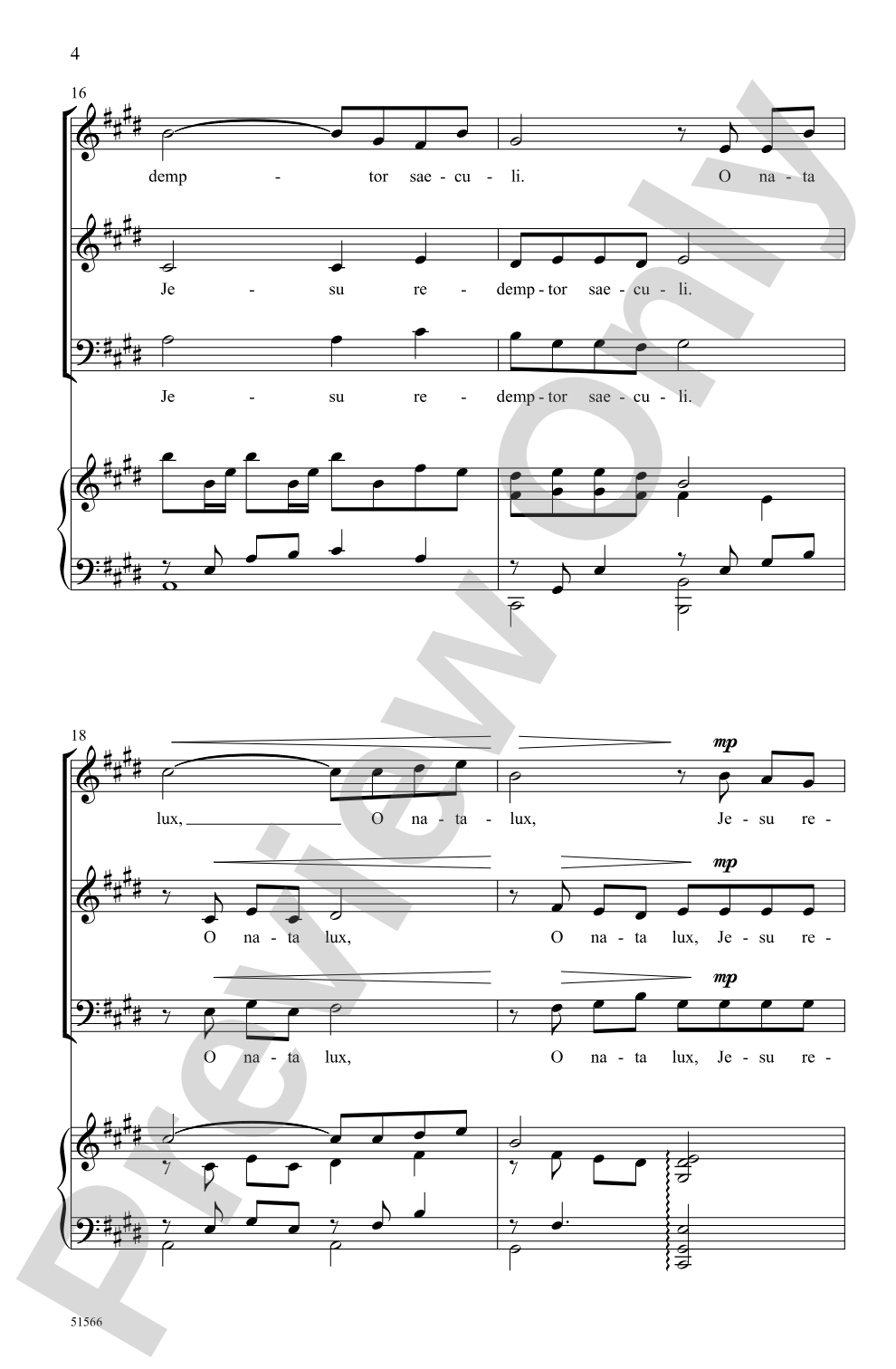

O Nata Lux: SAB Choral Octavo
Words from Traditional Latin, music by Victor C. Johnson
Item: 00-PO-0007537
$2.30
Minimum order quantity: 20 copies
Pickup currently not available
Description
Victor C. Johnson's radiant realization of the traditional Latin "light born of light" text is equally fitting for the concert hall, stage, or sanctuary. With plenty of room for expressive singing, this luminous setting gives every voice part a time to shine as it develops the glimmering opening motive into a stunning soundscape.


O Nata Lux: SAB Choral Octavo isn't in MakeMusic Cloud just yet...but it could be. Let us know you'd like to see it, and you'll help shape what comes next. In the meantime, start a free trial and dive into thousands of interactive titles your students can play along with today.
Request This Title
Tell us you want it.
Start Your Free Trial
Explore everything that's ready to play right now.
Sample Audio
1
Audio File
--:--
0:00
0:00
Sample Video
Additional Details
Series:
Alfred Choral Designs
Publisher:
Alfred Music
Page Count:
12
SKU:
00-PO-0007537
More about this title
About the Composer: Victor C. Johnson

Victor C. Johnson has established himself as a prolific voice in contemporary choral music, with more than 500 published works spanning choral octavos, vocal solos, and keyboard collections. Currently serving as School Choral Editor for Sing!, the educational arm of Choristers Guild, Johnson brings deep experience from his eighteen years as choral director at Ft. Worth Academy of Fine Arts, where he shaped the Academy Singers and Academy Men's Choir while also directing the Singing Girls of Texas and Children's Choir of Texas.
Based in Dallas, Johnson holds leadership roles in major music education organizations including the American Choral Directors Association, Texas Music Educators Association, and National Association for Music Education. In 2022, he was appointed conductor of the Dallas Symphony Children's Chorus Mixed Ensemble, the resident youth choir for the Dallas Symphony Orchestra, continuing his commitment to developing singers across age levels and skill ranges.
Why we love this
Johnson's gift for writing accessible yet musically substantive choral parts shines here. Every voice gets genuine material to sing, never filler; the progression from that delicate opening motive to the full-voiced finale creates real arc without requiring advanced technique. This is exactly the kind of piece that builds ensemble unity and vocal confidence across an SAB voicing.
What to expect
Light moves through this piece the way Johnson's motive spirals and expands. There's a contemplative opening that gradually gathers warmth and energy, creating moments of real luminescence without ever losing its intimate quality. The text resonates with spiritual weight while remaining musically joyful.
Who it's for
This works beautifully for intermediate to advanced mixed choirs seeking repertoire that sounds mature without demanding virtuosity. Whether you're programming for concert, festival competition, or liturgical use, the flexible voicing and manageable range make it accessible to most community and school ensembles.
How to get the most out of it
- Protect the luminosity of the opening motive by keeping the initial statement light and transparent; this fragility becomes the foundation for everything that follows.
- Shape phrases through vowel resonance rather than dynamic swells; let the text naturally guide your singers toward those glimmering moments Johnson builds.
- Consider how the recorded accompaniment can anchor entrances during rehearsal, then gradually layer in a cappella passages to strengthen internal independence.
- Balance the three parts carefully during development sections; the alto line often carries crucial harmonic information that can blur if not distinctly heard.
How to use it
Position this as a moment of contrast in a mixed repertoire concert, either as a sophisticated opener that sets a thoughtful tone or as a radiant conclusion to a longer program. It also serves festivals and competitions well, offering judges a clear window into your singers' blend and musicality. For liturgical settings, the reverent opening and soaring development make it equally at home in sanctuary or concert hall.
Skills your students will build
- Singing sustained, supported tones across a narrow range while maintaining textural clarity
- Blending three-part harmony with attention to individual voice integrity
- Phrasing through legit vowels and consonant placement rather than dynamic manipulation
- Developing ensemble balance and part independence in layered textures
- Interpreting sacred text with musical and emotional sensitivity