
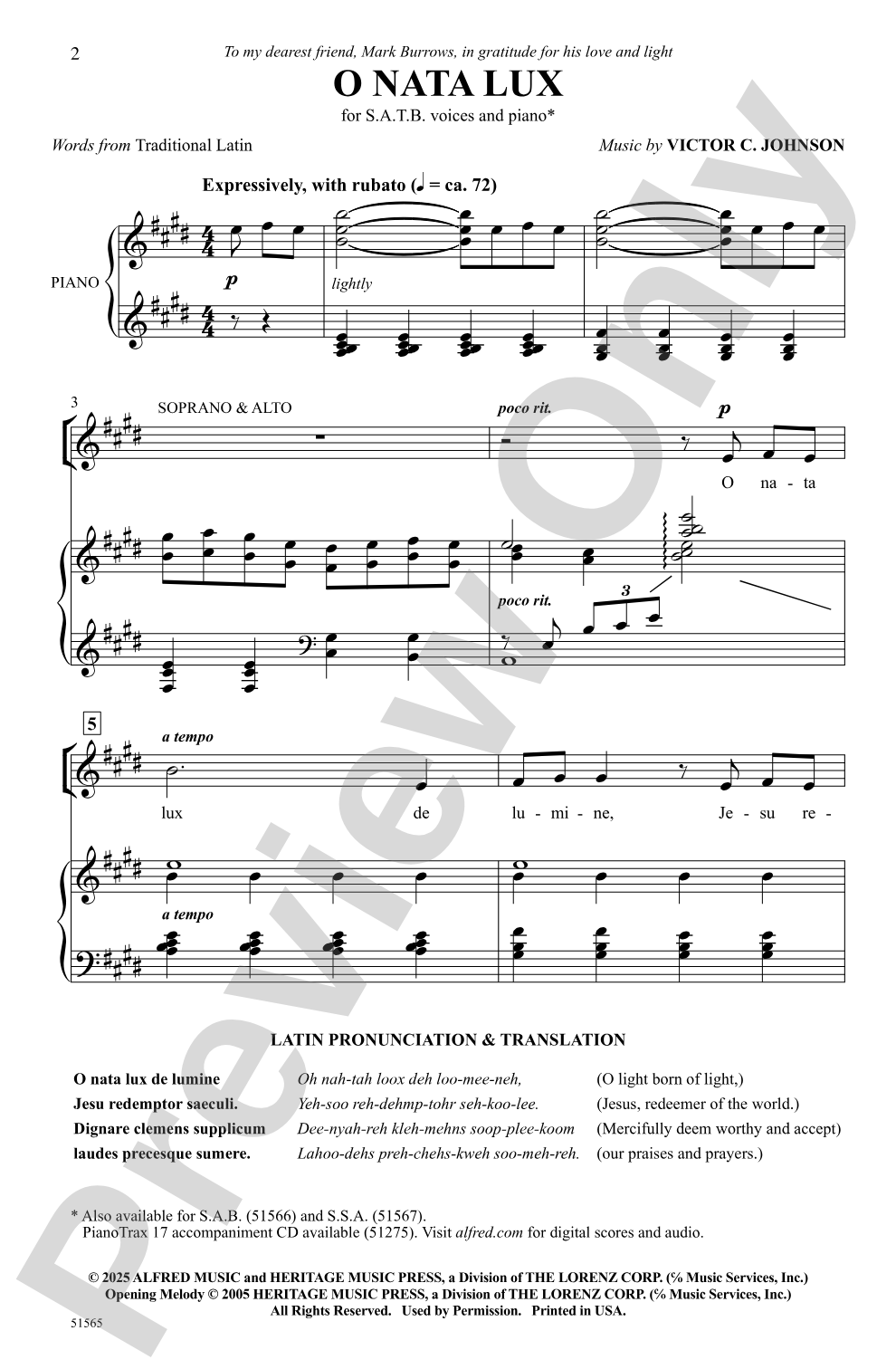
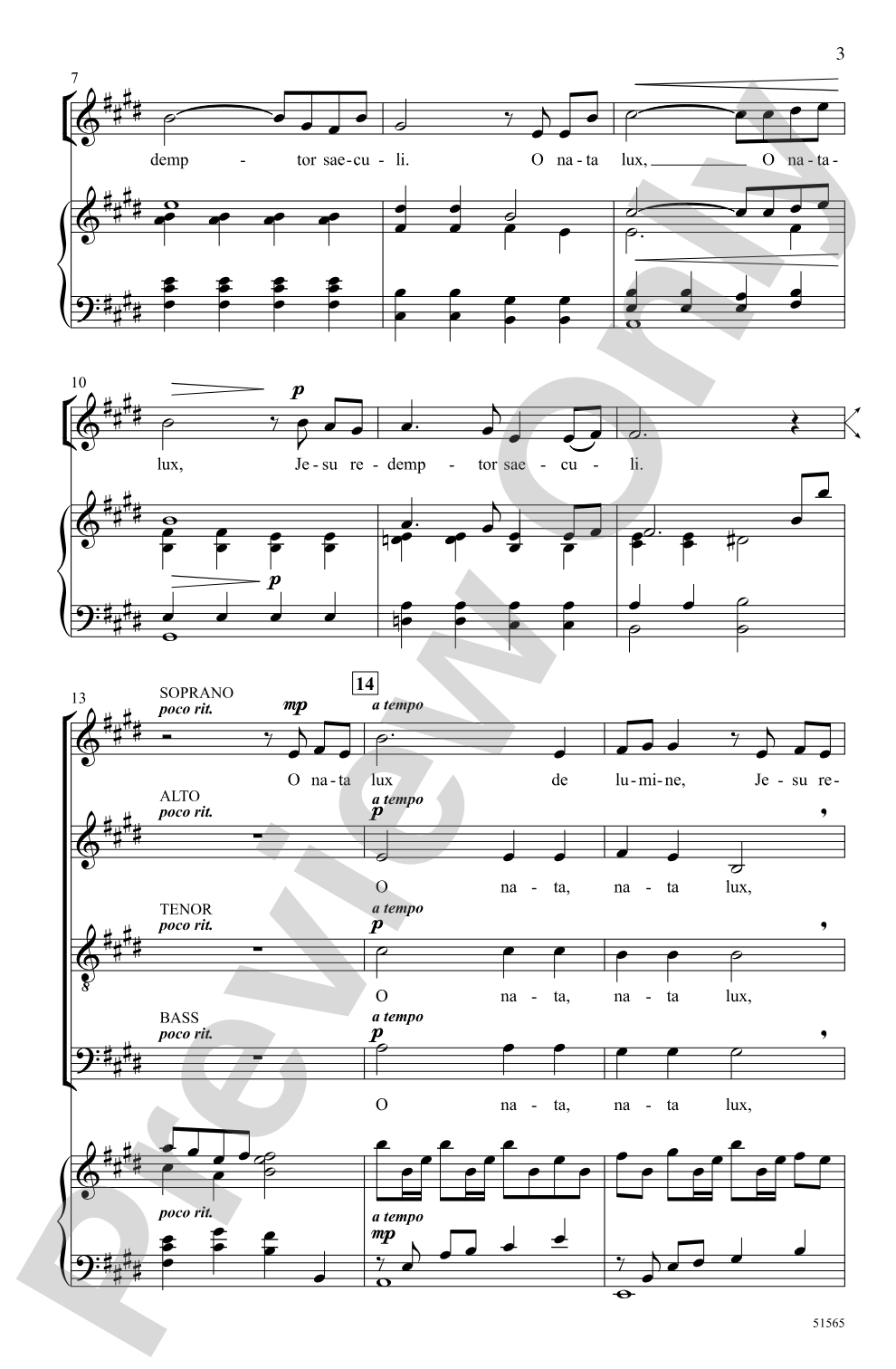
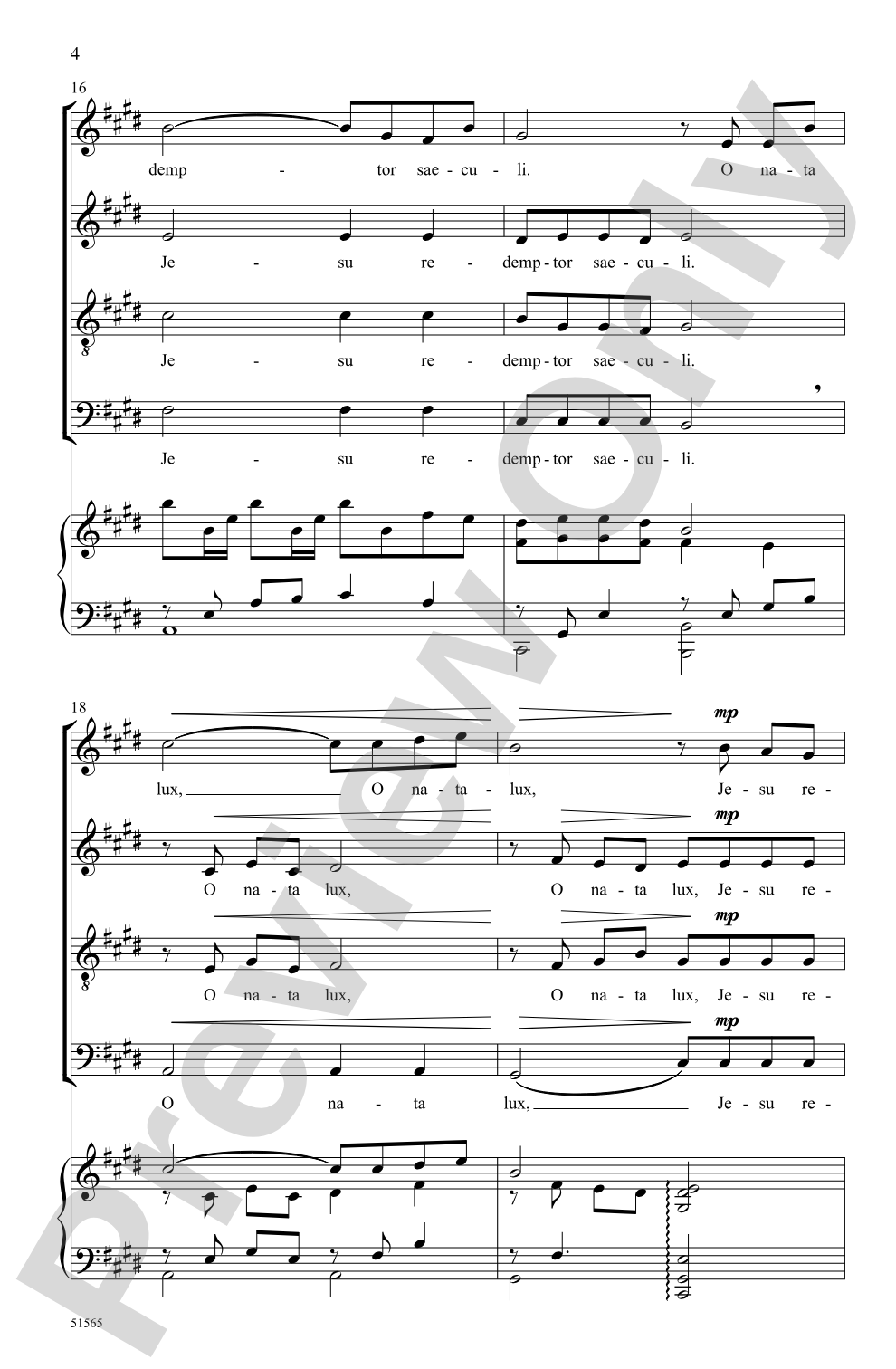

O Nata Lux: SATB Choral Octavo
Words from Traditional Latin, music by Victor C. Johnson
Item: 00-PO-0007536
$2.30
Minimum order quantity: 10 copies
Please note: Under U.S. copyright law, you must purchase the exact number of copies needed for your ensemble. Printing, duplicating or sharing additional copies is strictly prohibited.
Pickup currently not available
Description
Victor C. Johnson's radiant realization of the traditional Latin "light born of light" text is equally fitting for the concert hall, stage, or sanctuary. With plenty of room for expressive singing, this luminous setting gives every voice part a time to shine as it develops the glimmering opening motive into a stunning soundscape.


Discover MakeMusic Cloud: thousands of interactive titles your students can play along with today.
Sample Audio
1
Audio File
--:--
0:00
0:00
Sample Video
Additional Details
Series:
Alfred Choral Designs
Publisher:
Alfred Music
Page Count:
12
SKU:
00-PO-0007536
More about this title
About the Composer: Victor C. Johnson

Victor C. Johnson brings decades of choral leadership to his compositional work. Based in Dallas, Texas, he served as choral director at Fort Worth Academy of Fine Arts from 2000 to 2018, where he led multiple ensembles including the Academy Singers, Academy Men's Choir, and the Singing Girls of Texas. In 2022, he was appointed conductor of the Dallas Symphony Children's Chorus Mixed Ensemble, the resident children's choir for the Dallas Symphony Orchestra.
As School Choral Editor for Sing!, the educational publishing division of Choristers Guild, Johnson has become a prolific voice in choral music with over 500 published works spanning choral compositions, vocal solos, and keyboard collections. His involvement with major music education organizations including the American Choral Directors Association, Texas Music Educators Association, and National Association for Music Education reflects his commitment to the field.
Why we love this
Johnson transforms a brief liturgical text into an architecturally sophisticated arrangement that rewards both singers and listeners. The piece builds from its delicate opening idea into a luminous climax without ever feeling overwrought, giving you genuine expressive control over the dynamic arc. Every voice part gets a moment of melodic prominence, which means all four sections stay engaged and invested from start to finish.
What to expect
Light unfolds gradually, starting as a single point and expanding into something radiant and encompassing. The harmonic language glows with warmth, and the interweaving voices create an almost luminous texture that feels both contemplative and celebratory.
Who it's for
This octavo suits intermediate to advanced SATB choirs seeking a piece that works equally well in concert settings, festival competitions, or liturgical contexts. It fits ensembles that value expressive depth and can sustain long phrases with control and blend.
How to get the most out of it
- Shape the opening motive with clarity and stillness; this establishes the entire sound world of the piece and invites careful listening.
- Differentiate the dynamic levels subtly in the middle sections so that when the texture thickens, the growth feels organic rather than sudden.
- Balance the inner voices as the harmonic language develops; Johnson's writing often places important sonorities in alto or tenor, not just soprano.
- Let silence and space breathe where the texture thins; the glimmering quality depends on restraint as much as resonance.
How to use it
Place this on a concert program where you want a moment of genuine luminosity and introspection. Its 12 pages and moderate length make it ideal for pairing with contrasting repertoire, and its concert-hall polish works well alongside both sacred and secular programming.
Skills your students will build
- Sustaining long, shaped phrases with consistent breath support
- Balancing inner voices in rich harmonic textures
- Developing sensitivity to dynamic shaping and expressive control
- Blending extended harmonic vocabularies across all four parts
- Reading and executing smooth voice leading across registers