
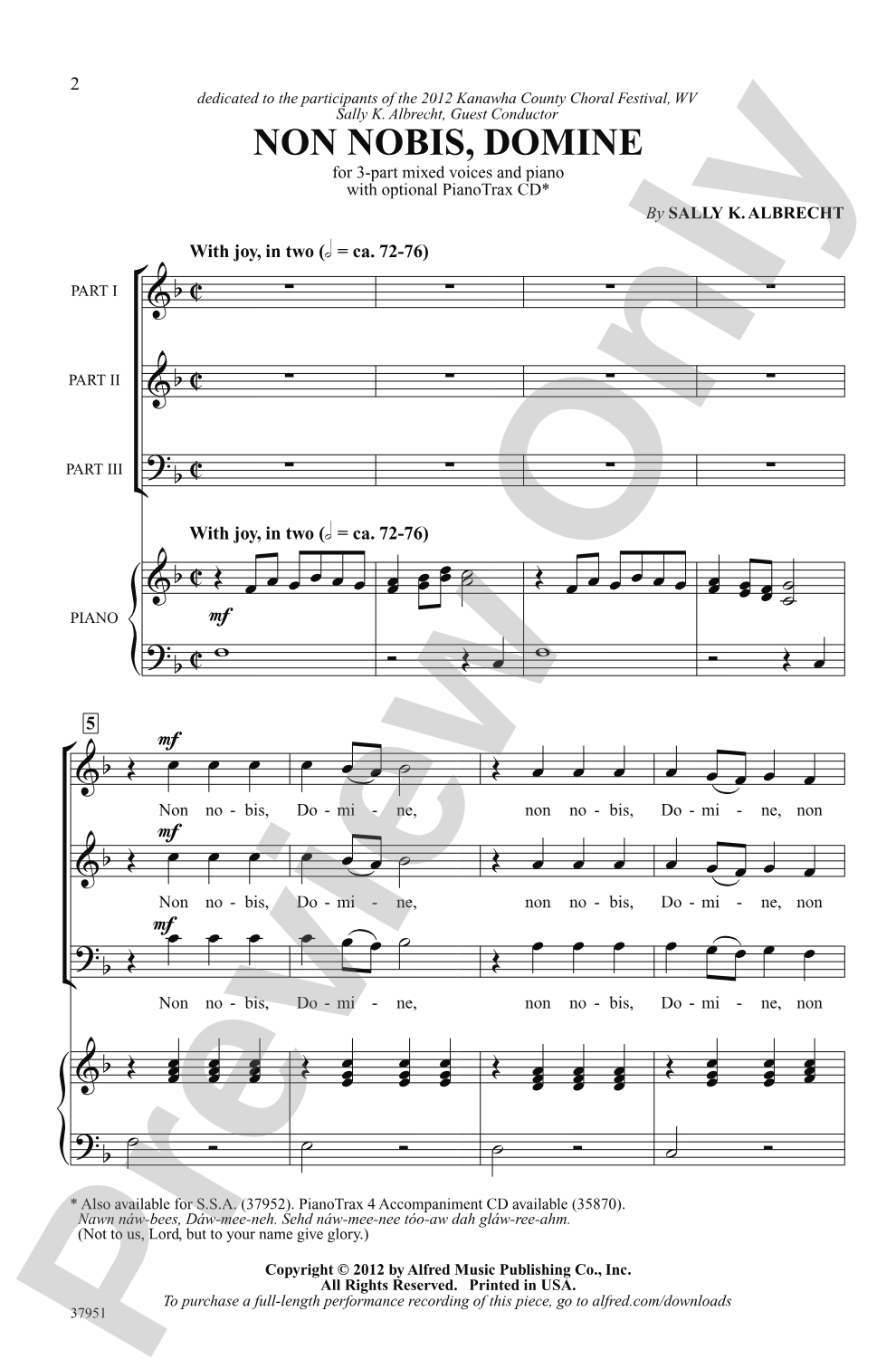
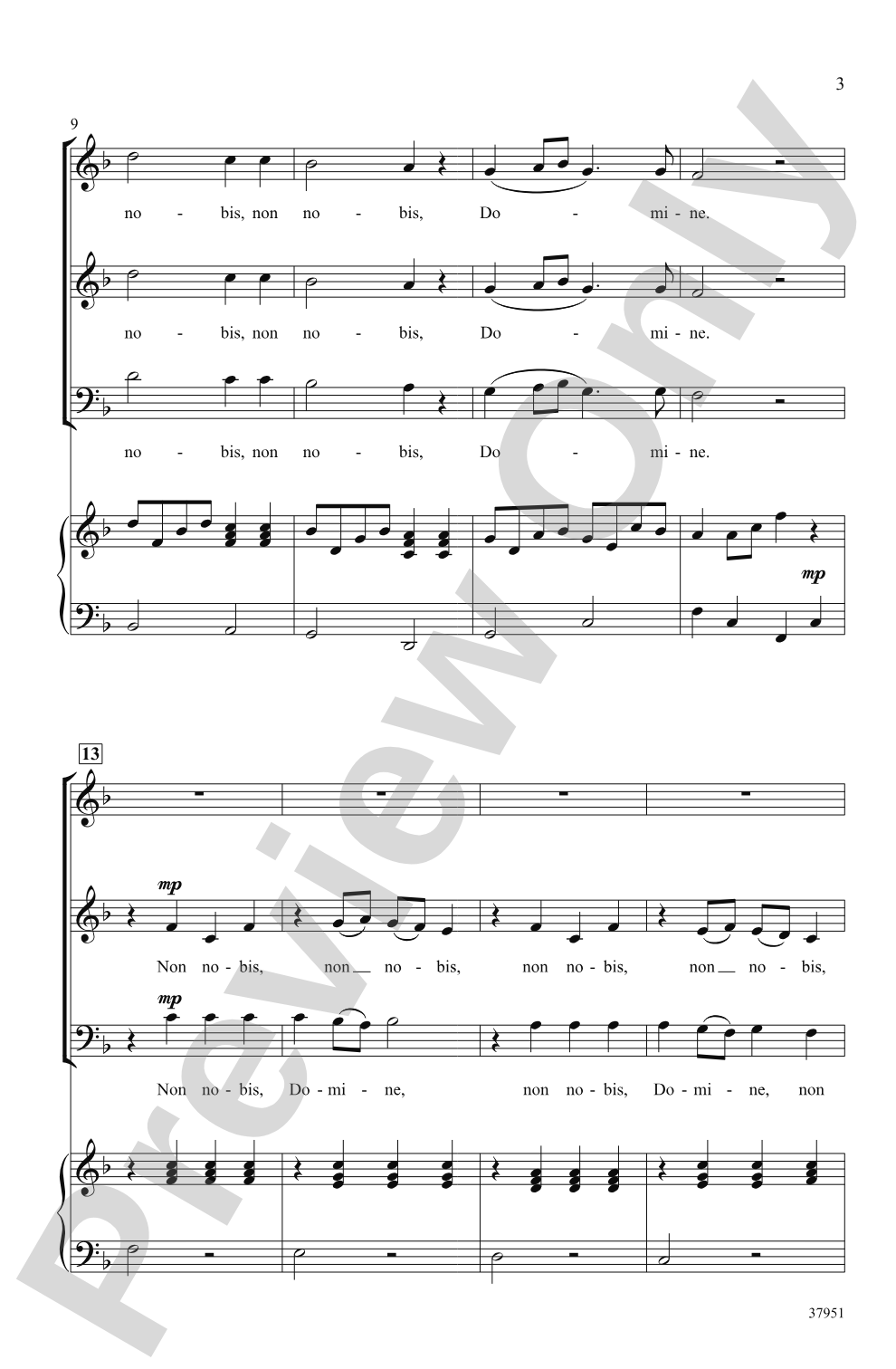

Non Nobis, Domine: 3-Part Mixed Choral Octavo
By Sally K. Albrecht
Item: 00-PO-0001292
$1.85
Minimum order quantity: 20 copies
Pickup currently not available
Description
This traditional Latin text is set in a light, classical style, featuring three solid, independent vocal lines. It all adds up to success for your developing choirs. Great for concert or contest. Accompaniment available on PianoTrax 4 CD (00-35870).


Non Nobis, Domine: 3-Part Mixed Choral Octavo isn't in MakeMusic Cloud just yet...but it could be. Let us know you'd like to see it, and you'll help shape what comes next. In the meantime, start a free trial and dive into thousands of interactive titles your students can play along with today.
Request This Title
Tell us you want it.
Start Your Free Trial
Explore everything that's ready to play right now.
Sample Audio
1
Audio File
--:--
0:00
0:00
Sample Video
No sample videos found.
Additional Details
Series:
Alfred Choral Designs
Publisher:
Alfred Music
Page Count:
12
SKU:
00-PO-0001292
More about this title
About the Composer: Sally K. Albrecht

Sally K. Albrecht has shaped choral music education for over three decades, first as Director of School Choral, Vocal, and Elementary Publications at Alfred Music and through her prolific output as a composer and arranger. Since 1987, she has been a consistent recipient of the ASCAP Special Music Award, with more than 600 published choral works and 75 larger musicals and songbooks currently in circulation. She has conducted honor choirs at prestigious venues including Lincoln Center, Carnegie Hall, and The Kennedy Center.
Albrecht holds degrees from Rollins College (B.A. in Music and Theater, 1976), the University of Miami (M.A. in Drama, 1977, and M.M. in Accompanying, 1979), and has taught at Oakland University, Jersey City State College, and Meredith College. In 2021, she received the Distinguished Alumna Award from both the University of Miami Frost School of Music and Rollins College, where she serves on the Board of Trustees. She and her husband, composer and arranger Jay Althouse, live in Wake Forest, North Carolina.
Why we love this
Albrecht writes for developing choirs with clarity and purpose. The three independent vocal lines sit well for singers still building confidence in part singing, and the light classical style creates genuine musical substance without overwrought complexity. You'll program this for concert or festival competition knowing your singers will feel accomplished and your audience will hear a polished result.
What to expect
The piece radiates quiet dignity. Albrecht's setting respects the weight of the Latin text without dragging; instead, the classical restraint creates an almost transparent quality that lets meaning and melody shine through cleanly.
Who it's for
This octavo is built for SAB choirs that have moved beyond unison singing but aren't yet ready for four-part writing. Directors working with middle school, young high school, or community choirs will find the part writing accessible while still demanding real musicianship.
How to get the most out of it
- Balance the three parts by asking each section to listen across to the others. SAB voicing can muddy easily if sopranos dominate; encourage them to shape around the alto and bass lines rather than floating above.
- Work the Latin text clearly before layering in the music. Accurate pronunciation of the vowels (especially the Latin 'i' as 'ee' and 'ae' as 'eye') lifts the classical character and communicates the sacred meaning.
- Use the optional PianoTrax accompaniment as a learning tool during rehearsal, then pull it back in performance to let the choir's voices become the centerpiece.
How to use it
Anchor a sacred or classical-themed concert with this piece, or use it as a centerpiece for a festival entry. The moderate difficulty and traditional sensibility make it an ideal bridge between lighter pop-style octavos and more demanding classical choral literature.
Skills your students will build
- Reading three independent vocal lines in SAB voicing
- Latin text pronunciation and diction in a sacred context
- Balancing voices as equals in a three-part texture
- Intonation stability across mixed voices with chromatic movement