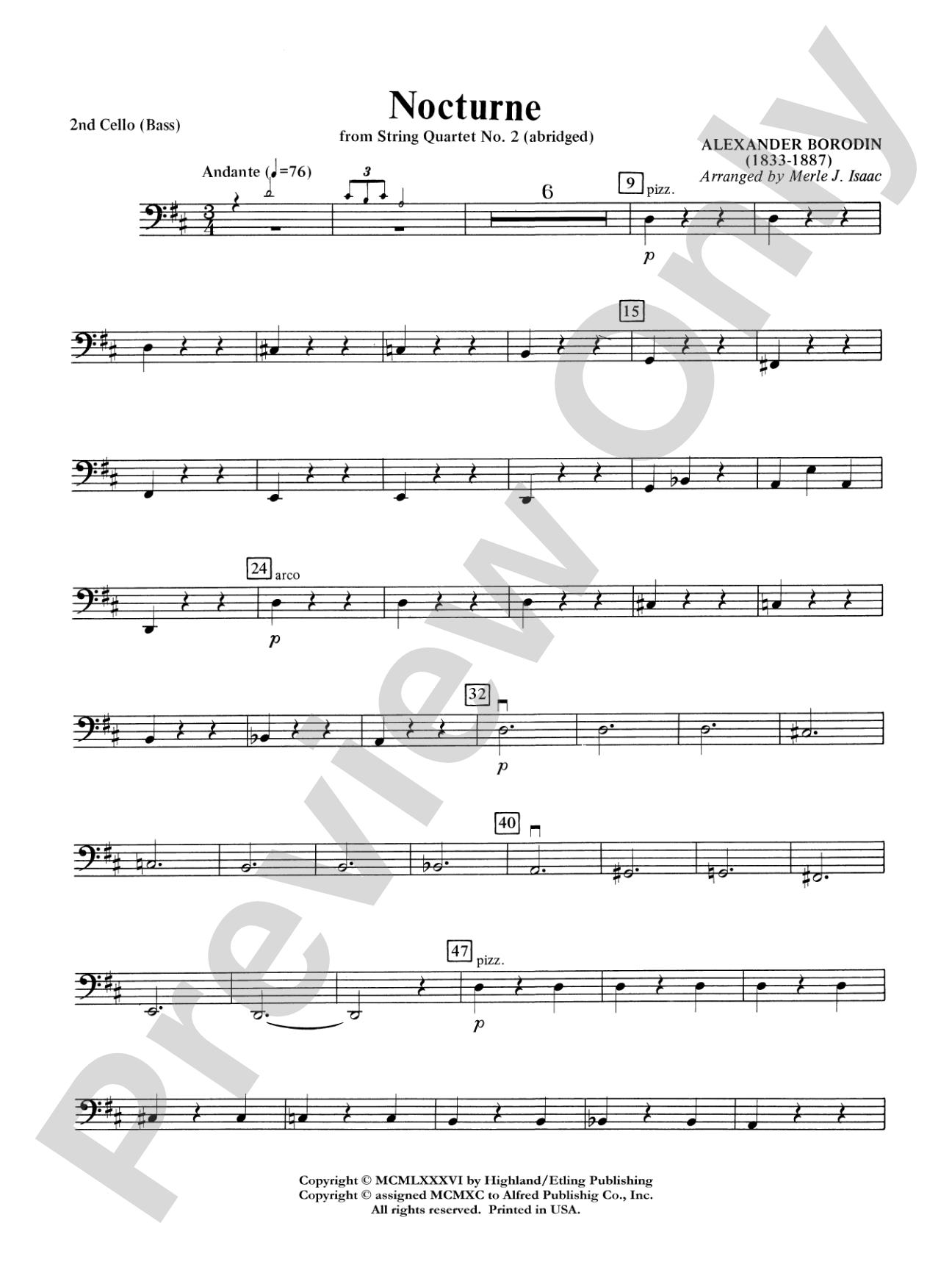
Nocturne: 2nd Cello Sheet Music Preview

Nocturne: 2nd Cello

from String Quartet No. 2 (Abridged)

By Alexander Borodin / arr. Merle J. Isaac

Grade: 3

Item: 00-PC-0000119_VC2

Digital Download
$5.99
Description

Don't just read it, hear it, play along with it, and watch your students grow with it. In MakeMusic Cloud, Nocturne: 2nd Cello comes alive with professional accompaniment, adjustable tempo, and built-in practice tools that turn solo practice into real progress.

Sample Audio
No sample audio found.
Sample Video
Additional Details
Series: Highland/Etling String Orchestra
Publisher: Alfred Music
Page Count: 156
SKU: 00-PC-0000119_VC2

More about this title

About the Composer: Alexander Borodin

Alexander Borodin (1833–1887) was a Russian composer of the Romantic era whose musical output was modest in quantity but substantial in artistic impact. A trained chemist who maintained a career in science throughout his life, Borodin composed in his spare time, creating works marked by lyrical melody, rich harmonic color, and the influence of Russian folk traditions. His most famous composition, the opera Prince Igor, remains a cornerstone of the Russian operatic repertoire.

Borodin's instrumental works, including his string quartets and orchestral pieces, showcase his gift for sustained, singing lines and sophisticated orchestration. His music bridges Western European Romantic traditions with distinctly Russian character, making his compositions enduringly popular in concert halls and educational settings worldwide.

Why we love this

Merle Isaac's arrangement preserves Borodin's signature warmth and lyricism while making the work accessible to Grade 3 string orchestras. This is the kind of repertoire that reminds young musicians why they chose strings in the first place: beautiful melody that sings naturally on the instrument, transparent texture that lets individual players shine, and enough harmonic interest to keep ensemble directors engaged.

What to expect

The nocturne unfolds with quiet elegance, full of yearning melody and gentle harmonic movement. It creates an intimate musical space despite the ensemble setting, inviting listeners into a moment of reflection and beauty characteristic of the Romantic period.

Who it's for

String orchestra directors working with Grade 3 ensembles who want repertoire that combines pedagogical value with genuine musical depth. Student players at this level can execute the technical demands while engaging meaningfully with Romantic-era compositional language.

How to get the most out of it

  • Bring out the lyrical quality by encouraging sustained, singing tone from every section. This nocturne lives and dies on the orchestra's ability to sustain phrases with control and shape.
  • Balance the inner voices carefully; often the violas and lower strings carry important harmonic material that supports the primary melody line.
  • Shape long phrases by thinking in terms of musical breathing rather than bar lines. Small crescendos and diminuendos within passages create movement without artificial disruption.
  • Use the recorded accompaniment (if available) to establish a consistent tempo foundation, particularly helpful for sections where the ensemble must maintain longer held notes or sparse textures.

How to use it

Program this for concert settings where you want a moment of lyrical contrast, or use it as a contest or festival piece that showcases ensemble musicianship without requiring high technical pyrotechnics. It pairs beautifully alongside other Romantic-era arrangements or as a bridge between modern works and canonical string orchestra repertoire.

Skills your students will build

  • Sustaining long tones with consistent tone quality and dynamic control
  • Shaping extended phrases and recognizing harmonic structure within Romantic melody
  • Balancing ensemble sound across multiple voice parts
  • Responding to subtle rubato and expressive tempo variations
  • Reading accidentals and chromatic writing common to 19th-century harmonic language

You May Also Like