

Nightingale: SSAA Choral Octavo
Words and music by Jay Althouse
Item: 00-PO-0005910
$2.05
Minimum order quantity: 20 copies
Pickup currently not available
Description
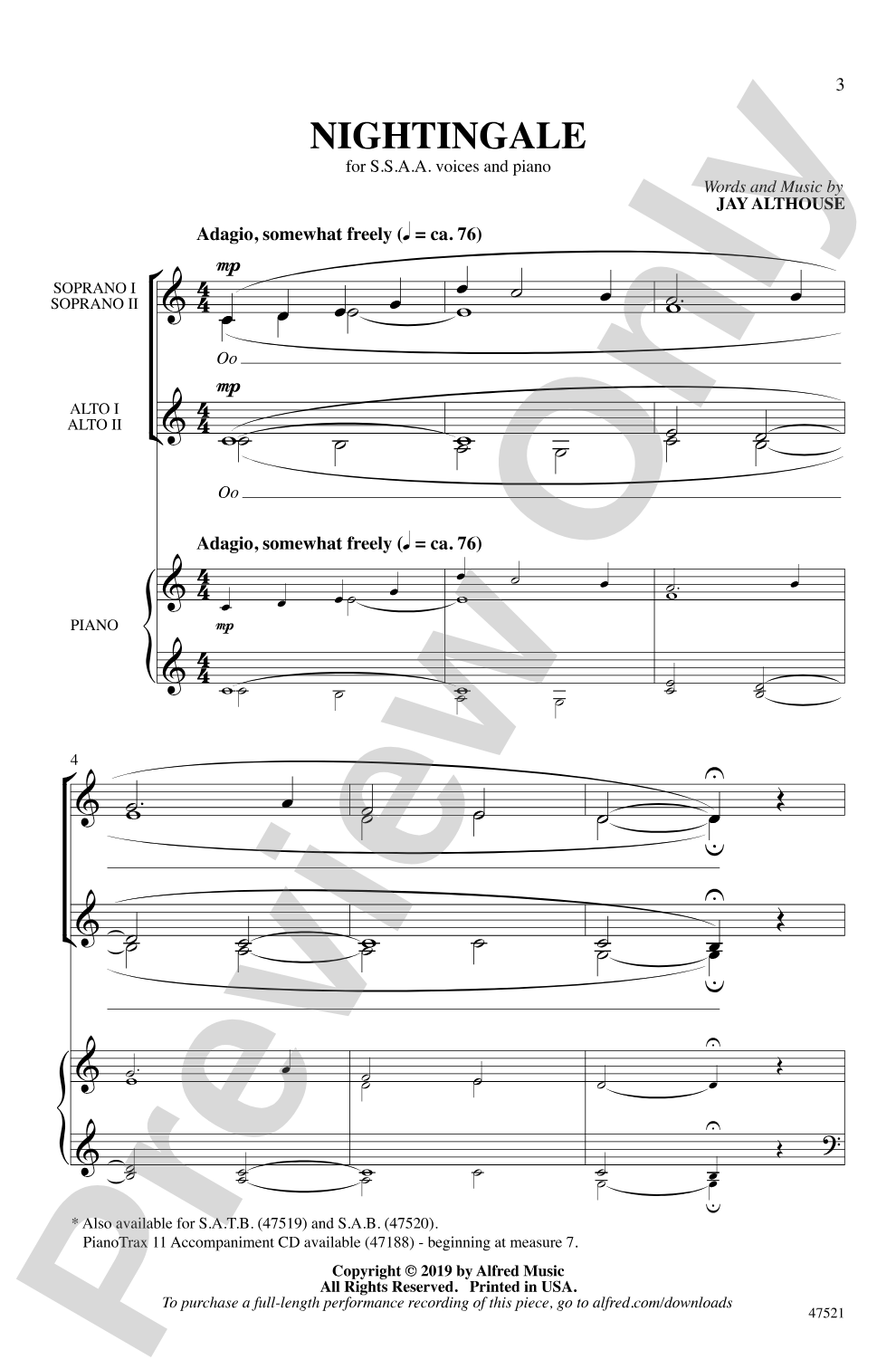
A hushed a cappella opening in rich harmony immediately captures the ear. The flowing piano joins just before two brief optional solos introduce the beloved nightingale and her tuneful melody. Expressive singing and vocal artistry are encouraged by the gentle ebb and flow of tempo.


Nightingale: SSAA Choral Octavo isn't in MakeMusic Cloud just yet...but it could be. Let us know you'd like to see it, and you'll help shape what comes next. In the meantime, start a free trial and dive into thousands of interactive titles your students can play along with today.
Request This Title
Tell us you want it.
Start Your Free Trial
Explore everything that's ready to play right now.
Sample Audio
1
Audio File
--:--
0:00
0:00
Sample Video
No sample videos found.
Additional Details
Series:
Alfred Choral Designs
Publisher:
Alfred Music
Page Count:
8
SKU:
00-PO-0005910
More about this title
About the Composer: Jay Althouse

Jay Althouse holds degrees in Music Education and Music from Indiana University of Pennsylvania, where he was later honored as a Distinguished Alumnus. His career in music spans both the publishing world, where he spent eight years in rights and licensing administration and served on the Executive Board of the Music Publishers Association of America, and composition, with over 800 choral works now in print across all levels and skill ranges.
As a prolific composer and arranger, Althouse has earned regular ASCAP Special Awards for his contributions to standard music repertoire. He has collaborated with his wife Sally K. Albrecht on children's musicals and significant choral works, including "I Hear America Singing," which was performed by the San Francisco Girls and Boys Choirs at President Obama's 2009 Inauguration. Beyond composition, he has authored numerous educational resources for the classroom and served on the board of the North Carolina Master Chorale. He currently advises the National Folk Art Society of America.
Why we love this
Althouse captures something essential in this piece: the balance between structural elegance and emotional restraint. The optional solos give you flexibility in casting without demanding a soloist, while the a cappella opening establishes harmonic sophistication immediately. This is the kind of concert piece that builds genuine audience connection without sentimentality.
What to expect
The piece opens in intimate quiet, as if listening to something private and delicate. The piano's arrival brings gentle warmth while the optional solos evoke the nightingale's own song with lyrical beauty. Throughout, there's a sense of refinement and restraint, encouraging singers to find expression in subtlety rather than volume.
Who it's for
This works beautifully for treble choirs (SSAA) at the high school and adult levels who have developed ear independence and can hold harmony without doubling from piano. It suits programs seeking a concert piece with substance that doesn't require auditioned soloists but rewards musicianship and expressive maturity.
How to get the most out of it
- Shape the opening a cappella passage with subtle dynamic waves rather than static volume; let the inner harmonies breathe and support the melody naturally.
- Rehearse the piano entry separately, marking exactly where it joins so the singers feel supported without losing the intimacy of the opening.
- Treat tempo flexibility as a storytelling device; the "gentle ebb and flow" Althouse indicates should feel organic to the phrasing, not metronomic.
- If using the optional solos, balance them so they feel like part of the ensemble's expressive landscape, not separate show moments.
How to use it
Program this as a contrast piece in a concert set, especially effective following something with more dramatic energy. It pairs well with other nature-inspired choral works or can serve as an elegant closer that leaves audiences in a reflective mood. The piece also translates well to festival and competition settings where artistry and vocal control are valued.
Skills your students will build
- A cappella intonation and harmonic independence in four-part writing
- Expressive tempo control and rubato that serves the text
- Balance and blend within a rich harmonic texture
- Optional solo performance for volunteers
- Interpretive choices that honor the composer's indicated emotional arc