
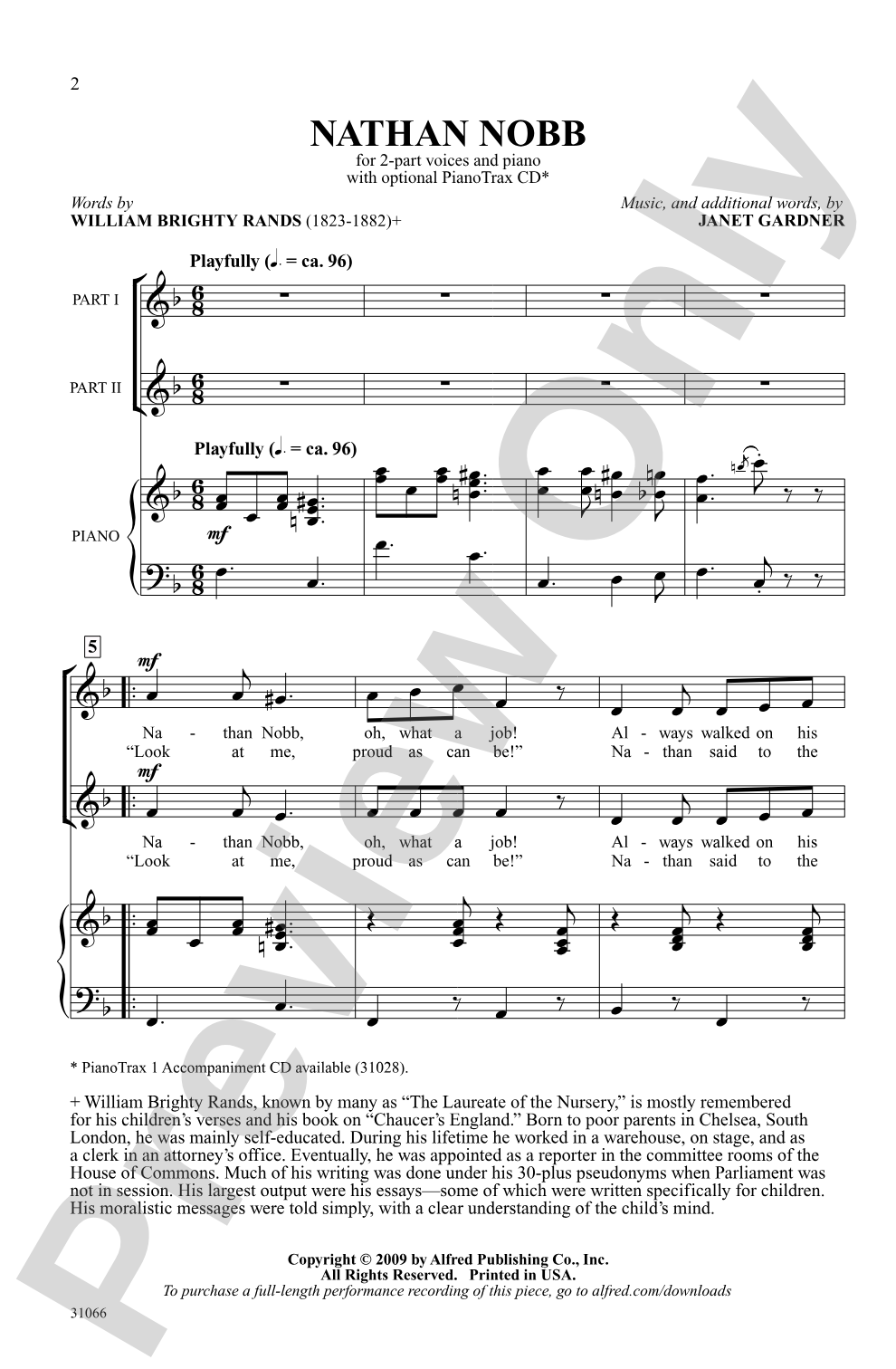

Nathan Nobb: 2-Part Choral Octavo
Words by William Brighty Rands, additional words and music by Janet Gardner
Item: 00-PO-0000767
$1.75
Minimum order quantity: 20 copies
Pickup currently not available
Description
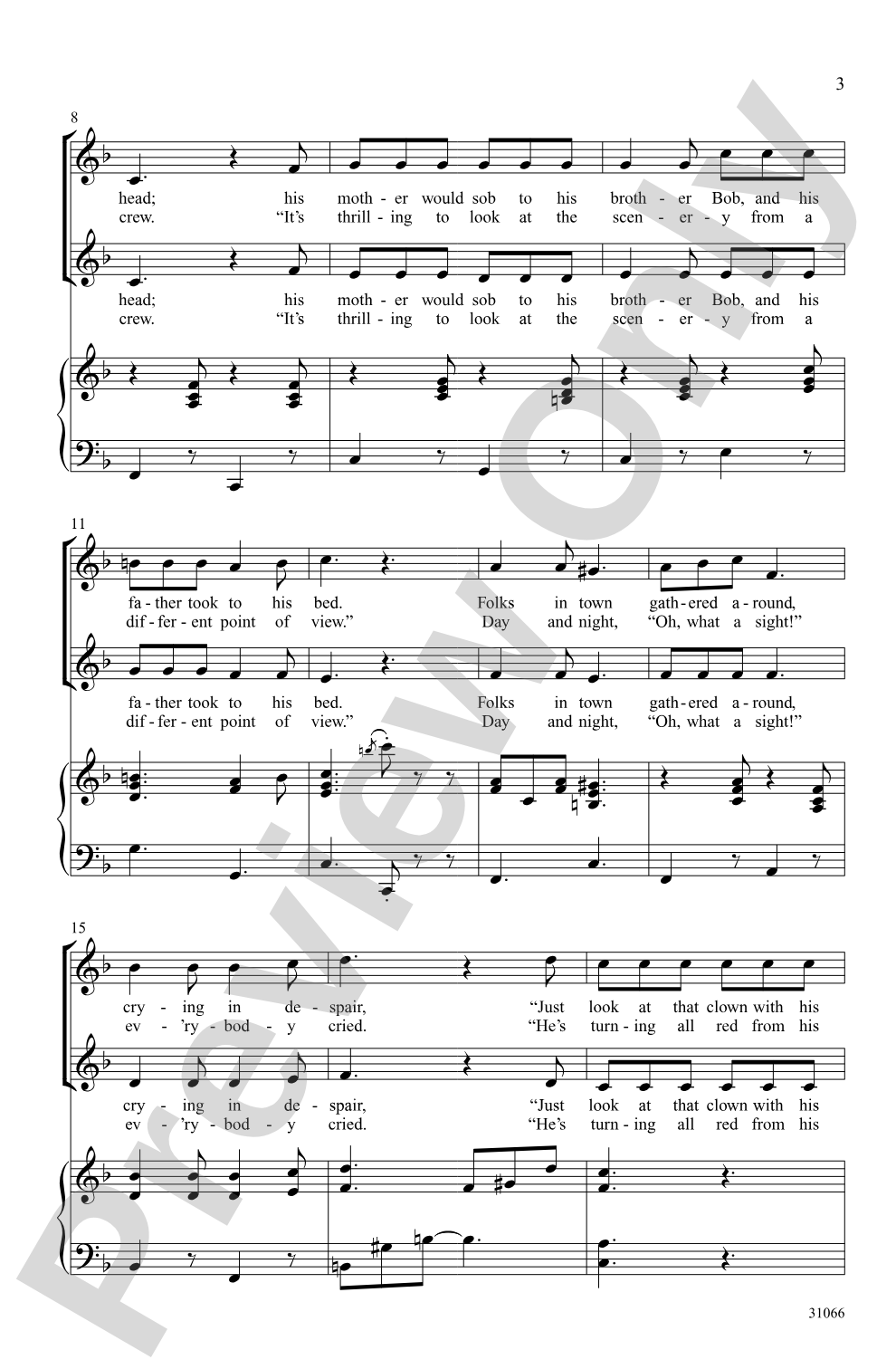
Children will love singing this silly story about a boy who liked to stand on his head! But don't be fooled by the whimsical poetic text, this song encourages solid 2-part singing. Wacky, and worthwhile. Accompaniment included on PianoTrax 1 CD (00-31028).


Nathan Nobb: 2-Part Choral Octavo isn't in MakeMusic Cloud just yet...but it could be. Let us know you'd like to see it, and you'll help shape what comes next. In the meantime, start a free trial and dive into thousands of interactive titles your students can play along with today.
Request This Title
Tell us you want it.
Start Your Free Trial
Explore everything that's ready to play right now.
Sample Audio
1
Audio File
--:--
0:00
0:00
Sample Video
No sample videos found.
Additional Details
Series:
Alfred Choral Designs
Publisher:
Alfred Music
Page Count:
12
SKU:
00-PO-0000767
More about this title
About the Composer: Janet Gardner

Janet Gardner earned her Bachelor's degree in music education from Concordia College in Moorhead, Minnesota, and spent 33 years teaching elementary general music in Montevideo, Minnesota. Throughout her career, she became known for bringing music to life in the classroom; she facilitated workshops at state universities, served as a clinician at state music conventions, and was recognized as the 1995 Minnesota Music Classroom Teacher of the Year. She has also chaired the Minnesota Elementary Composition Contest for six years and been a featured composer and clinician at music events across the United States and Canada.
Gardner's catalog spans musicals (Bones!, Broadway Santa, The Phantom of the Music Room) and choral works published by Alfred, all written with elementary and middle school singers in mind. Her compositions have earned annual ASCAP recognition for their originality and classroom appeal. Since retiring from teaching in 2006, she has continued composing in Montevideo, where she remains active as a church musician and community arts advocate.
Why we love this
Gardner knows exactly how to hook young singers with humor while building genuine musicianship. The 2-part writing here strengthens blend and independence without becoming a slog; the whimsy of a boy standing on his head keeps energy high, and the text lands with just enough absurdity to hold fourth and fifth graders' attention through multiple rehearsals.
What to expect
Nathan Nobb bounces along with playful energy and innocent charm. The melody sits comfortably in the young voice and invites bright articulation; the story unfolds with enough wit to raise smiles without ever winking at the audience. It's the musical equivalent of a well-told joke that lands better each time you hear it.
Who it's for
This piece suits upper elementary and early middle school choir singers encountering 2-part singing for the first time or building confidence in part independence. It works equally well for heterogeneous ensembles where vocal maturity and reading ability vary; the approachable melody and comic premise keep everyone engaged.
How to get the most out of it
- Lean into the comedic narrative. Let singers discover the humor in the lyrics during early rehearsals; their delight will naturally inform phrasing and dynamics.
- Work the two parts separately at first, especially if this is students' first experience with printed part-singing. Have each part sing their line while you play the other part on piano.
- Use the recorded accompaniment on PianoTrax 1 for rehearsal flexibility and as a performance backup if needed. Solo voices tend to gain confidence hearing the full texture around them.
- Balance the two parts so neither dominates. Check blend frequently during the chorus, where both parts move together.
How to use it
Nathan Nobb brings levity to a concert and gives your audience permission to enjoy themselves. Program it after a more serious, focused piece to reset the room's energy, or use it as a finale if your concert leans toward showcasing the lighter side of your choir's personality. It's also an excellent teaching piece to program at a festival or community performance where you want to demonstrate that young singers can handle part-singing with style.
Skills your students will build
- Independent part-singing in 2-part texture
- Following a melodic line while other voices sing different material
- Rhythmic accuracy and ensemble blend
- Expressive phrasing within an accessible harmonic framework
- Confidence in public performance of contemporary choral literature