

My Lord, What a Morning: 2-Part Choral Octavo
Traditional Spiritual / arr. Victor C. Johnson
Item: 00-PO-0006858
$2.05
Minimum order quantity: 20 copies
Pickup currently not available
Description
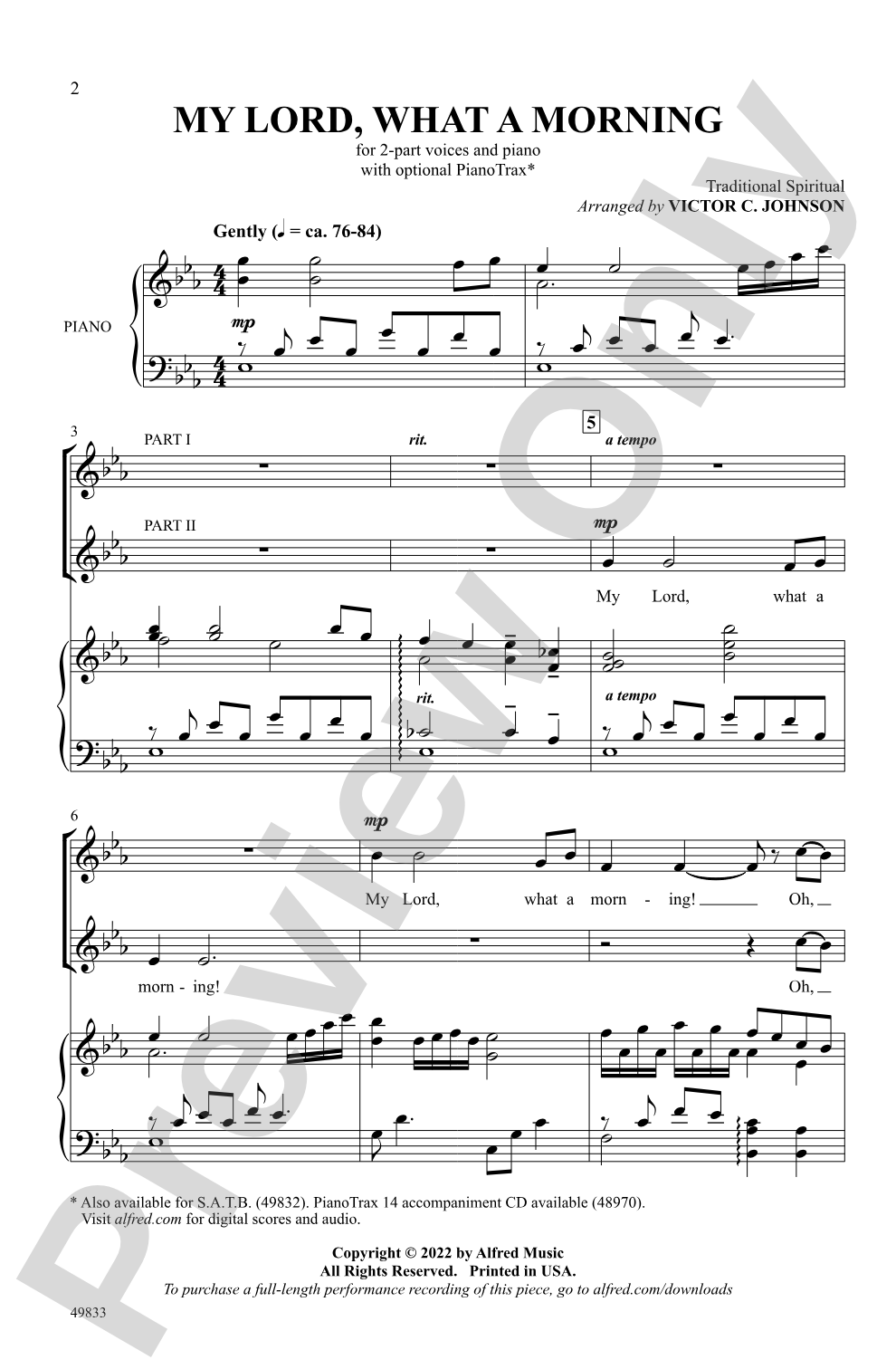
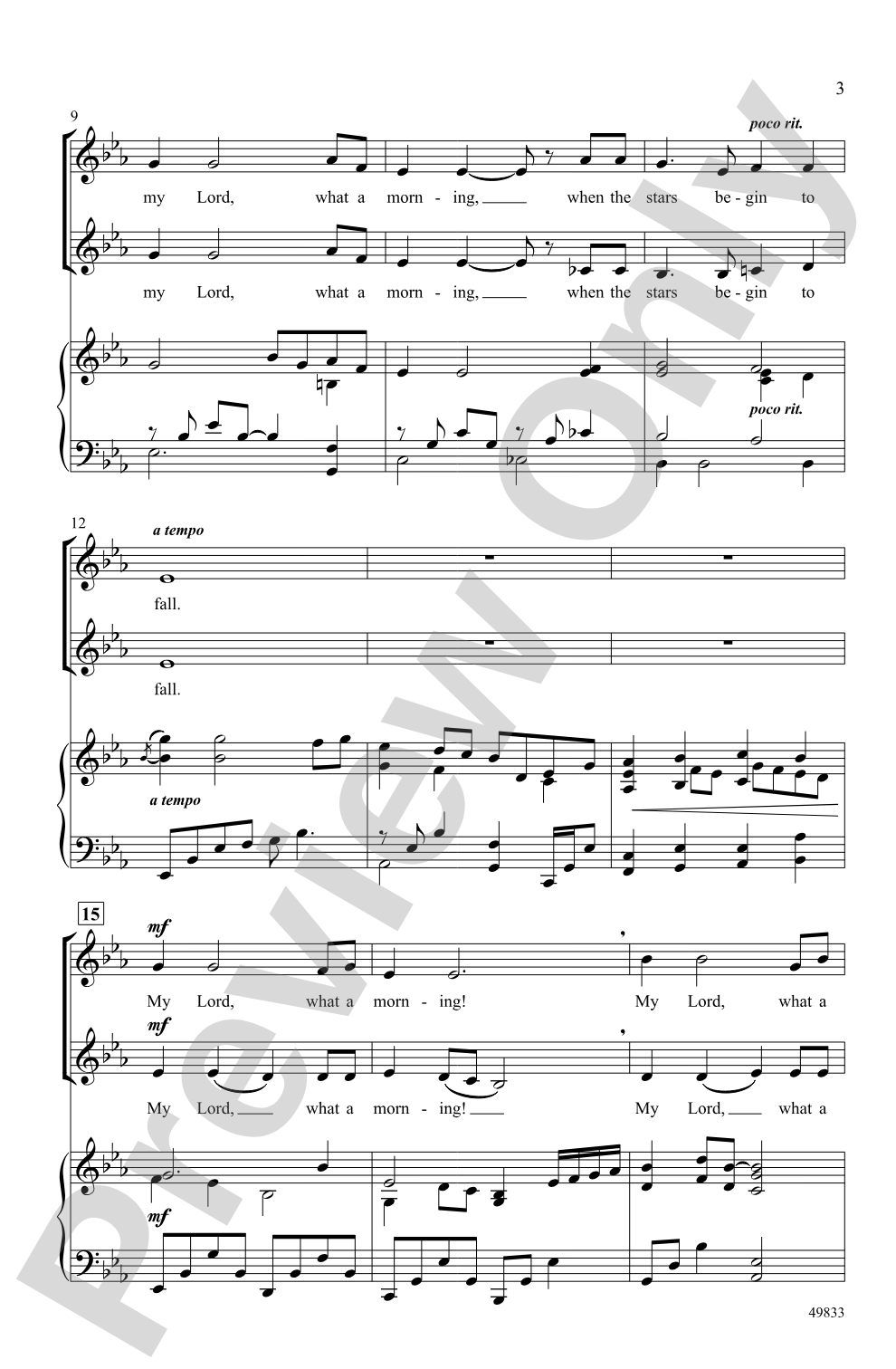
Here's a beloved American spiritual, sensitively prepared for school and church singers by Victor C. Johnson. The familiar strophic melody is fully arranged with progressively richer sonorities throughout. Expressive tempo markings stretch the final moment of every phrase and suggest more motion for the "hear the trumpet sound" verse. A lovely piano accompaniment does not double, but rather decorates the satisfying choral parts. A gentle gem that grows to an impressive height before a quiet conclusion.


My Lord, What a Morning: 2-Part Choral Octavo isn't in MakeMusic Cloud just yet...but it could be. Let us know you'd like to see it, and you'll help shape what comes next. In the meantime, start a free trial and dive into thousands of interactive titles your students can play along with today.
Request This Title
Tell us you want it.
Start Your Free Trial
Explore everything that's ready to play right now.
Sample Audio
1
Audio File
--:--
0:00
0:00
Sample Video
Additional Details
Series:
Alfred Choral Designs
Publisher:
Alfred Music
Page Count:
8
SKU:
00-PO-0006858
More about this title
About the Arranger: Victor C. Johnson

Victor C. Johnson brings decades of choral direction experience to his prolific arranging career. As School Choral Editor for Sing! (Choristers Guild's educational publishing arm), he oversees resources designed for singers at all levels. His extensive tenure directing choirs at Fort Worth Academy of Fine Arts, combined with his current role conducting the Dallas Symphony Children's Chorus, has deepened his understanding of what works in rehearsal and performance.
Why we love this
Johnson respects the spiritual's essential melody while refusing to leave it bare. His arrangement unfolds gradually, moving from straightforward two-part writing to richer textures that showcase how much color two voices can generate when the accompaniment is intelligent and independent. The piano part transforms from support to genuine conversation partner, giving singers something genuine to listen to rather than something that simply doubles their line.
What to expect
There's unhurried grace in this arrangement. The familiar melody carries spiritual weight, but Johnson's harmonic language keeps it from feeling static. As the sonorities deepen, the piece builds genuine emotional momentum, culminating in a reflective moment that feels both intimate and profound.
Who it's for
This arrangement suits school and church choirs seeking repertoire that respects singers' musicality without demanding advanced technique. The two-part writing makes it accessible to developing ensembles while the sophisticated accompaniment and expressive architecture reward choirs with more experience.
How to get the most out of it
- Shape the familiar melody with the expressive tempo markings Johnson provides; the phrase extensions aren't arbitrary, they're built into how the spiritual lands emotionally.
- Let the piano accompaniment breathe as its own voice. Conductors should listen as carefully to the keyboard part during rehearsals as they do to the singers, since it suggests harmonic color and pacing.
- Contrast the 'hear the trumpet sound' verse with lighter, more urgent motion; the score's tempo suggestion here changes the character significantly and shouldn't be overlooked.
- Save the fullest vocal resonance for the arrangement's peak moment, allowing the quiet conclusion to feel earned rather than abrupt.
How to use it
Program this as a centerpiece for a concert exploring American sacred music, where its familiar melody will resonate with audiences while its refined arrangement demonstrates musical depth. It works equally well in a combined concert with instrumental and choral repertoire, where it can provide a moment of genuine stillness and reflection.
Skills your students will build
- Singing with expressive tempo flexibility and phrase shaping
- Listening to and balancing with an independent piano accompaniment
- Sustaining two-part voicing while maintaining blend and intonation
- Differentiating energy and tempo within verses to serve text and emotional arc