

My Lord, What a Morning: SATB Choral Octavo
Traditional Spiritual / arr. Victor C. Johnson
Item: 00-PO-0006857
$2.05
Minimum order quantity: 20 copies
Pickup currently not available
Description
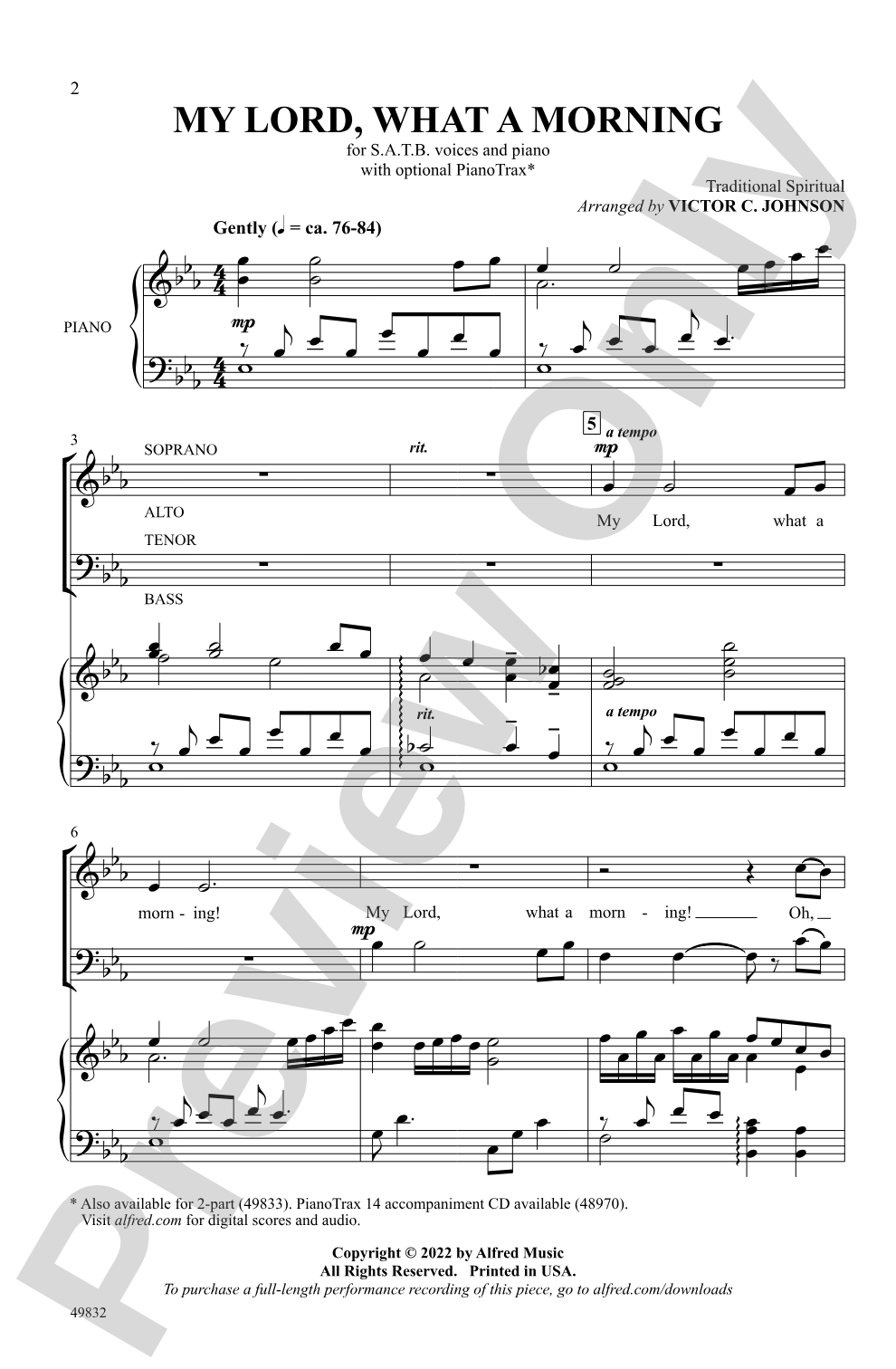
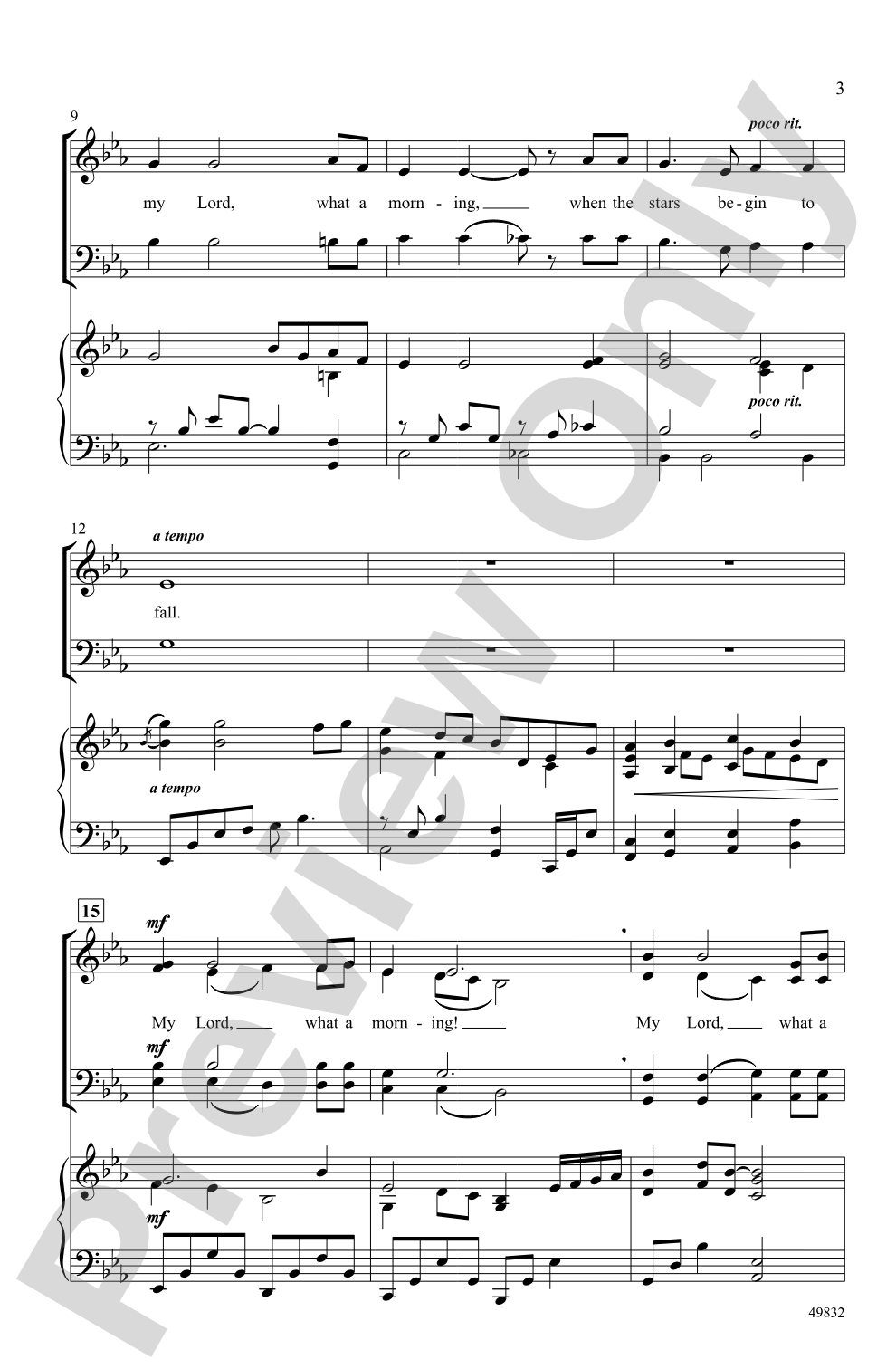
Here's a beloved American spiritual, sensitively prepared for school and church singers by Victor C. Johnson. The familiar strophic melody is fully arranged with progressively richer sonorities throughout. Expressive tempo markings stretch the final moment of every phrase and suggest more motion for the "hear the trumpet sound" verse. A lovely piano accompaniment does not double, but rather decorates the satisfying choral parts. A gentle gem that grows to an impressive height before a quiet conclusion.


My Lord, What a Morning: SATB Choral Octavo isn't in MakeMusic Cloud just yet...but it could be. Let us know you'd like to see it, and you'll help shape what comes next. In the meantime, start a free trial and dive into thousands of interactive titles your students can play along with today.
Request This Title
Tell us you want it.
Start Your Free Trial
Explore everything that's ready to play right now.
Sample Audio
1
Audio File
--:--
0:00
0:00
Sample Video
Additional Details
Series:
Alfred Choral Designs
Publisher:
Alfred Music
Page Count:
8
SKU:
00-PO-0006857
More about this title
About the Arranger: Victor C. Johnson

Victor C. Johnson, born and raised in Dallas, Texas, brings deep roots in American choral music to his work as School Choral Editor for Sing!, the educational publishing arm of Choristers Guild. His catalog spans over 500 published choral works, vocal solos, and keyboard pieces, reflecting a career shaped by hands-on experience directing young singers at every level.
From 2000 to 2018, Johnson served as choral director at Ft. Worth Academy of Fine Arts, where he built programs ranging from chamber ensembles to children's choirs. He currently conducts the Dallas Symphony Children's Chorus Mixed Ensemble for high school students and holds memberships in the American Choral Directors Association, Texas Music Educators Association, National Association for Music Education, and ASCAP.
Why we love this
Johnson's arrangement respects the spiritual's familiar strophic form while building emotional arc through orchestration alone. The piano part refuses to shadow the voices, instead weaving independent lines that enrich rather than support—a mark of writing crafted by someone who understands how school singers grow confident when the accompaniment complements instead of doubles. The structural economy (eight pages for a complete spiritual that works in concert or festival settings) makes this a smart choice for programming.
What to expect
The piece opens with quiet recognition of a beloved melody, then gradually deepens through richer harmonies that feel earned rather than imposed. There is a moment of brightness and movement in the middle before the arrangement pulls back to stillness, leaving singers and listeners with the intimacy of a spiritual fully voiced but never oversized.
Who it's for
School and church choirs singing at the intermediate to advanced level will find this arrangement accessible yet rewarding. SATB singers with secure part-reading skills and some experience with expressive phrasing will connect immediately with the spiritual's emotional arc and Johnson's sensitive orchestration.
How to get the most out of it
- Shape each phrase ending with the expressive tempo markings Johnson provides; they are not suggestions but integral to the piece's architecture.
- Balance the 'hear the trumpet sound' verse by following the markings for increased motion; this verse propels the arrangement forward after the gentler opening sections.
- Let the piano accompaniment breathe independently during sustained choral passages; the arrangement depends on this separation to avoid murkiness in the middle voices.
- Reserve your choir's fullest sound for the climactic moment Johnson builds toward, then honor the quiet conclusion to preserve the spiritual's reflective power.
How to use it
Program this as an anchor for a concert exploring American sacred music or as a festival selection where schools value pieces that combine accessibility with musical substance. The arrangement's eight-page length and strophic structure also make it useful for youth choir tours or community events requiring reliable material that sings well with limited rehearsal time.
Skills your students will build
- Reading expressive tempo markings and translating them into musical phrasing
- Balancing independent voice parts while maintaining awareness of the accompaniment's counterpoint
- Sustaining emotional presence in quiet passages and building intensity through harmonic color rather than volume
- Interpreting the spiritual tradition through arrangement choices that honor both tradition and artistic intent