

My Bonnie Lass: TBB, a cappella Choral Octavo
English Madrigal
Music by Thomas Morley, words by Michael Drayton / arr. Russell Robinson
Item: 00-PO-0000063

$1.65
Minimum order quantity: 20 copies
Pickup currently not available
Description
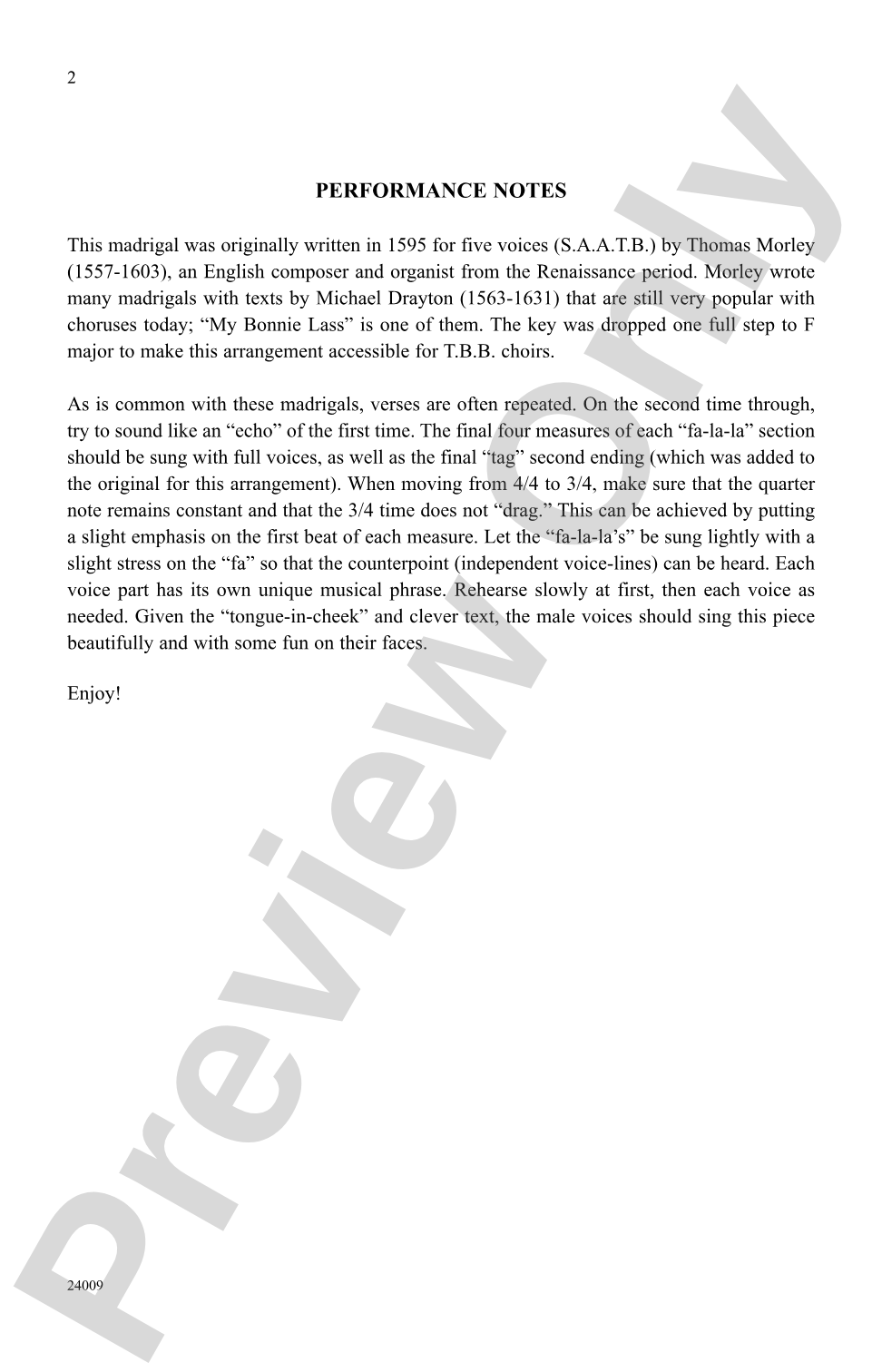
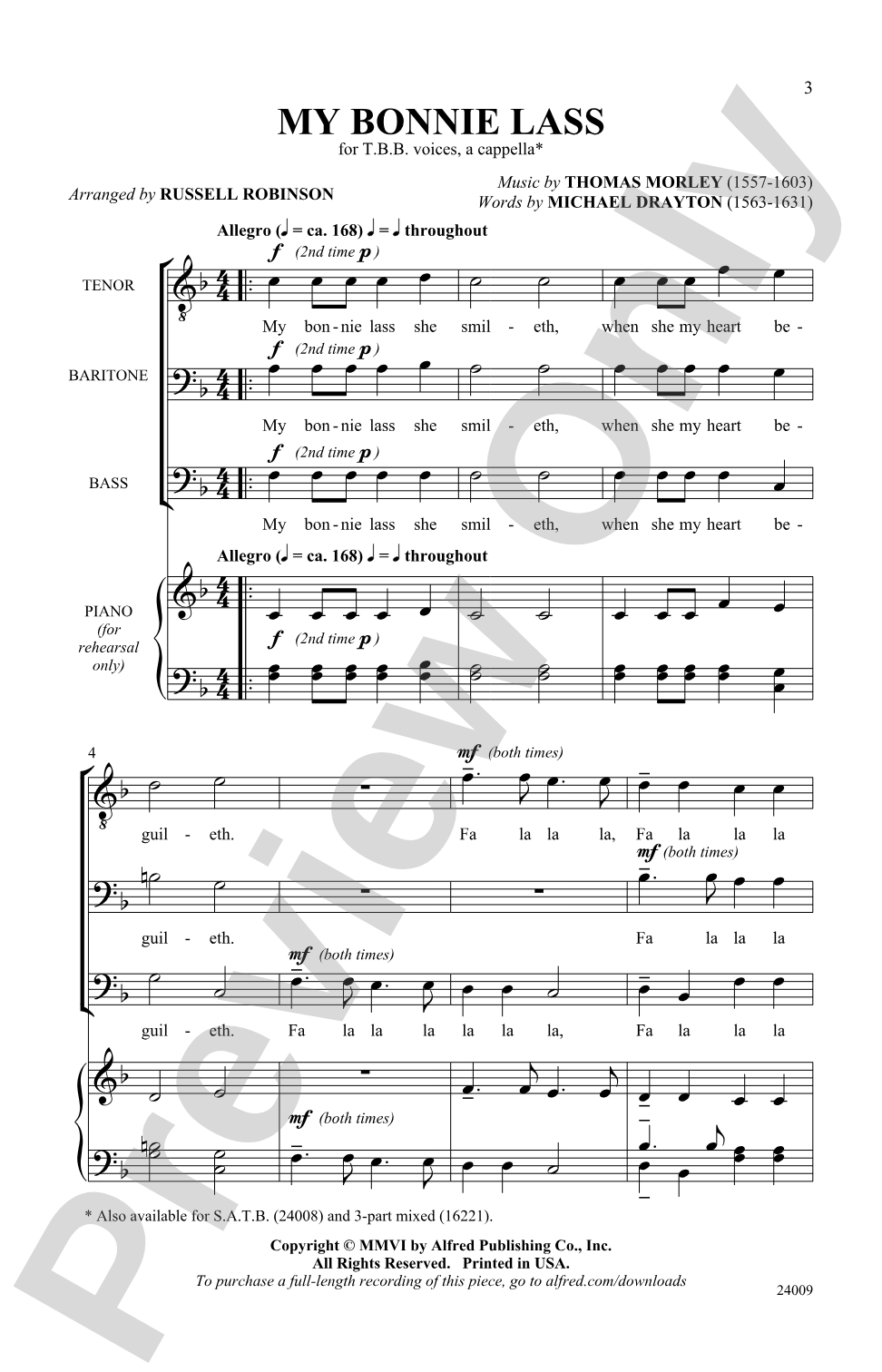
This arrangement of a favorite Thomas Morley madrigal, a popular choice in the 3-part voicing, is now available for SATB and TBB choirs. Bright tonalities and buoyant contrapuntal textures display the sound of Renaissance choral music. Another fine Robinson edition.


Don't just read it, hear it, play along with it, and watch your students grow with it. In MakeMusic Cloud, My Bonnie Lass: TBB, a cappella Choral Octavo comes alive with professional accompaniment, adjustable tempo, and built-in practice tools that turn solo practice into real progress.
Open in the Player
Jump straight in and assign it today.
Start Your Free Trial
Open this title and explore the full library in minutes.
Sample Audio
1
Audio File
--:--
0:00
0:00
Sample Video
No sample videos found.
Additional Details
Series:
Alfred Choral Designs
Publisher:
Alfred Music
Page Count:
12
SKU:
00-PO-0000063
More about this title
About the Composer: Thomas Morley
Thomas Morley (1557/1558–1602) was England's most celebrated madrigalist and a pivotal figure in bringing the Italian madrigal tradition to English shores. A student of William Byrd and later a Gentleman of the Chapel Royal, Morley composed over 180 madrigals alongside his work as an organist, music theorist, and publisher. His madrigals are marked by word-painting, rhythmic vitality, and a gift for setting English texts with natural, singable lines.
Morely's influence on English music education extends beyond his compositions. His treatise "A Plaine and Easie Introduction to Practicall Musicke" (1597) remains a foundational text for understanding Renaissance musical practice and pedagogy. His madrigals continue to anchor choral curricula because they demonstrate how to balance technical sophistication with immediate musicality.
Why we love this
Robinson's TBB voicing opens this staple madrigal to tenor-dominated ensembles without sacrificing the bright, contrapuntal character that makes the original so teachable. The arrangement preserves Morley's elegant text-setting and buoyant rhythmic momentum while sitting securely in the lower voices, making it an excellent vehicle for building vocal independence and Renaissance style awareness in male or mixed choirs.
What to expect
Bright, conversational, and delightfully contrapuntal. The three voices tumble over and under one another with the wit and charm characteristic of Renaissance madrigals, creating a sense of intimate musical dialogue. The <i>a cappella</i> texture lets the natural resonance of the voices shine, making the piece feel immediate and human.
Who it's for
Directors with TBB, TTB, or TTBB ensembles seeking authentic Renaissance choral literature that doesn't require transposition or significant adaptation. This arrangement also works for mixed choirs that want to feature their tenor section or reduce soprano demands while maintaining a full, resonant sound.
How to get the most out of it
- Clarify the imitative entrances by rehearsing each voice part separately first, then layer them one at a time to establish how each line interacts with the others.
- Shape phrases according to the text rather than bar lines; Renaissance madrigals breathe with the poetry, not the measure.
- Balance the parts so that no single voice dominates; the counterpoint works only when all three lines are equally present and clear.
- Keep the tempo buoyant and consistent. This madrigal thrives on forward momentum, not dragging or oversinging.
How to use it
Pair this with other Morley madrigals or Renaissance choral works to build a thematic concert section celebrating English vocal music. It also serves as an accessible entry point to Renaissance counterpoint for choirs moving beyond homophonic repertoire, or as a cheerful concert closer that leaves audiences smiling.
Skills your students will build
- Reading and performing imitative counterpoint
- Maintaining independent vocal lines while listening to others
- Renaissance text-setting and word-painting conventions
- Phrasing to poetic structure rather than bar lines
- A cappella intonation and blend in three-part voicing