

My Bonnie Lass: SATB, a cappella Choral Octavo
English Madrigal
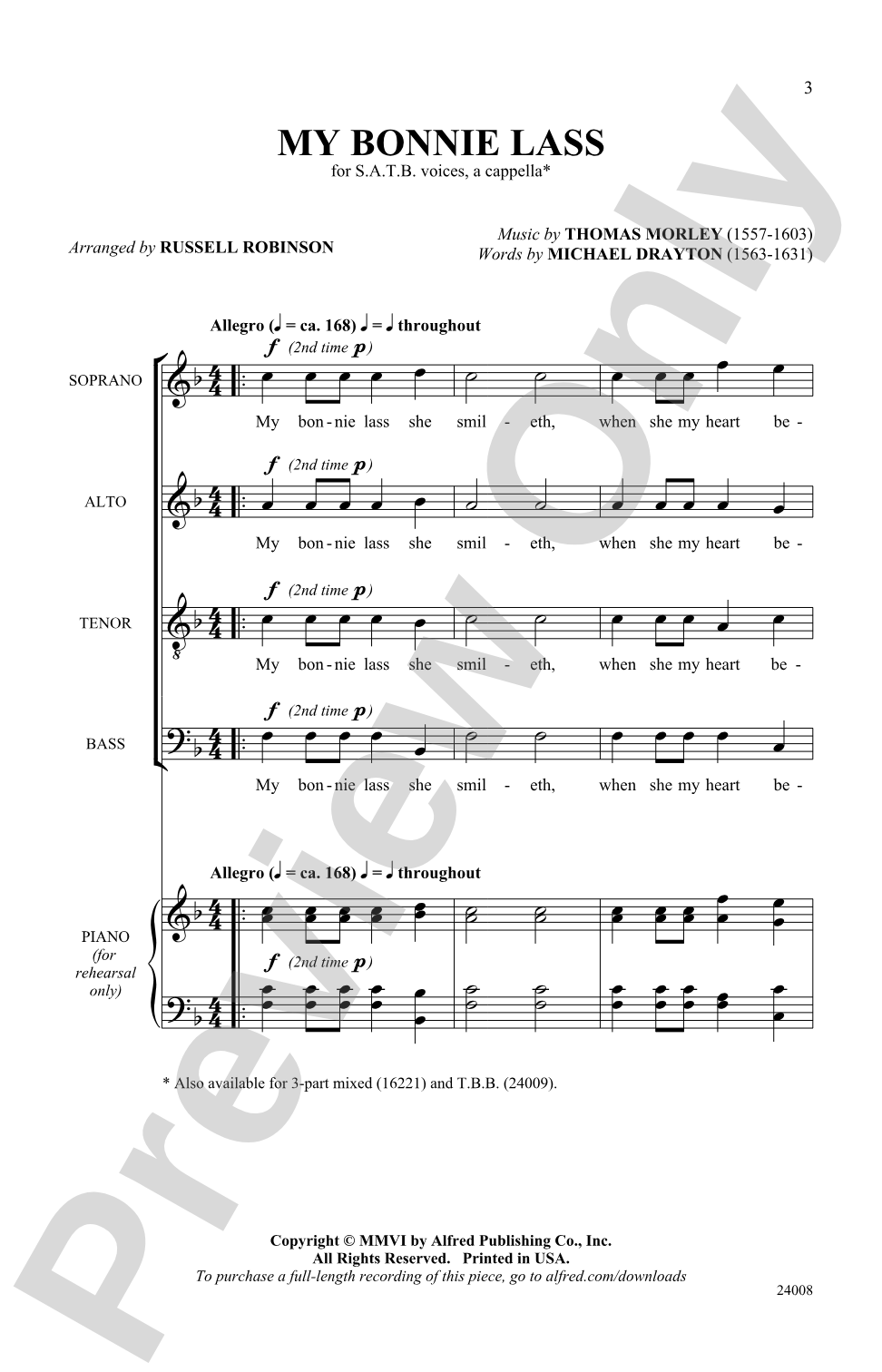
Music by Thomas Morley, words by Michael Drayton / arr. Russell Robinson
Item: 00-PO-0000062
$1.65
Minimum order quantity: 20 copies
Pickup currently not available
Description
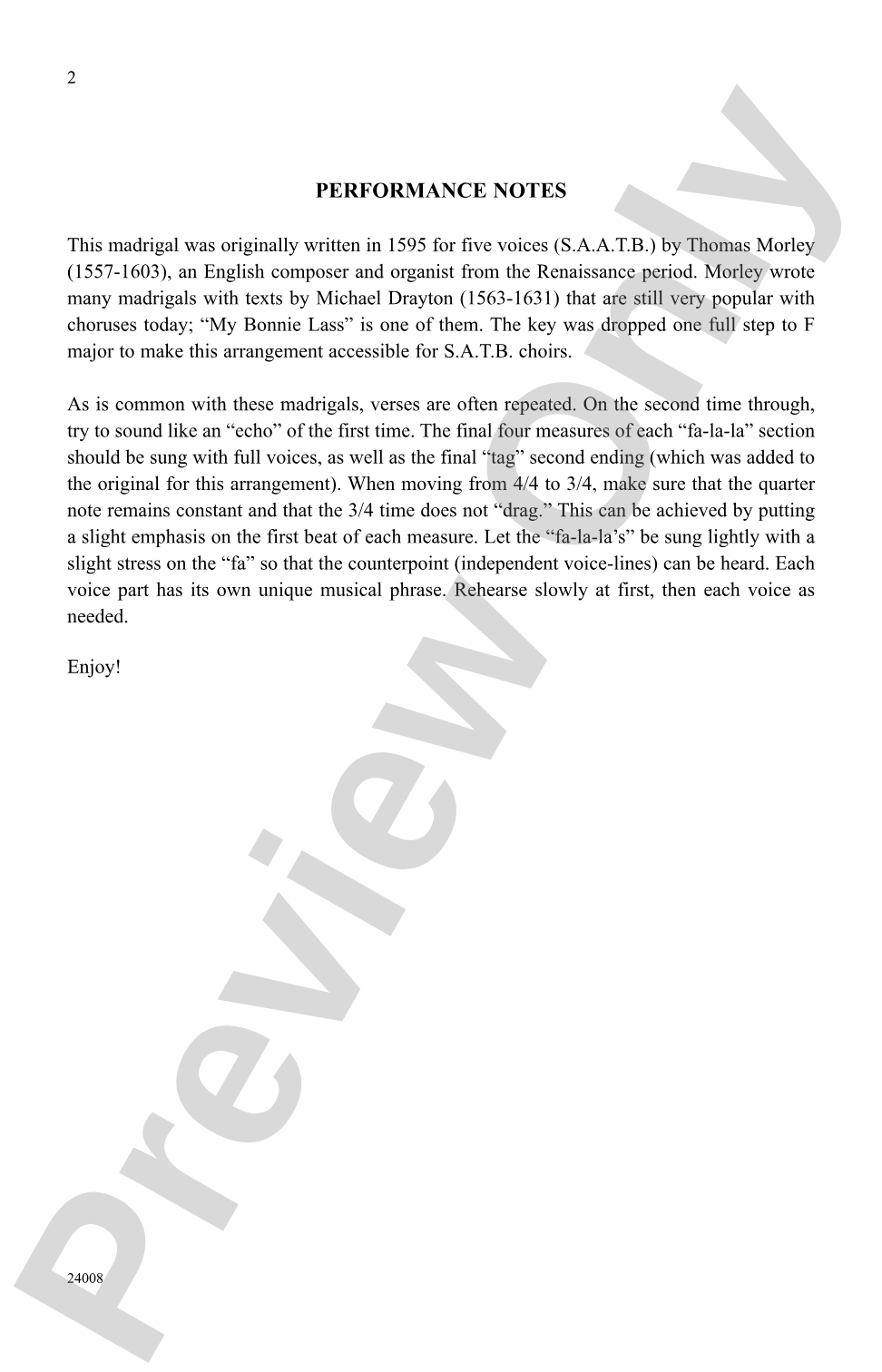
This arrangement of a favorite Thomas Morley madrigal, a popular choice in the 3-part voicing, is now available for SATB and TBB choirs. Bright tonalities and buoyant contrapuntal textures display the sound of Renaissance choral music. Another fine Robinson edition.


My Bonnie Lass: SATB, a cappella Choral Octavo isn't in MakeMusic Cloud just yet...but it could be. Let us know you'd like to see it, and you'll help shape what comes next. In the meantime, start a free trial and dive into thousands of interactive titles your students can play along with today.
Request This Title
Tell us you want it.
Start Your Free Trial
Explore everything that's ready to play right now.
Sample Audio
1
Audio File
--:--
0:00
0:00
Sample Video
No sample videos found.
Additional Details
Series:
Alfred Choral Designs
Publisher:
Alfred Music
Page Count:
12
SKU:
00-PO-0000062
More about this title
About the Composer: Thomas Morley
Thomas Morley (1557-1602) stands as one of the most prolific and influential English composers of the late Renaissance. A student of William Byrd, Morley became a master of the madrigal form, publishing several collections that shaped the English madrigal tradition and influenced generations of composers. His output ranged from intimate vocal works to keyboard music, but his madrigals remain his most enduring legacy, celebrated for their melodic wit, harmonic sophistication, and theatrical expressiveness.
Morely held significant positions in the musical establishment of his time, including roles as a court musician and organist. His published works circulated widely in England and abroad, making him one of the most recognizable composers of his era among both musicians and educated patrons. His madrigals exemplify the playful, often romantic character of the form while showcasing the technical mastery that defined Renaissance choral writing.
Why we love this
Russell L. Robinson's SATB arrangement opens this Renaissance gem to a broader range of choirs while preserving the elegance and buoyancy that make Morley's madrigals so satisfying to sing. The contrapuntal clarity and bright harmonic language remain immediately accessible to singers and audiences alike, making this a natural choice for festivals, contests, and concert programs that need polished, engaging repertoire with historical substance.
What to expect
Morley's madrigal sparkles with Renaissance charm and harmonic brightness. The a cappella texture allows the interweaving vocal lines to create a sense of intimate conversation, where clarity and buoyancy replace the grandeur of larger sacred works. Singers experience the satisfaction of precise ensemble alignment paired with genuine musical content that rewards careful attention to voice independence.
Who it's for
This arrangement suits SATB choirs at the intermediate level and above who are ready to engage with Renaissance repertoire and contrapuntal writing. It works equally well for concert choirs, chamber ensembles, and festival singers seeking material with authentic musical substance and strong audience appeal.
How to get the most out of it
- Approach the text with the playfulness inherent in madrigal tradition; avoid over-romanticizing what is fundamentally a witty, theatrical form.
- Balance the four voices so that melodic lines emerge clearly through the texture without any part overwhelming the others.
- Shape phrases according to the natural speech rhythm of the English text rather than forcing uniform phrasing across all voices.
- Use subtle dynamic shaping to highlight harmonic motion and the interplay of voices, which drives the forward momentum characteristic of Renaissance counterpoint.
How to use it
Position this alongside other madrigals or Renaissance secular works to create a thematic concert segment, or program it as a lighter contrast to more substantial choral works. It performs equally well as a festival selection or concert piece, and its accessibility makes it suitable for showing audiences the sophistication and wit of Renaissance vocal writing.
Skills your students will build
- Reading and performing independent melodic lines within four-part polyphonic texture
- Maintaining rhythmic independence between voices while achieving ensemble unity
- Shaping Renaissance-era phrase structure based on text accent and harmonic rhythm
- Balancing and blending four equal voices in a cappella setting
- Interpreting historically informed musical style and character of the madrigal form