
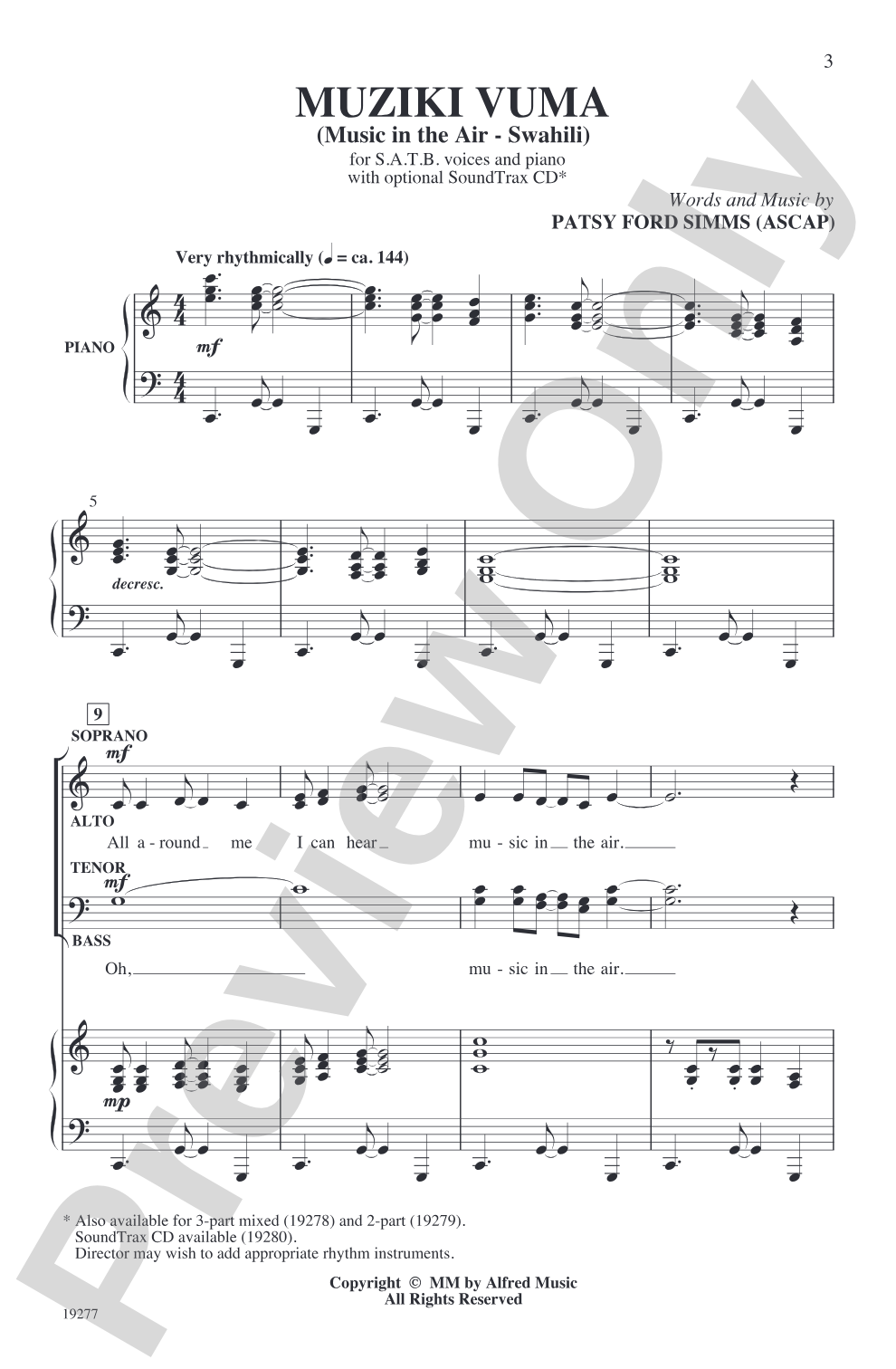
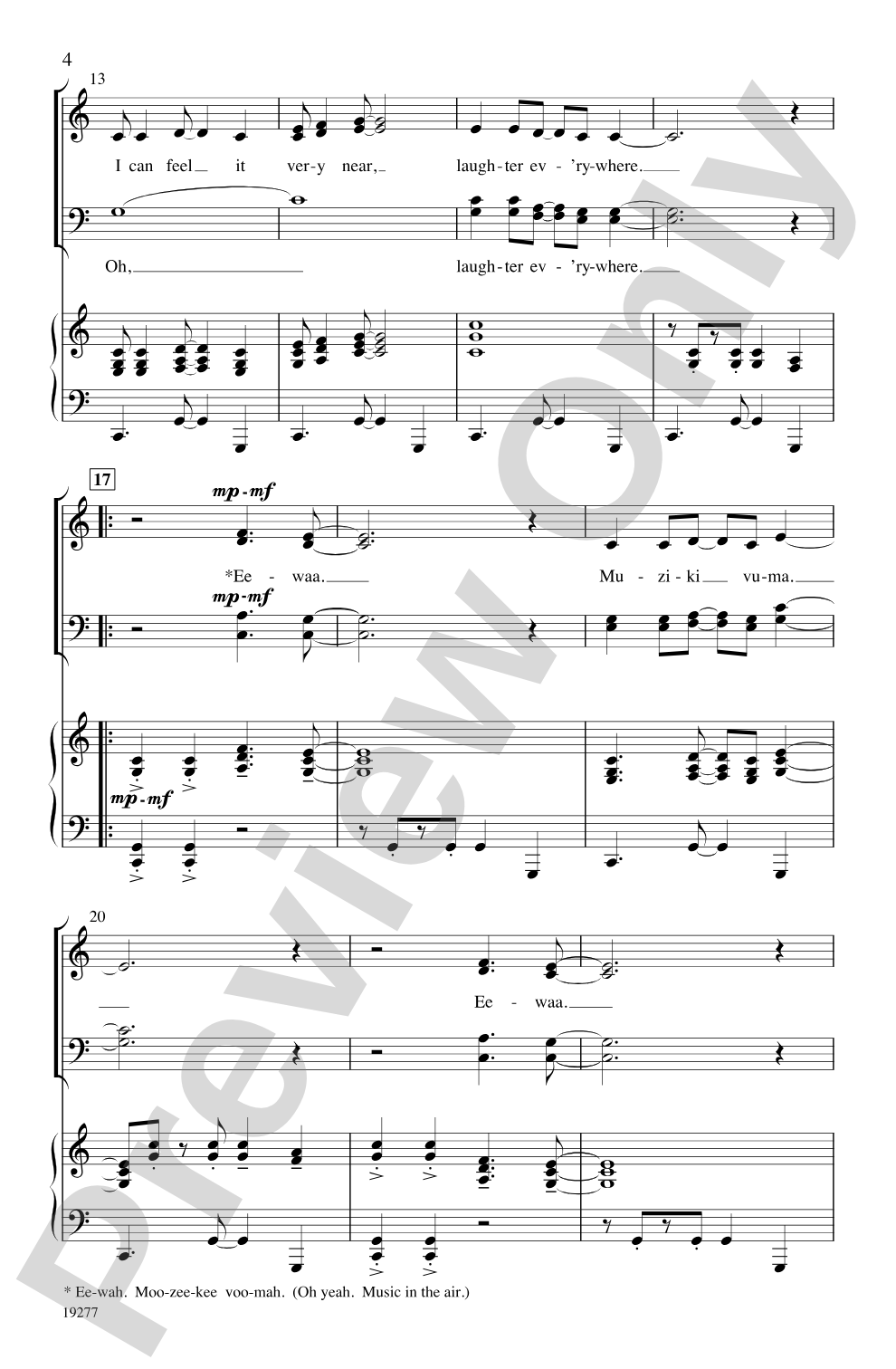

Muziki Vuma: SATB Choral Octavo
(Music in the Air -- Swahili)
Music by Patsy Ford Simms
Item: 00-PO-0006508
$2.25
Minimum order quantity: 20 copies
Pickup currently not available
Related Items
Muziki Vuma (Music in the Air - Swahili): 3-Part Mixed Choral Octavo |
$2.25
|
View | |
Muziki Vuma (Music in the Air - Swahili): 2-Part Choral Octavo |
$2.25
|
View | |
Muziki Vuma: SATB Choral Octavo |
$2.25
|
View | |
Muziki Vuma: 3-Part Mixed Choral Octavo |
$2.25
|
View | |
Muziki Vuma: 2-Part Choral Octavo |
$2.25
|
View | |
Muziki Vuma: Choral Octavo SoundTrax CD |
$27.99
|
View |
Description
Muziki Vuma means "music in the air" in Swahili, and the text of this infectious, cross-cultural piece is a combination of English and Swahili. It's rhythmic, with an African pulse, and the melodies reflect its African heritage. Rhythm instruments can be easily added, or use the African feel of the SoundTrax CD. Great for choirs of all ages; one of the three editions will be perfect for your group. A fun-to-sing, easy-to-learn cross-cultural piece for your general concerts. Included on Sally's "In the Spotlight!" Video, #19803.


Muziki Vuma: SATB Choral Octavo isn't in MakeMusic Cloud just yet...but it could be. Let us know you'd like to see it, and you'll help shape what comes next. In the meantime, start a free trial and dive into thousands of interactive titles your students can play along with today.
Request This Title
Tell us you want it.
Start Your Free Trial
Explore everything that's ready to play right now.
Sample Audio
1
Audio File
--:--
0:00
0:00
Sample Video
Additional Details
Series:
Alfred Archive Edition: Alfred Choral Designs
Publisher:
Alfred Music
Page Count:
12
SKU:
00-PO-0006508
More about this title
About the Composer: Patsy Ford Simms
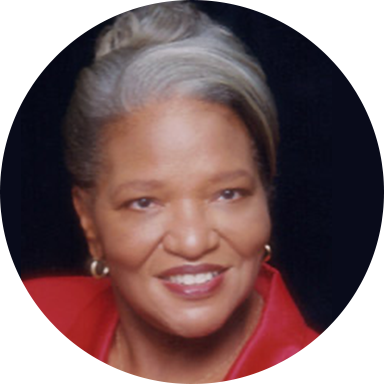
Patsy Ford Simms began composing and arranging during her teaching career when she recognized a shortage of accessible choral literature for junior high and middle school singers. She holds a Bachelor of Science in Music Education from Knoxville College, a Master of Education from the University of Louisville, and a doctorate in Music Education from Columbia Pacific University. Over her 30 years teaching in grades K-12, including time at the Youth Performing Arts School, she has published more than 300 songs across educational and church markets.
Simms has established herself as an internationally recognized arranger, composer, and clinician, presenting her work in Italy and Africa. Her compositions include commissioned pieces and musical works centered on African American history. Two of her pieces were selected for MENC World's Largest Concerts, and she has received multiple ASCAP Special Music Awards for her contributions to music education.
Why we love this
Simms writes specifically for singers who are still building confidence and technique, and this piece proves she understands what makes a song stick with a choir. The blend of English and Swahili text combined with an infectious rhythmic pulse creates something genuinely fun to rehearse and perform, not just educational. You'll find your singers asking to sing it again immediately after learning it.
What to expect
Muziki Vuma pulses with infectious joy and rhythmic vitality. The African melodic contours and the interplay of English and Swahili text create an immediate sense of cultural celebration, while the accessibility of the harmonic language lets singers focus on enjoying the groove rather than wrestling with complexity.
Who it's for
This octavo works beautifully for developing choirs of any age who need repertoire that energizes singers without overwhelming them technically. It's especially valuable for middle school and junior high ensembles seeking repertoire that celebrates global music while remaining straightforward to learn.
How to get the most out of it
- Emphasize the rhythmic precision in the African pulse; even when parts layer, the groove stays tight and grounded.
- Bring in unpitched percussion (shakers, drums, cowbell) if available to reinforce the piece's cross-cultural character and add textural depth.
- Shape the English and Swahili phrases as distinct musical moments; the language shifts can become a natural interpretive tool rather than a technical hurdle.
- If using the recorded accompaniment, rehearse sections both with and without it so singers can internalize their parts and feel secure standing alone.
How to use it
Program this as a concert opener or a high-energy moment in a spring or end-of-year concert; its buoyant character lifts audiences and creates an immediate sense of celebration. It pairs naturally with other world music selections or works well as a standalone showcase of multicultural repertoire in a general audience concert.
Skills your students will build
- Singing rhythmic precision within a steady African pulse
- Blending languages (English and Swahili) with clear diction in both
- Maintaining rhythmic independence while listening to other parts
- Responding to percussion and rhythmic accompaniment