
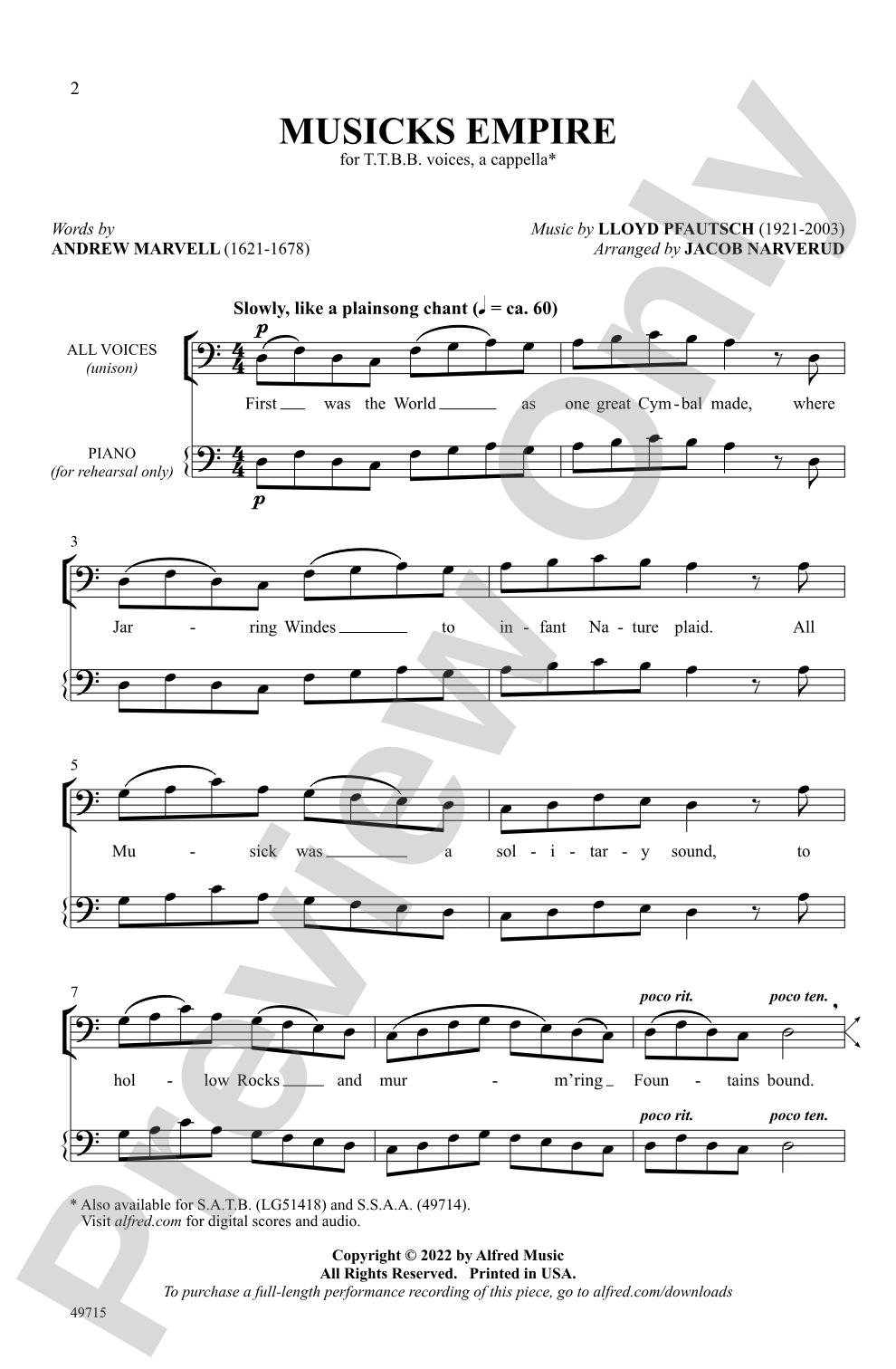
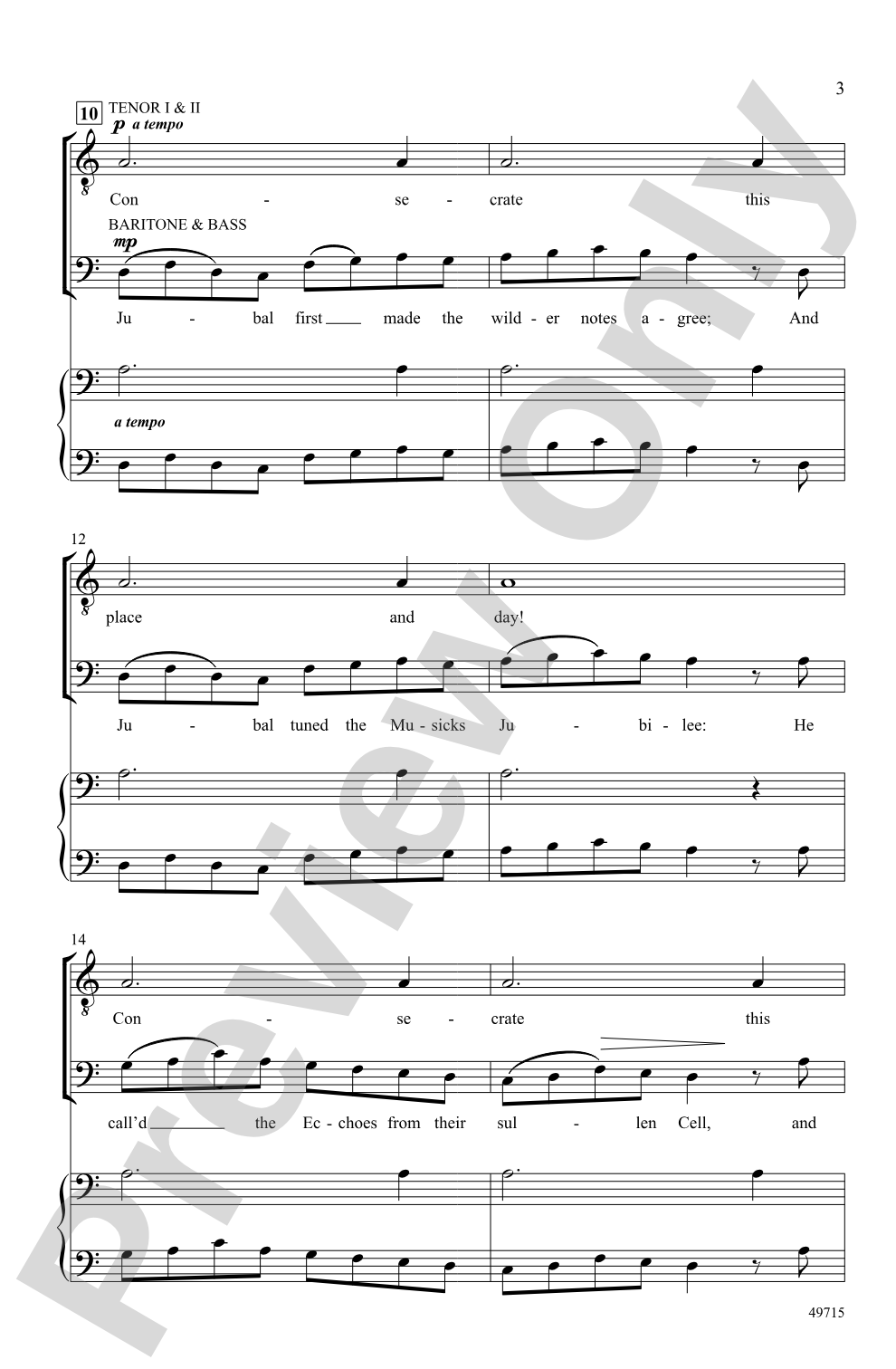
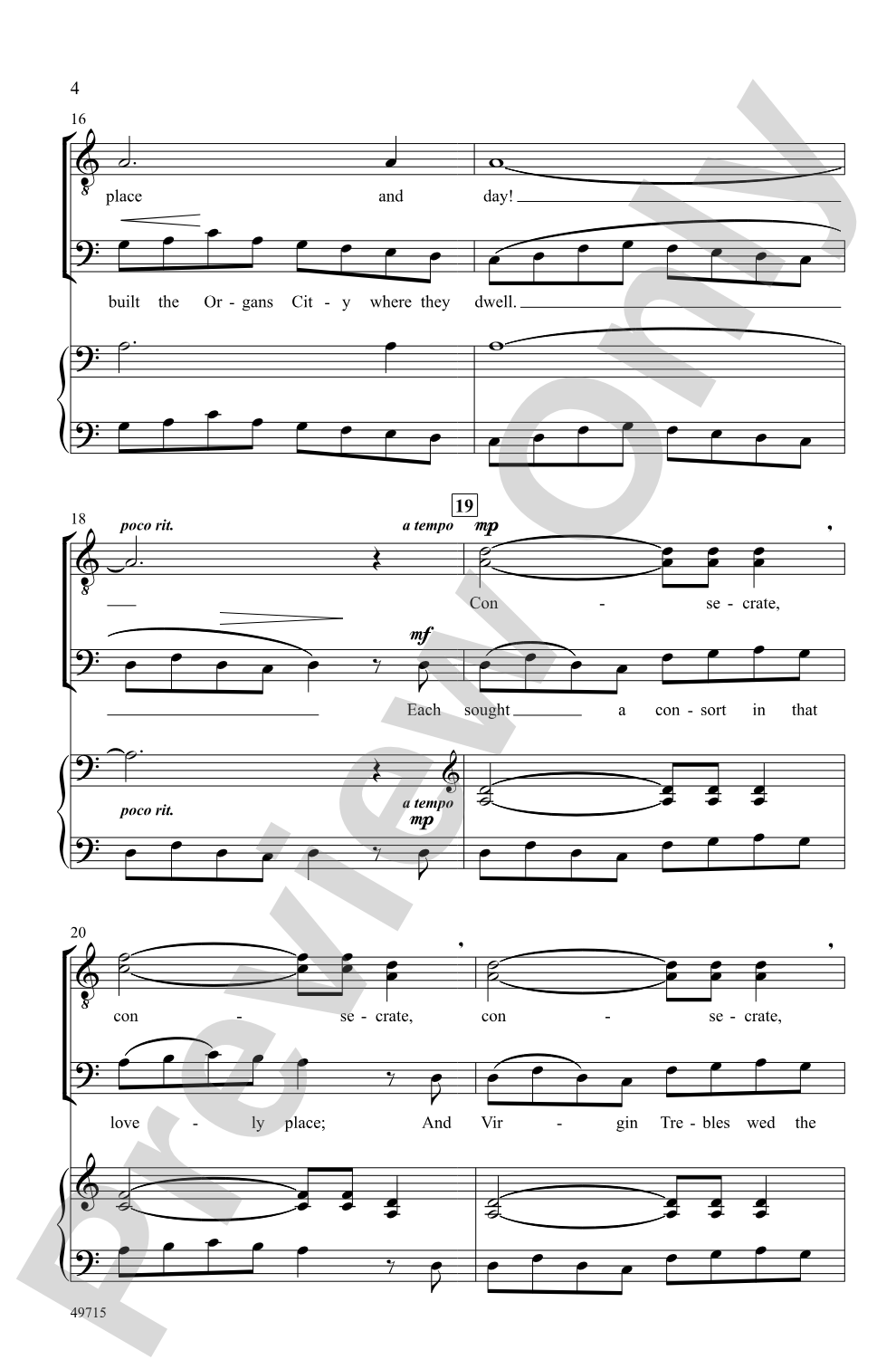

Musicks Empire: TTBB, a cappella Choral Octavo
Words by Andrew Marvell, music by Lloyd Pfautsch / arr. Jacob Narverud
Item: 00-PO-0006919
$2.05
Minimum order quantity: 20 copies
Pickup currently not available
Description
A tour de force cornerstone of choral literature. Lloyd Pfautsch's remarkable setting of the 17th-century poem by Andrew Marvell continues to be a popular choice with contest, festival, and collegiate choirs. Lawson-Gould is proud to present new voicings of this a cappella staple, as realized by contemporary composer/conductor Jacob Narverud. Notably authentic, with the original vocal lines still intact.


Musicks Empire: TTBB, a cappella Choral Octavo isn't in MakeMusic Cloud just yet...but it could be. Let us know you'd like to see it, and you'll help shape what comes next. In the meantime, start a free trial and dive into thousands of interactive titles your students can play along with today.
Request This Title
Tell us you want it.
Start Your Free Trial
Explore everything that's ready to play right now.
Sample Audio
1
Audio File
--:--
0:00
0:00
Sample Video
Additional Details
Series:
Lawson-Gould
Publisher:
Alfred Music
Page Count:
12
SKU:
00-PO-0006919
More about this title
About the Composer: Lloyd Pfautsch
Lloyd Pfautsch (1920-2005) was a towering figure in American choral music, known for settings that balance technical sophistication with emotional directness. His decades of work as a conductor, composer, and teacher at Southern Methodist University shaped a generation of choral musicians who learned from his belief that great choral writing serves the text first and foremost.
Pfautsch's catalogue spans sacred and secular repertoire, but his secular works have proven especially durable in the competitive and festival circuit. His arrangements and original compositions are studied in college conducting courses as models of voice leading and textural clarity. Musicks Empire stands among his most frequently performed pieces, a testament to his gift for matching musical architecture to poetic structure.
Why we love this
Pfautsch's original setting has long been the gold standard for this Marvell text, and Narverud's new voicings preserve every ounce of that artistry while opening the piece to more choirs. The revoicing maintains the integrity of the original lines but distributes the tessitura in ways that work better for real singers. This is a piece that wins contests and sticks with audiences, and now it's genuinely more singable without losing its sophistication.
What to expect
Marvell's reflection on time, empire, and the relentless march of history finds its perfect complement in Pfautsch's harmonically sophisticated yet deeply human setting. The piece moves between moments of meditative beauty and more dramatic, almost defiant gestures, creating an emotional arc that feels both urgent and timeless. Singers often report that learning this piece changes how they think about text-painting and choral expression.
Who it's for
This is essential repertoire for advanced high school choirs with strong musicianship, collegiate ensembles at all levels, and adult community choirs with contest or festival ambitions. The revoicing by Narverud makes it accessible to choirs that might have struggled with the original's tessiture without sacrificing the piece's intellectual and artistic demands.
How to get the most out of it
- Treat the text with the clarity and precision it deserves; Marvell's language is dense and philosophical, so articulation and diction choices matter enormously to comprehension.
- Balance the texture carefully in passages where Narverud redistributes the harmonic load across voices; avoid letting any single part overpower the architectural design.
- Work the final cadential phrases with attention to breath placement and phrase shape; the ending demands control and intentionality.
- Invest rehearsal time in the middle sections where the harmonic language becomes most intricate; this is where the piece earns its reputation.
How to use it
Program this as a centerpiece of a concert devoted to American choral literature or pair it with other substantial secular repertoire to demonstrate the range and depth of your ensemble's capabilities. It works equally well in contest and festival contexts, where its combination of musicianship, text clarity, and artistic maturity consistently impresses adjudicators and audiences.
Skills your students will build
- Singing in multiple voice parts within the TTBB texture, including revoiced harmonic passages
- Diction and text comprehension in early modern English poetry
- Understanding advanced harmonic language and voice leading in a cappella writing
- Sustaining lyrical lines while maintaining accurate tuning in complex harmonies
- Balancing individual vocal line integrity with ensemble blend