
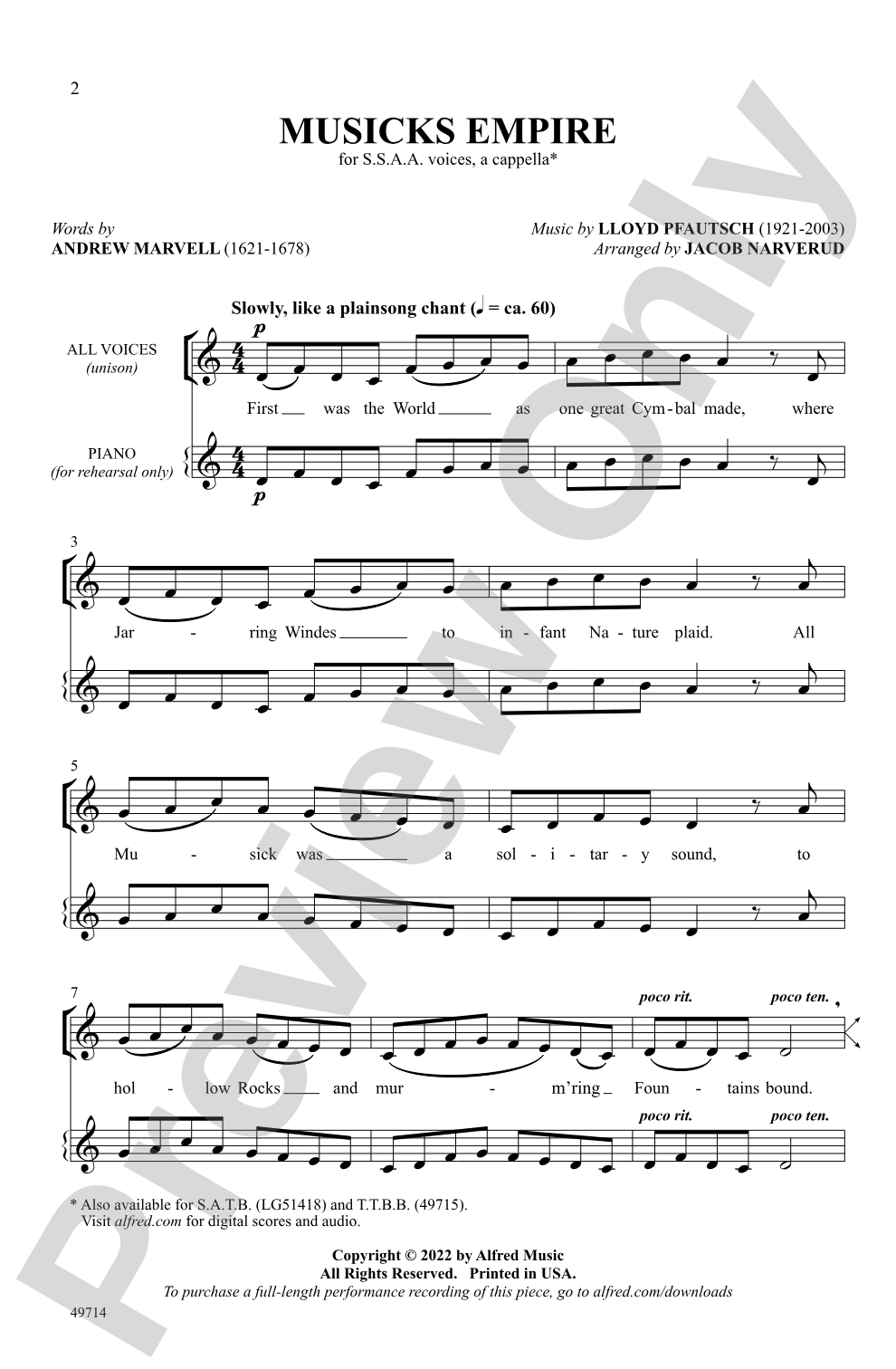
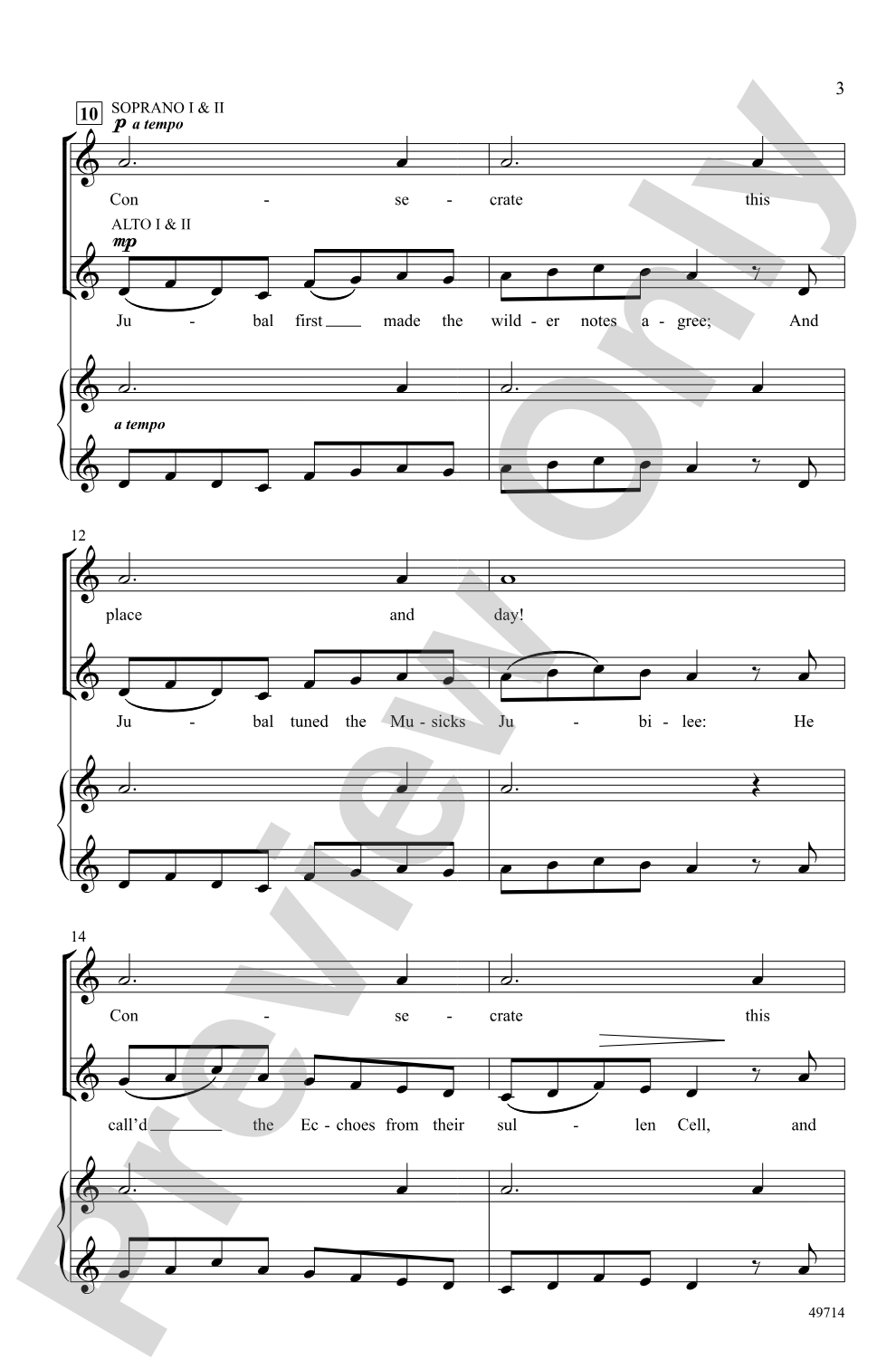
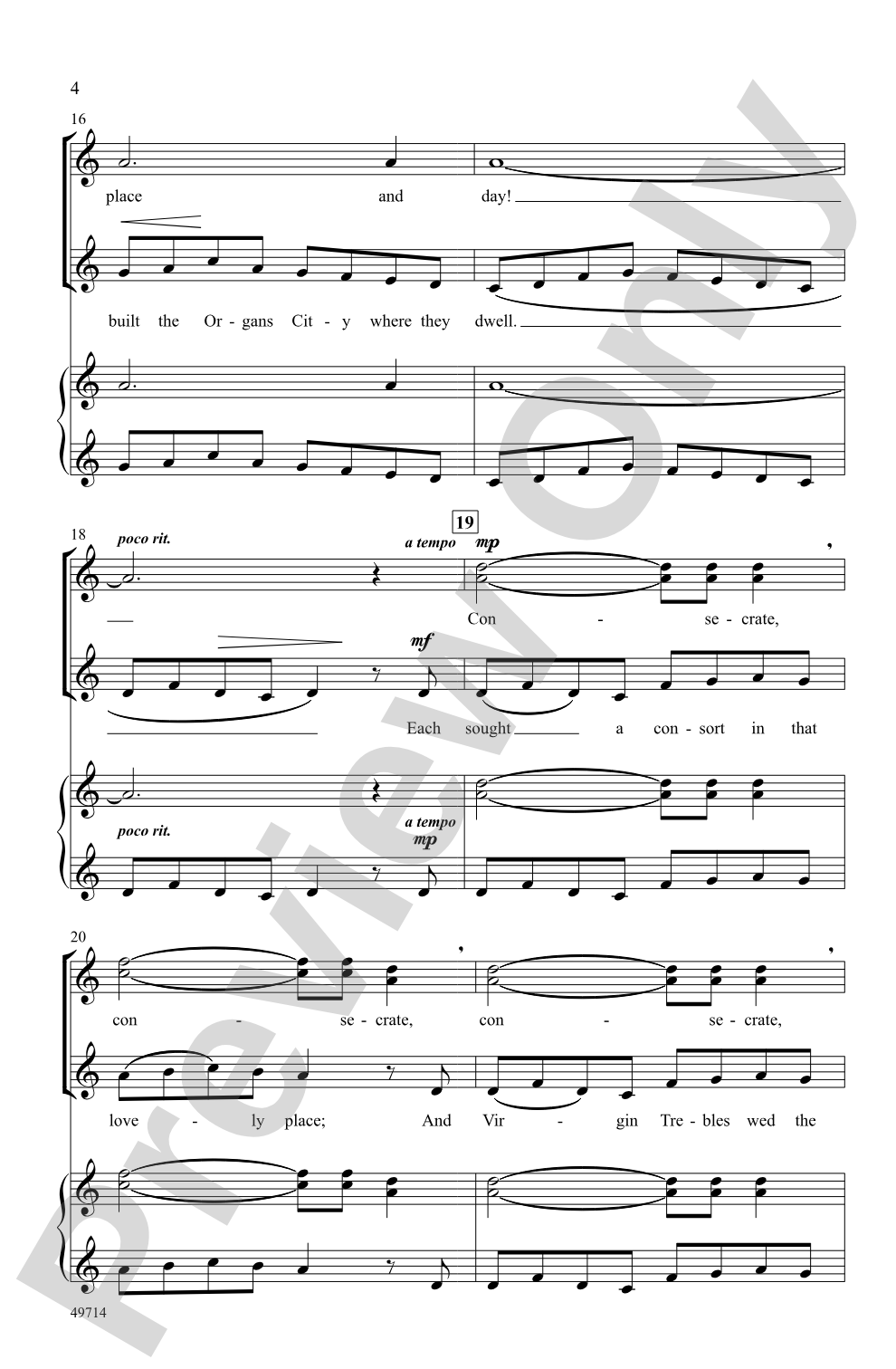

Musicks Empire: SSAA, a cappella Choral Octavo
Words by Andrew Marvell, music by Lloyd Pfautsch / arr. Jacob Narverud
Item: 00-PO-0006918
$2.05
Minimum order quantity: 20 copies
Pickup currently not available
Description
A tour de force cornerstone of choral literature. Lloyd Pfautsch's remarkable setting of the 17th-century poem by Andrew Marvell continues to be a popular choice with contest, festival, and collegiate choirs. Lawson-Gould is proud to present new voicings of this a cappella staple, as realized by contemporary composer/conductor Jacob Narverud. Notably authentic, with the original vocal lines still intact.


Musicks Empire: SSAA, a cappella Choral Octavo isn't in MakeMusic Cloud just yet...but it could be. Let us know you'd like to see it, and you'll help shape what comes next. In the meantime, start a free trial and dive into thousands of interactive titles your students can play along with today.
Request This Title
Tell us you want it.
Start Your Free Trial
Explore everything that's ready to play right now.
Sample Audio
1
Audio File
--:--
0:00
0:00
Sample Video
Additional Details
Series:
Lawson-Gould
Publisher:
Alfred Music
Page Count:
12
SKU:
00-PO-0006918
More about this title
About the Composer: Lloyd Pfautsch
Lloyd Pfautsch (1921-2010) was a choral conductor and composer whose settings of sacred and secular texts became foundational repertoire for American choirs at every level. His decades teaching at Southern Methodist University shaped generations of musicians who carried his disciplined approach to textual clarity and vocal writing throughout their careers. Pfautsch understood how to build sophisticated harmonic language that remained singable, a quality that made his work essential in choral classrooms and concert halls alike.
Beyond the studio, Pfautsch's legacy rests in pieces that endure because they solve real musical problems while delivering genuine artistry. His setting of Marvell's "The Garden" stands as proof that a cappella writing need not be sparse or austere to be powerful. The work demonstrates how carefully voiced counterpoint and tonal clarity can convey the intellectual and sensory richness of 17th-century poetry in a modern idiom.
Why we love this
Pfautsch's original voicings are intact, which means you're preserving the architectural thinking that made this piece a competition standard and classroom staple. Jacob Narverud's recasting for SSAA opens the work to choirs whose voice distributions differ from traditional SATB configurations, without compromising the contrapuntal clarity that audiences recognize immediately. Few secular a cappella pieces achieve this balance of accessible engagement and genuine musical substance.
What to expect
The piece moves between moments of intricate vocal counterpoint and passages where voices lock into rich harmonic sonorities, creating a sense of intellectual meditation interrupted by passages of vivid sensory detail. Andrew Marvell's meditation on the garden translates musically as cycles of geometric precision and lyrical release. The overall effect is contemplative yet never static, grounded in language that feels both archaic and immediate.
Who it's for
Advanced high school choirs and collegiate ensembles preparing for contest, festival, or concert performance will find this a natural choice for program diversity and musical growth. Directors seeking a secular work that demonstrates serious craft and rewards sustained rehearsal investment will recognize Pfautsch's signature balance of accessibility and depth. Choirs with strong soprano sections and flexible middle voices will benefit most from the SSAA voicing.
How to get the most out of it
- Shape the text according to Marvell's syntax, not just the musical phrases. Attend to where the poem breathes and pivots, which often diverges from where Pfautsch's voice leading wants to settle.
- Anchor the piece in the lowest voice part (second soprano when functioning as a bass line). This foundation supports the entire harmonic structure and prevents the a cappella sound from becoming weightless.
- Mark dynamic contours measure by measure rather than relying on general expression markings. The counterpoint demands precise relative balances between parts to stay audible without oversinging.
- Record a rehearsal performance early in your preparation. Listening back reveals whether text clarity has been achieved and where blend is still muddied by unequal vowel formation across voices.
How to use it
Position this as a centerpiece in a concert section built around secular texts or Renaissance-to-modern literary settings. Its moderate length and concert-appropriate difficulty make it a natural contrast after a substantial sacred work or before a lighter closing number. The piece also rewards scheduling on a festival program where judges and audience will recognize its standing in the choral canon and hear how your particular singers inhabit Pfautsch's sophisticated writing.
Skills your students will build
- Reading and executing divisi passages and independent voice lines in a cappella texture
- Balancing soprano prominence with supporting harmonic voices in all-treble voicing
- Sustaining pure vowels and smooth voice leading across rests and unison moments
- Interpreting text-driven phrasing that operates independently from musical cadences
- Intonation stability in chromatic and modal harmonic language without instrumental support