
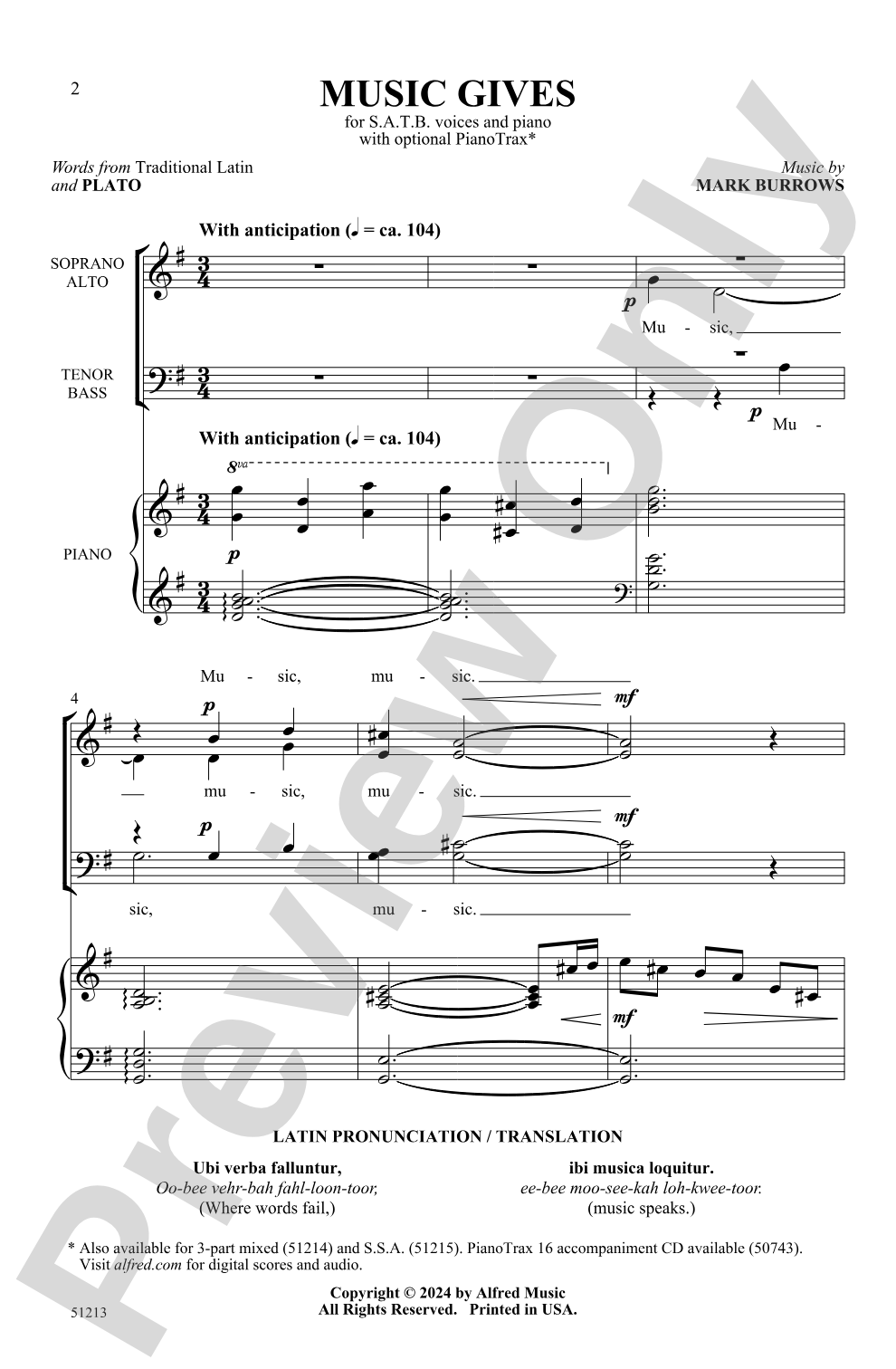
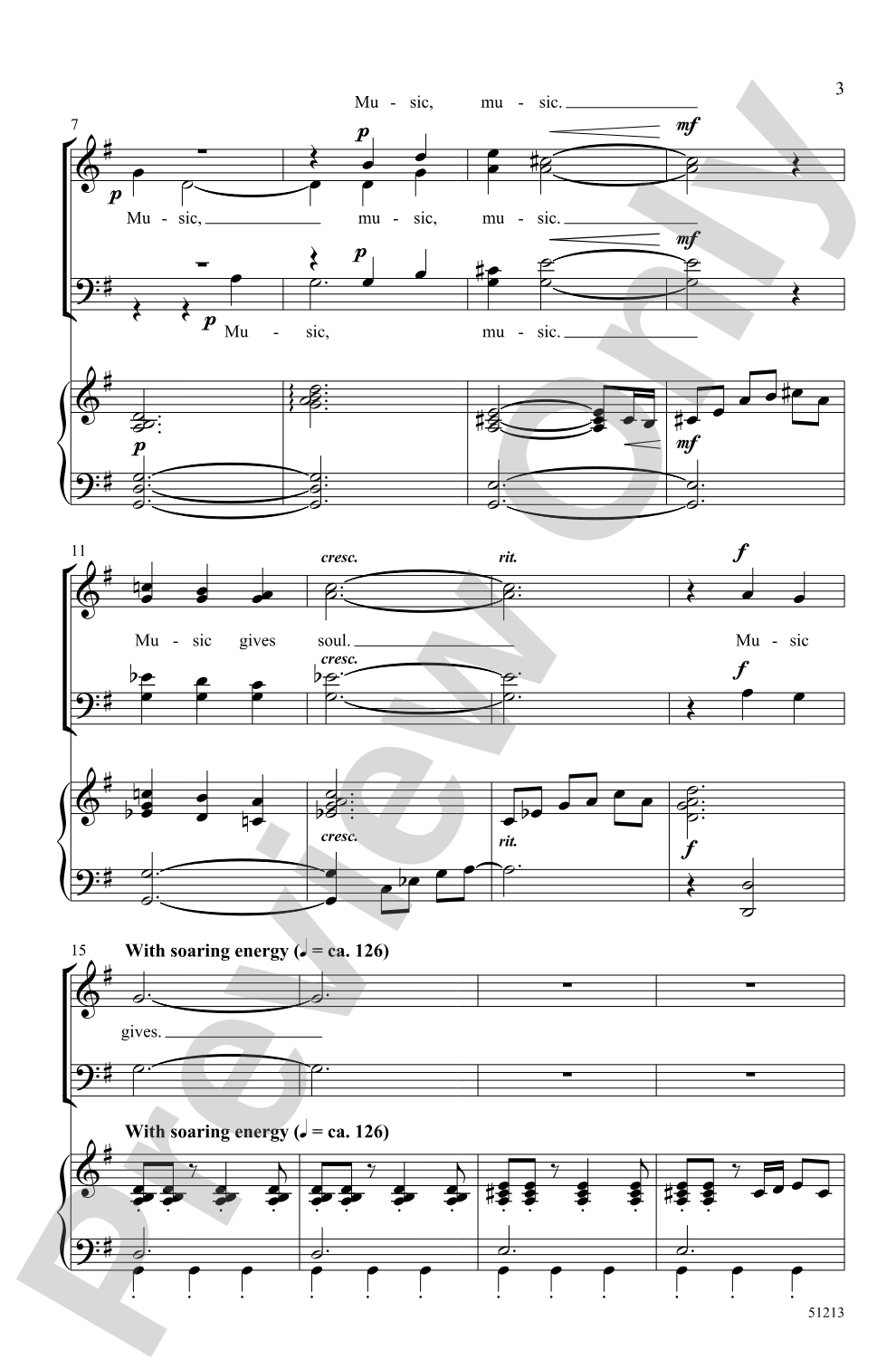
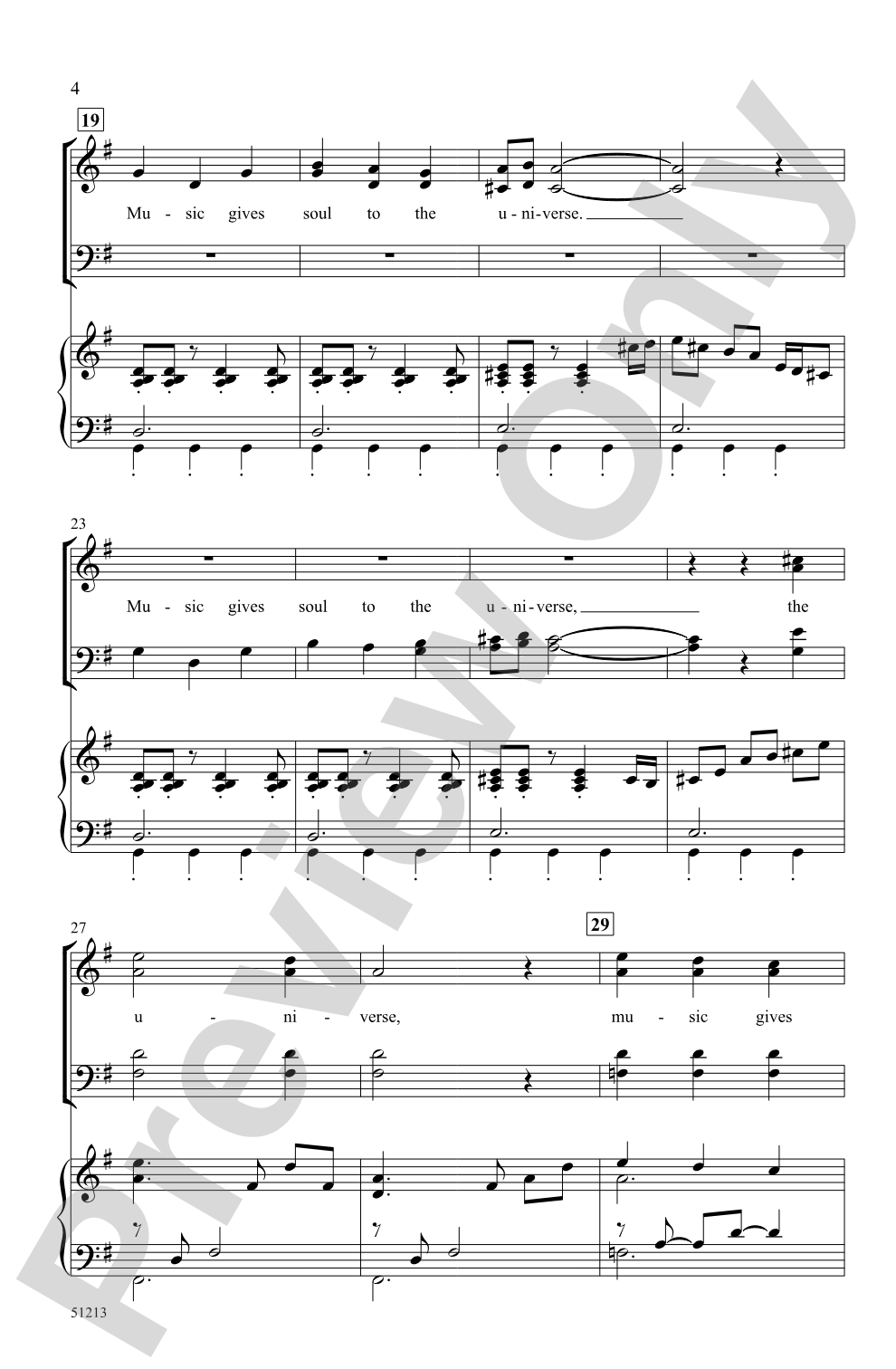

Music Gives: SATB Choral Octavo
Words from Traditional Latin and Plato, music by Mark Burrows
Item: 00-PO-0007257
$2.30
Minimum order quantity: 20 copies
Pickup currently not available
Description
"Music gives . . . life to everything." Powerful words by Plato are given a contemporary sound in this buoyant piece by Mark Burrows. Soaring with radiant energy, it uses colorful harmonies and a driving 3/4 meter to extol the virtues of music. A central chant-like section sets the familiar phrase "Where words fail, music speaks" in Latin. Highly recommended for concert, contest, or festival.


Discover MakeMusic Cloud: thousands of interactive titles your students can play along with today.
Sample Audio
1
Audio File
--:--
0:00
0:00
Sample Video
Additional Details
Series:
Alfred Choral Designs
Publisher:
Alfred Music
Page Count:
12
SKU:
00-PO-0007257
More about this title
About the Composer: Mark Burrows
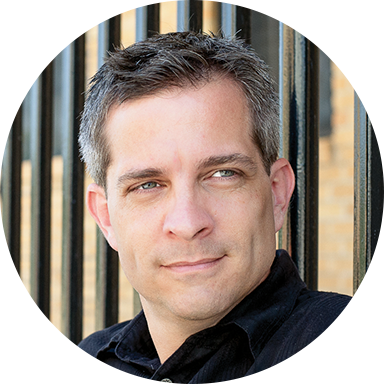
Mark Burrows composes for ensembles across the spectrum, from children's choirs to adult festival groups, and his catalogue appears regularly on state and festival adjudication lists. His music is published through major houses, and he fields multiple commissions annually from educational and community choirs. He holds degrees in music education from Southern Methodist University and conducting from Texas Christian University, and he directs children's music ministries at FUMC in Fort Worth, where he lives with his family.
Why we love this
Burrows pairs a text of genuine substance—Plato's meditation on music's power—with writing that feels contemporary rather than reverent. The 3/4 meter and radiant harmonic language give the piece an irresistible forward momentum, and the strategic placement of the Latin text creates a moment of introspection that makes the return to the main material land with renewed force. This works equally well in concert or festival settings because it honors both the music and the message.
What to expect
The piece radiates an optimistic, forward-moving energy, driven by its 3/4 pulse and shimmering harmonic movement. The central Latin section quiets that momentum into something more meditative and grounded, creating a dynamic arc that mirrors the text's own meditation on what music accomplishes. By the return, the radiant quality feels earned rather than simply bright.
Who it's for
Choirs seeking repertoire with both artistic depth and accessibility will find much to like here. This octavo works for concert choirs, festival-ready ensembles, and groups aiming to compete at the contest level; the piece offers enough musical substance to impress adjudicators while remaining teachable with standard rehearsal time.
How to get the most out of it
- Anchor the driving 3/4 meter early in rehearsals; mark the conductor's beat clearly and ask the ensemble to feel the pulse rather than subdivide it, which will help the piece breathe.
- Bring out the colorful harmonies by balancing inner voices carefully during sections where the sopranos soar; ensemble balance here is what makes the contemporary sound distinctive.
- Prepare the Latin chant-like section with special attention to diction and phrase shape; this moment's power depends on clarity and a sense of stillness that contrasts with the energy surrounding it.
- Use the recorded accompaniment in early rehearsals to establish tempos and harmonic context, then shift to a cappella work when possible to build ensemble independence.
How to use it
Program this as a concert opener or closer to set or bookend a thematic program about music, creativity, or human connection. Its uplifting character and manageable length also make it an excellent choice for festival or contest programs where it can hold its own alongside heavier choral works while providing welcome contrast.
Skills your students will build
- Sustaining lyrical phrasing in 3/4 meter without rushing
- Balance and blend of colorful harmonic structures
- Clear diction in Latin text within a chant-like context
- Ensemble independence from recorded accompaniment
- Dynamic shaping across sections with contrasting tempos and textures