
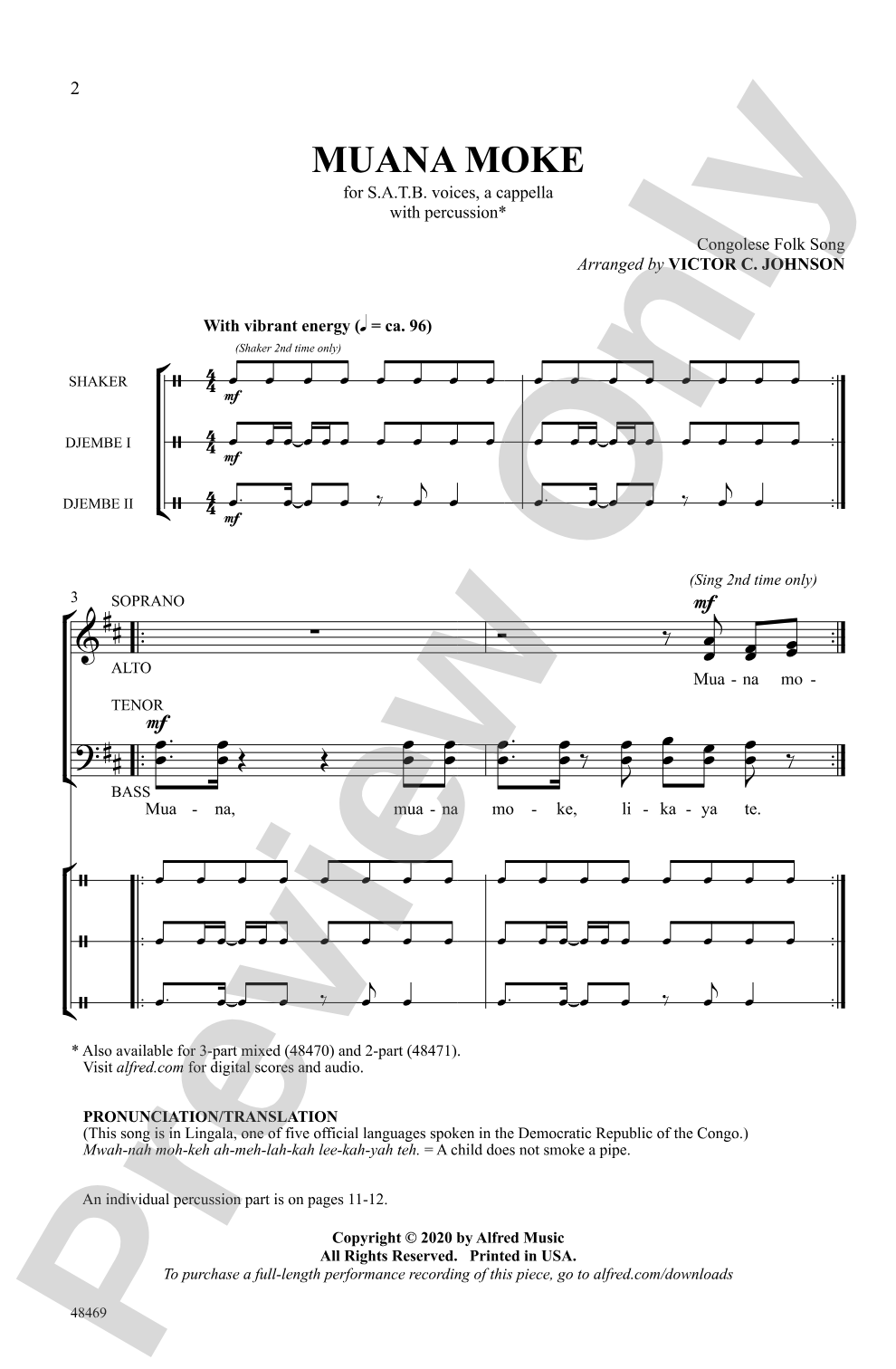
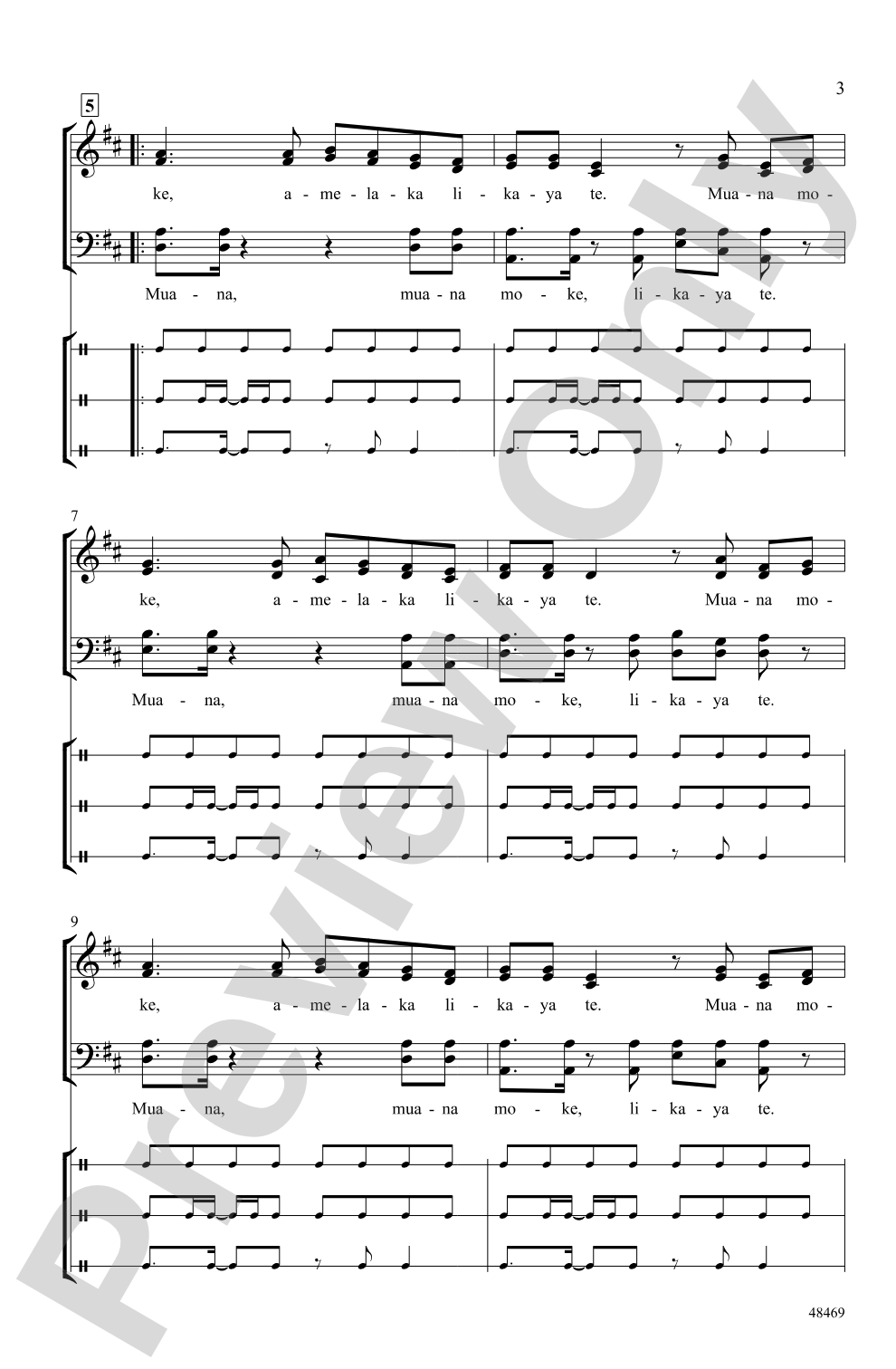
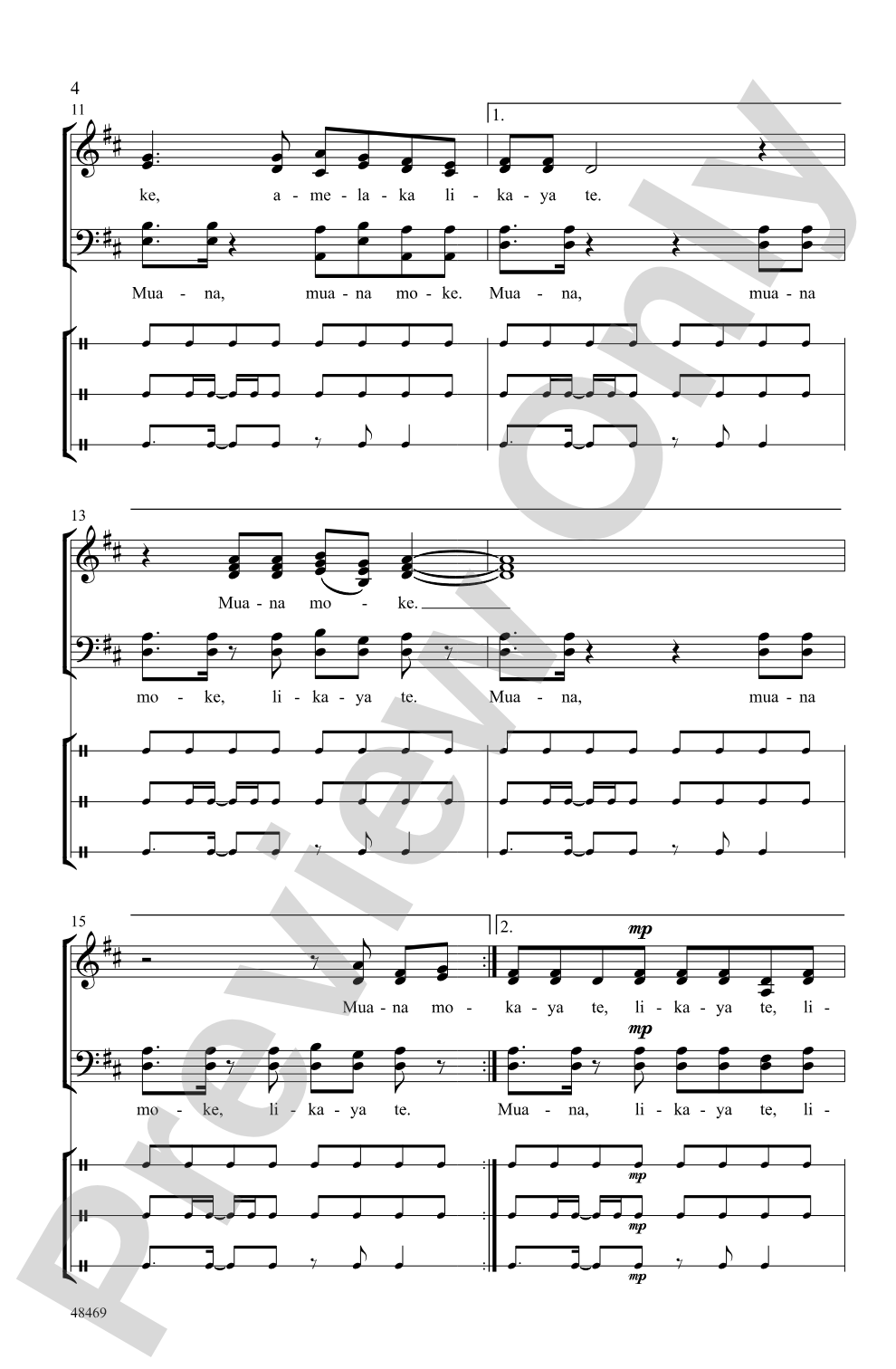

Muana Moke: SATB a cappella Choral Octavo
Congolese Folk Song / arr. Victor C. Johnson
Item: 00-PO-0006389
$2.05
Minimum order quantity: 20 copies
Pickup currently not available
Related Items
Muana Moke: 3-Part Mixed, a cappella Choral Octavo |
$2.05
|
View | |
Muana Moke: 2-Part, a cappella Choral Octavo |
$2.05
|
View | |
Muana Moke: SATB a cappella Choral Octavo |
$2.05
|
View | |
Muana Moke: 3-Part Mixed, a cappella Choral Octavo |
$2.05
|
View | |
Muana Moke: 2-Part, a cappella Choral Octavo |
$2.05
|
View |
Description
A trio of percussion instruments lays down an ostinato groove in this otherwise a cappella arrangement of the authentic folk song from the Democratic Republic of the Congo. Expert arranger Victor Johnson sets up an assortment of accessible melodic and harmonic patterns that weave throughout, creating a wealth of fun-to-sing choral textures. Not to be missed!


Muana Moke: SATB a cappella Choral Octavo isn't in MakeMusic Cloud just yet...but it could be. Let us know you'd like to see it, and you'll help shape what comes next. In the meantime, start a free trial and dive into thousands of interactive titles your students can play along with today.
Request This Title
Tell us you want it.
Start Your Free Trial
Explore everything that's ready to play right now.
Sample Audio
1
Audio File
--:--
0:00
0:00
Sample Video
Additional Details
Series:
Alfred Choral Designs
Publisher:
Alfred Music
Page Count:
12
SKU:
00-PO-0006389
Instrumentation:
Shaker; Djembe
More about this title
About the Arranger: Victor C. Johnson

Victor C. Johnson, based in Dallas, Texas, serves as School Choral Editor for Sing!, the educational publishing division of Choristers Guild. With more than 500 choral works, vocal solos, and keyboard collections in circulation, he has shaped the sound of school and church choirs across the country.
From 2000 to 2018, Johnson directed choirs at Ft. Worth Academy of Fine Arts, where he led the Academy Singers and Academy Men's Choir while serving as Artistic Director for the Singing Girls of Texas and Children's Choir of Texas. Since August 2022, he has conducted the Dallas Symphony Children's Chorus Mixed Ensemble, working with high school singers as the resident children's choir for the Dallas Symphony Orchestra. He holds memberships in the American Choral Directors Association, American Guild of Organists, Texas Music Educators Association, National Association for Music Education, Texas Choral Directors Association, ASCAP, and Phi Mu Alpha Sinfonia.
Why we love this
Johnson's use of shaker and djembe creates rhythmic anchoring that lets your singers focus on the intricate layering of melodic and harmonic lines without getting lost. The arrangement opens up multiple entry points for singers of different ranges and confidence levels, so your section leaders can drive the groove while newer singers find their footing in accessible parts. It's the rare multicultural piece that feels both authentic and genuinely enjoyable to teach.
What to expect
Warm, propulsive, and grounded in something genuine. The percussion groove invites movement and energy while the vocal textures remain intricate enough to hold a musician's attention. There's a buoyancy here that comes from authentic source material meeting skillful modern arrangement work.
Who it's for
Choirs with solid fundamental blend and the ability to hold independent lines will thrive with this arrangement. It works equally well for mixed ensembles ranging from strong middle school groups through advanced high school and community choirs.
How to get the most out of it
- Establish the percussion ostinato first in rehearsal; once the rhythmic foundation locks, the vocal lines sit much more securely into the groove.
- Treat each voice part as a distinct melodic layer rather than traditional harmonic support. Have singers listen across the ensemble to hear how their line interacts with adjacent parts.
- Record a run-through early in the rehearsal process so singers can hear the cumulative texture they're building and stay motivated through the repetitive sections.
- Balance the shaker and djembe carefully in performance; they should propel without overwhelming the voices.
How to use it
Program this as a concert centerpiece that showcases both rhythmic sophistication and multicultural repertoire. It's substantial enough for festival or competition settings while remaining accessible to students encountering Congolese music for the first time. The 12-page octavo also works well as a season opener, since its uplifting character and rhythmic drive set a positive tone.
Skills your students will build
- Maintaining independent vocal lines within a rhythmic ostinato
- Listening and blending within a layered harmonic texture
- Understanding call-and-response and polyrhythmic structures from African musical traditions
- Ensemble independence and part security without instrumental doubling
- Rhythmic precision and entrances in syncopated passages