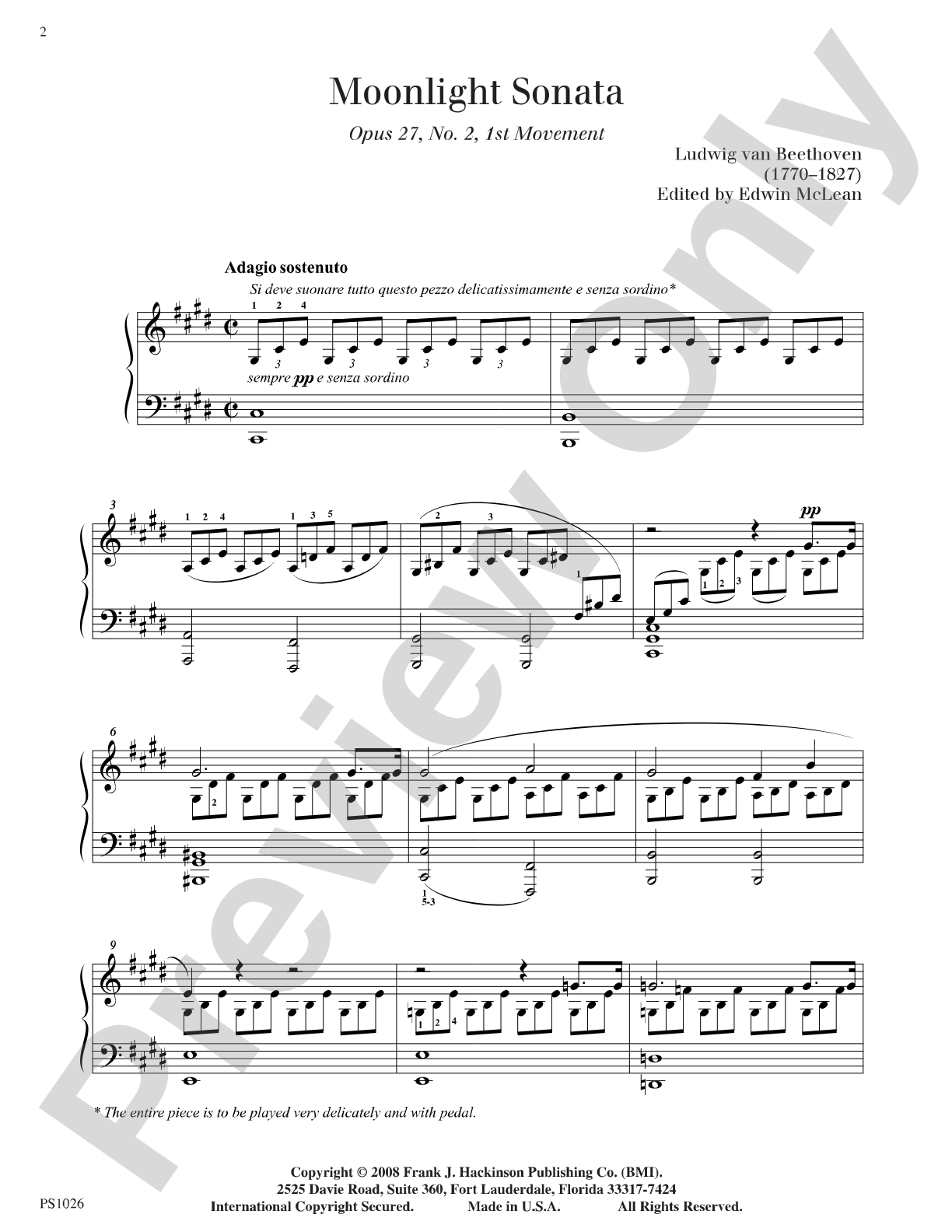
Newly engraved and edited, this classic first movement from Beethoven's Sonata Opus 27, No. 2 is presented here as part of the FJH Piano Solo Series. A long time favorite of piano students, this solo sheet will be an essential piece in your studio.
Discover MakeMusic Cloud: thousands of interactive titles your students can play along with today.
Ludwig van Beethoven (1770-1827) stands as a bridge between Classical and Romantic music, a composer whose innovations in harmony, form, and emotional depth shaped every musical tradition that followed. His thirty-two piano sonatas represent some of the most influential works ever written for the instrument, each one expanding the possibilities of what a solo pianist could express through sound and structure.
Why we love this
This opening movement has captivated generations of pianists because it balances technical accessibility with profound emotional depth. The arpeggiated accompaniment and haunting right-hand melody create an immediate sense of intimacy, making it engaging enough for students to fall in love with while remaining musically substantial enough to reward years of refinement.
What to expect
The opening unfolds like a whispered confession, with delicate arpeggios cradling a vulnerable melody that seems to float just above them. The work maintains an intimate, introspective quality throughout, drawing listeners into a deeply personal emotional landscape marked by both beauty and quiet melancholy.
Who it's for
This movement is ideal for intermediate to early advanced piano students ready to engage with Romantic-era interpretation and independent left-hand accompaniment patterns. Teachers seeking repertoire that challenges students technically while offering genuine musical substance will find this a cornerstone piece for any serious piano studio.
How to get the most out of it
Shape the melody across the full arch of each phrase rather than treating it as isolated notes; think of the opening melodic line as one continuous utterance that breathes and unfolds over several measures.
Allow the steady triplet figuration in the left hand to remain consistent but never mechanical; a slight natural flexibility in tempo (rubato) in the right hand works best when the accompaniment stays grounded.
Experiment with pedal changes that align with harmonic shifts rather than strict measure lines, letting the resonance bloom without becoming muddy.
Resist the temptation to rush the softer passages; the movement's power comes partly from its restraint and the space it creates for listening.
How to use it
Program this as a recital centerpiece that stands on its own or as the anchor of a Beethoven-focused concert. Its emotional gravitas makes it an excellent choice for student showcases where you want to demonstrate maturity and musical depth rather than virtuosic flash.
Skills your students will build
Independent hand coordination with sustained arpeggiated accompaniment
Legato pedaling and harmonic awareness
Phrasing and rubato in a Romantic-era context
Control of dynamics in a narrow range (pp to p with occasional f moments)
Voice leading in sustained melody lines over moving accompaniment
You May Also Like
Scan to Complete Your Purchase
Use your phone's camera to scan the code below
You'll log in on your phone and the order will be added to your account