
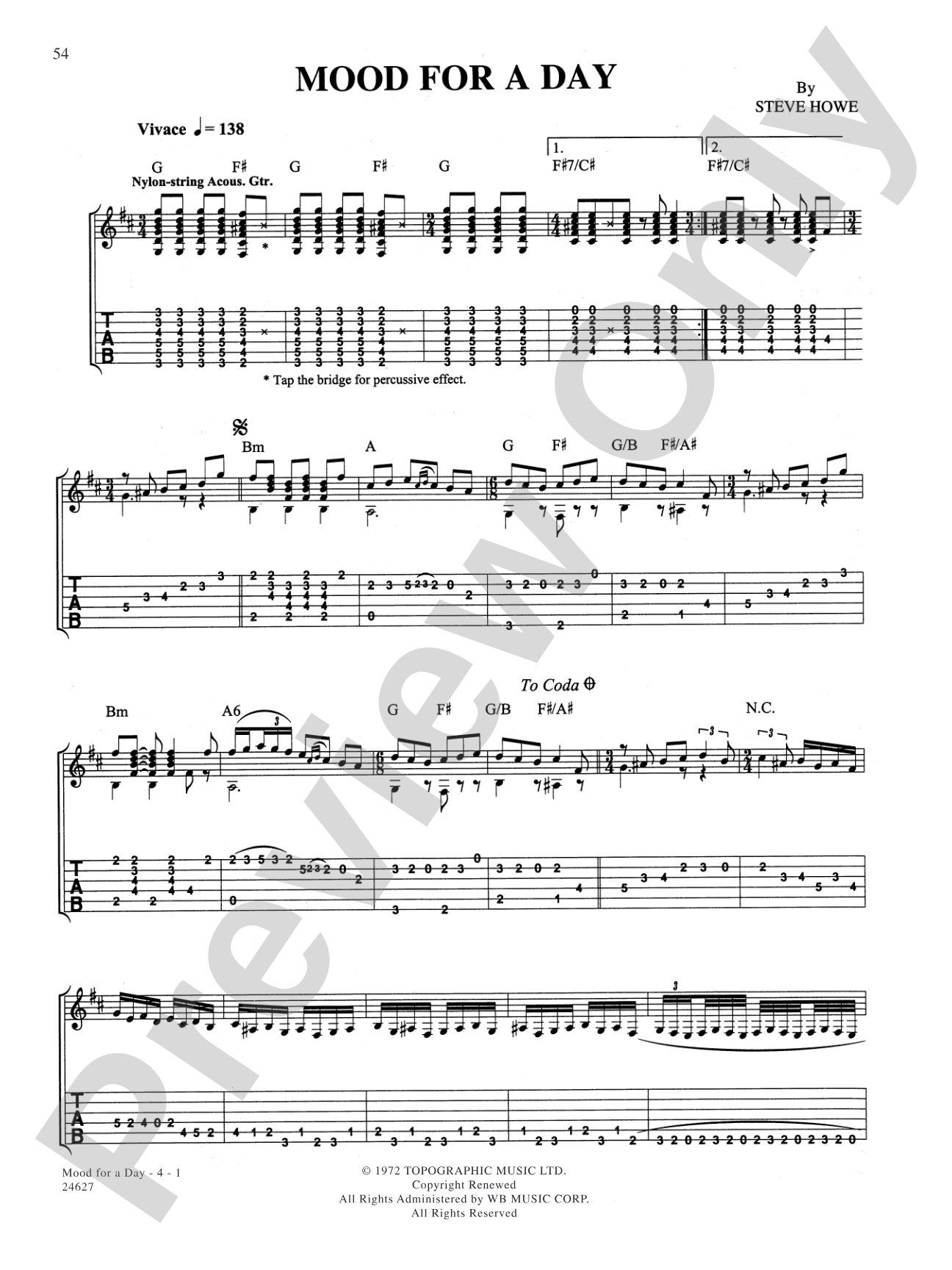

Mood For A Day: Authentic Guitar TAB
Yes
Item: 00-PSG-000011
$4.99
One moment…
Description
Since the group's formation in 1968, Yes has been an influential, progressive band that not only pioneered the use of synthesizers and sound effects in modern music, but also produced timeless symphonic-rock masterworks. This collection offers 11 classic songs from Yes in full Guitar TAB notation. Titles are: Clap * Hold On * I've Seen All Good People (a. Your Move b. All Good People) * Long Distance Runaround * Money * Montreux's Theme * Mood for a Day * Owner of a Lonely Heart * Roundabout * Tempus Fugit.


Mood For A Day: Authentic Guitar TAB isn't in MakeMusic Cloud just yet...but it could be. Let us know you'd like to see it, and you'll help shape what comes next. In the meantime, start a free trial and dive into thousands of interactive titles your students can play along with today.
Request This Title
Tell us you want it.
Start Your Free Trial
Explore everything that's ready to play right now.
Sample Audio
No sample audio found.
Sample Video
No sample videos found.
Additional Details
Series:
Guitar Anthology Series
Publisher:
Alfred Music
Page Count:
124
SKU:
00-PSG-000011
More about this title
About the Artist: Yes
Yes formed in 1968 and fundamentally reshaped progressive rock by integrating synthesizers, sound effects, and classical compositional techniques into an electric ensemble sound. The band's approach to arrangement and production influenced generations of musicians working across rock, metal, and alternative genres, establishing them as pioneers in the use of studio technology as an instrument itself.
Their catalog spans five decades of studio and live recording, with signature works that blend complex time signatures, extended instrumental passages, and layered vocal harmonies. The compositions in this collection represent their most accessible and enduring material, making them ideal reference points for guitarists studying how to construct compelling parts within a densely orchestrated ensemble.
Why we love this
These transcriptions capture some of the most ingenious guitar work in progressive rock, with parts that balance technical precision and melodic clarity. Guitarists get direct insight into how lead and rhythm lines interact across synthesizer textures, arrangement principles that transfer across genres. The TAB notation gives players immediate access to material they might otherwise struggle to decode by ear.
What to expect
These pieces move between moments of crystalline clarity and dense textural layers, balancing intricate fingerwork with sustained melodic passages that soar above synthesizers. You'll encounter unexpected time signatures, quick position shifts, and parts that demand both precision and musicality, capturing the sonic ambition that made Yes central to rock's expansion.
Who it's for
Guitar students and self-taught players who want to learn from the actual recorded arrangements of Yes rather than simplified versions or approximations. Guitarists pursuing progressive rock, fusion, or any style that values harmonic sophistication and rhythmic complexity will find direct technical and compositional lessons here.
How to get the most out of it
- Study the guitar layering in context with the keyboard arrangements where possible; these songs rely on complementary textures rather than guitar-alone exposition, which changes how you voice and time your lines.
- Lock into the rhythmic pulse across signature changes by practicing with a metronome set to subdivisions; these pieces shift meters frequently, and internal stability prevents the listener from sensing hesitation.
- Pay attention to dynamics and articulation as transcribed; progressive rock depends on subtle shifts in attack and sustain to convey phrasing across instrumental passages where vocals are absent.
- Use the full fingerboard range and position shifts shown in the TAB; Yes compositions rarely stay in one box, and embracing the vertical geography of the neck opens up the resonance these arrangements demand.
How to use it
Program individual tracks as solo recital pieces or ensemble features where guitar stands forward from backing tracks. Many of these songs work as study material across a full school year, offering scaffolded technical challenges that grow from basic rhythm work through advanced soloing and counterpoint.
Skills your students will build
- Reading and performing in non-standard time signatures (5/4, 7/8, mixed meters)
- Executing position shifts and fingering patterns across the full neck
- Interpreting TAB notation with articulation marks and dynamic shadings
- Developing rhythmic independence across syncopated and shifting bass lines
- Balancing melodic phrasing with harmonic support in an ensemble context
- Understanding layered arrangement and how guitar interacts with keyboard textures