
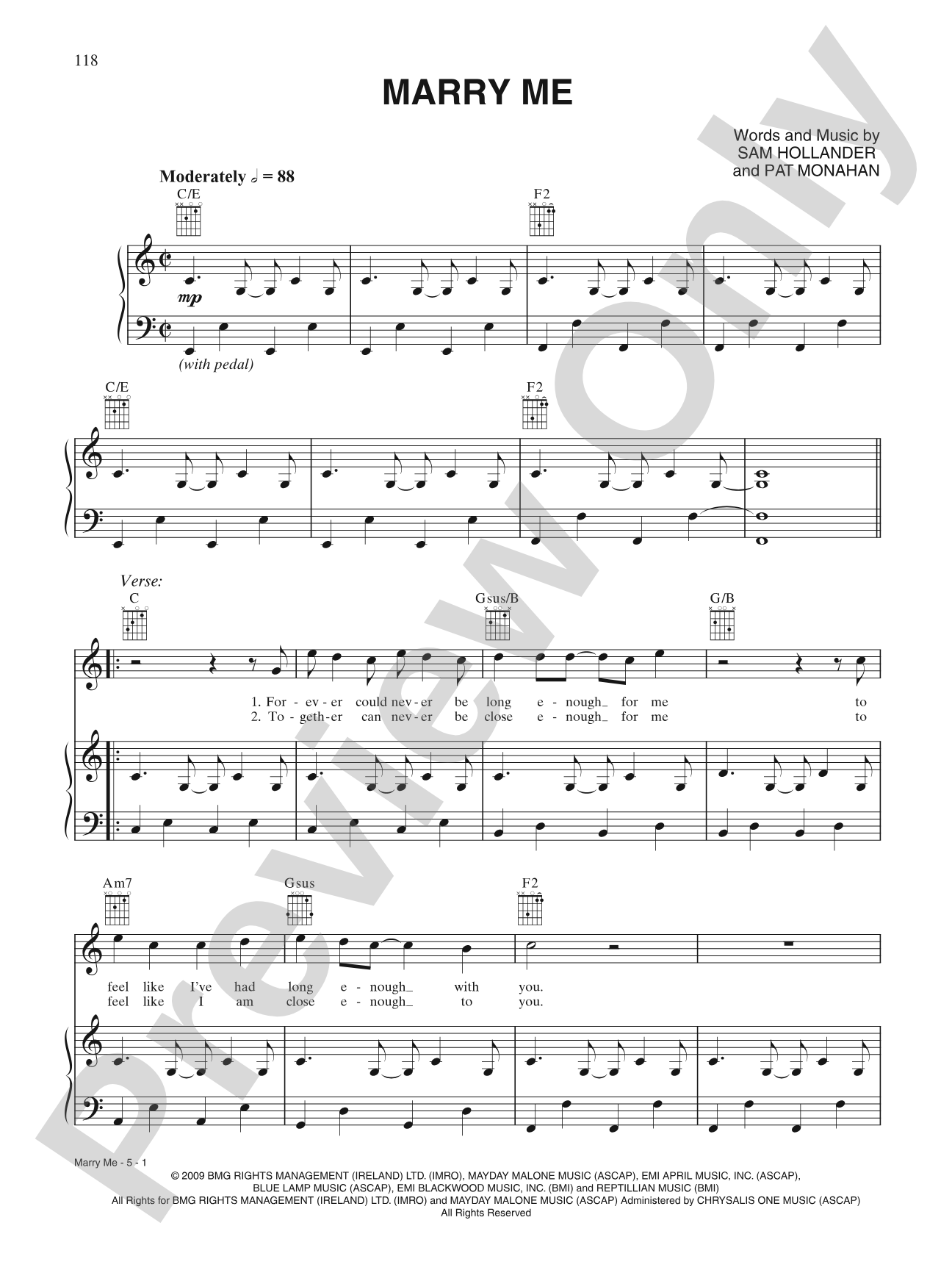

Marry Me: Piano/Vocal/Chords
20 Pop, Rock, Country, TV, and Movie Chartbusters
Item: 00-PS-0015516
$4.99
One moment…
Description
Piano/Vocal/Guitar arrangements of extremely popular songs like "Home" (Phillip Phillips), "Good Time" (Owl City and Carly Rae Jepsen), and "Wide Awake" (Katy Perry) anchor this great collection. A variety of pop, rock, and country megahits are featured, along with memorable songs from blockbuster movies and TV shows. Twenty songs in all are arranged for piano and voice, including complete lyrics and basic fingering grids for optional guitar accompaniment. Titles: The Big Bang Theory (Main Title Theme) * Blown Away (Carrie Underwood) * Change Nothing (Jessica Sanchez, from American Idol) * Come Away to the Water (The Hunger Games) * Disparate Youth (Santigold) * Don't Stop Believin' (Rock of Ages) * Everybody Talks (Neon Trees) * Falling Slowly (from Once, the Broadway musical that swept the 2012 Tony Awards) * For You (Keith Urban) * Good in Goodbye (Carrie Underwood) * Good Time (Owl City and Carly Rae Jepsen) * Home (Phillip Phillips, from American Idol) * If I Die Young (The Band Perry) * Keep Your Head Up (Andy Grammer) * Love You Like a Love Song (Selena Gomez & The Scene) * Make You Feel My Love (Adele) * Marry Me (Train) * The Prayer (Christina Aguilera and Chris Mann, from The Voice) * Red Solo Cup (Toby Keith) * Wide Awake (Katy Perry).


Marry Me: Piano/Vocal/Chords isn't in MakeMusic Cloud just yet...but it could be. Let us know you'd like to see it, and you'll help shape what comes next. In the meantime, start a free trial and dive into thousands of interactive titles your students can play along with today.
Request This Title
Tell us you want it.
Start Your Free Trial
Explore everything that's ready to play right now.
Sample Audio
No sample audio found.
Sample Video
No sample videos found.
Additional Details
Series:
Megahits
Publisher:
Alfred Music
Page Count:
144
SKU:
00-PS-0015516
More about this title
About the Composer: Sam Hollander
Sam Hollander is a songwriter and producer who has shaped the sound of contemporary pop and rock music through his work with major artists across multiple genres. His ability to craft memorable melodies and accessible arrangements has made him a sought-after collaborator in the industry, bringing songs to life across radio, streaming, and live performance contexts.
Why we love this
This collection captures songs that genuinely matter to young singers and pianists right now. The repertoire spans Broadway, pop radio, country, and television themes, so every student finds something they already love to play, which transforms practice from obligation into genuine engagement. The arrangement of 20 current and recent hits in one book creates real programming flexibility for recitals, showcase concerts, and solo competitions.
What to expect
A snapshot of modern popular music, from the infectious optimism of "Good Time" to the vulnerability of "Falling Slowly" and the anthemic energy of "Don't Stop Believin'." These arrangements preserve the character of songs many students already listen to, making the leap from fan to performer feel natural and rewarding.
Who it's for
Pianists studying contemporary and pop repertoire, singers preparing material for auditions or recitals, and pianists accompanying vocalists in lessons or performances. This book works equally well for solo pianists exploring arranged popular music and for singer/pianist duos who want accessible, current material that resonates with audiences.
How to get the most out of it
- Lean into the character of each song rather than playing by rote. Owl City's "Good Time" reads completely differently than Adele's "Make You Feel My Love," so let the genre cues and chord progressions guide your phrasing and touch.
- Use the fingering grids alongside chord symbols to strengthen left hand independence. The guitar chords give you an opportunity to explore how piano voicings can align with or reinterpret those shapes.
- Balance the melody and accompaniment by experimenting with dynamics. Many of these songs work best when you treat the vocal line as your primary voice and support it rather than competing with it.
- Study the vocal line first if you're learning multiple arrangements in sequence. Knowing what the singer does helps you anticipate phrasing and shape the accompaniment accordingly.
How to use it
Build a contemporary pop recital around 4 or 5 selections from this book, choosing songs that tell a narrative or showcase different vocal qualities. You might also use individual arrangements as encore pieces or as a bridge between classical and musical theatre programming on a mixed-genre concert.
Skills your students will build
- Reading lead sheets with guitar chord symbols and translating them to piano voicings
- Balancing vocal melody with piano accompaniment in arrangement
- Navigating varied song structures across pop, country, and rock idioms
- Building fluency with contemporary harmonic language and progressions
- Accompanying singers with stylistically appropriate rhythmic and textural choices