
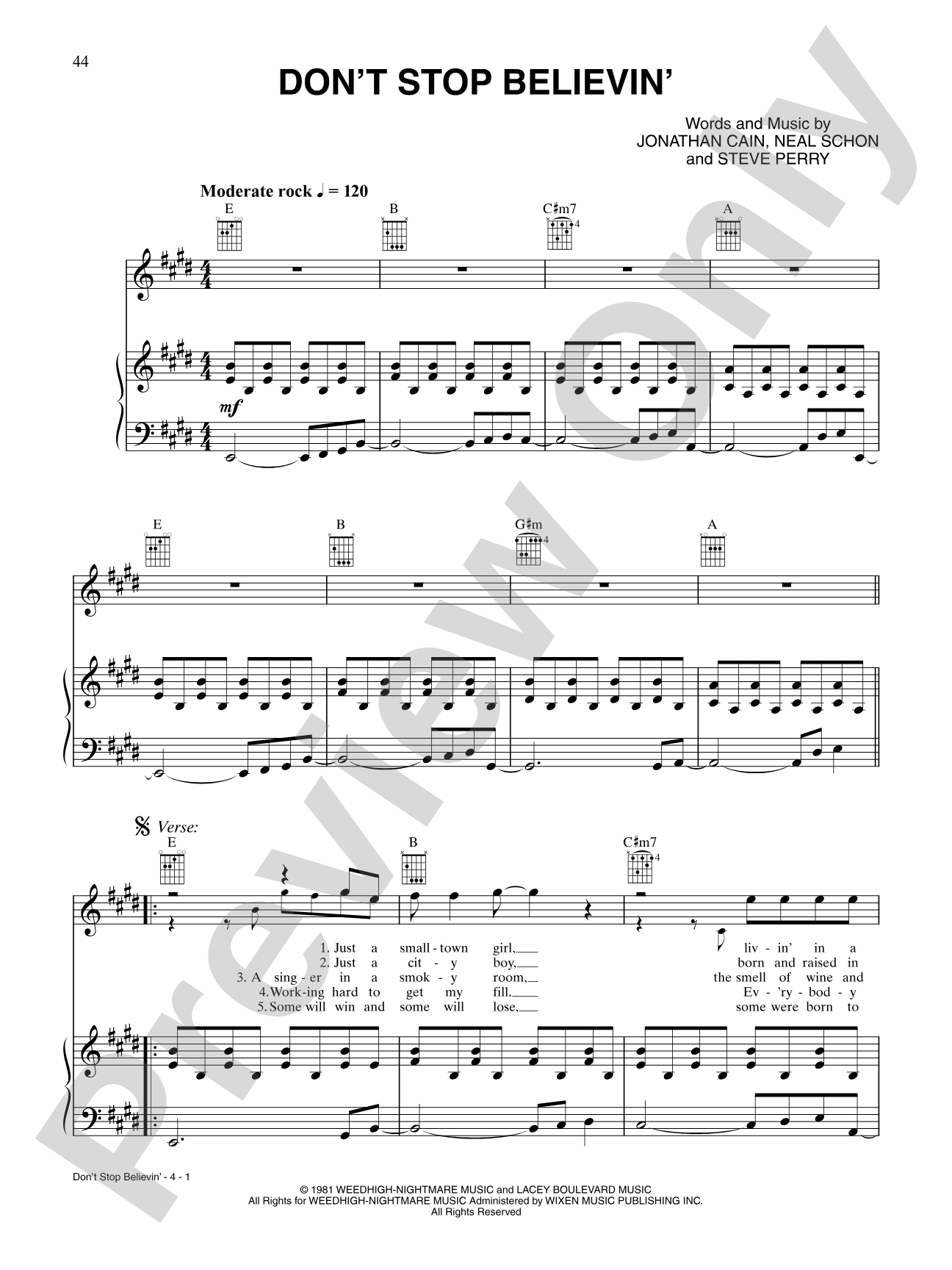

Don't Stop Believin': Piano/Vocal/Chords
20 Pop, Rock, Country, TV, and Movie Chartbusters
Item: 00-PS-0015515
$4.99
Pickup currently not available
Description
Piano/Vocal/Guitar arrangements of extremely popular songs like "Home" (Phillip Phillips), "Good Time" (Owl City and Carly Rae Jepsen), and "Wide Awake" (Katy Perry) anchor this great collection. A variety of pop, rock, and country megahits are featured, along with memorable songs from blockbuster movies and TV shows. Twenty songs in all are arranged for piano and voice, including complete lyrics and basic fingering grids for optional guitar accompaniment. Titles: The Big Bang Theory (Main Title Theme) * Blown Away (Carrie Underwood) * Change Nothing (Jessica Sanchez, from American Idol) * Come Away to the Water (The Hunger Games) * Disparate Youth (Santigold) * Don't Stop Believin' (Rock of Ages) * Everybody Talks (Neon Trees) * Falling Slowly (from Once, the Broadway musical that swept the 2012 Tony Awards) * For You (Keith Urban) * Good in Goodbye (Carrie Underwood) * Good Time (Owl City and Carly Rae Jepsen) * Home (Phillip Phillips, from American Idol) * If I Die Young (The Band Perry) * Keep Your Head Up (Andy Grammer) * Love You Like a Love Song (Selena Gomez & The Scene) * Make You Feel My Love (Adele) * Marry Me (Train) * The Prayer (Christina Aguilera and Chris Mann, from The Voice) * Red Solo Cup (Toby Keith) * Wide Awake (Katy Perry).


Don't Stop Believin': Piano/Vocal/Chords isn't in MakeMusic Cloud just yet...but it could be. Let us know you'd like to see it, and you'll help shape what comes next. In the meantime, start a free trial and dive into thousands of interactive titles your students can play along with today.
Request This Title
Tell us you want it.
Start Your Free Trial
Explore everything that's ready to play right now.
Sample Audio
No sample audio found.
Sample Video
No sample videos found.
Additional Details
Series:
Megahits
Publisher:
Alfred Music
Page Count:
144
SKU:
00-PS-0015515
More about this title
About the Composer: Jonathan Cain
Jonathan Cain is a keyboardist, composer, and founding member of Journey, the arena rock band that defined stadium anthems across multiple decades. Beyond his work as performer and bandleader, Cain has composed or co-composed some of rock's most enduring melodies, including the title track of this collection. His understanding of what makes a song singable and memorable across different voicings and instrumental combinations reflects decades spent crafting music for live performance and recording.
Cain's influence on music education extends through arrangements and folios like this one, which bring contemporary and classic popular songs into the practice room and performance space. His work demonstrates how strong melodic writing translates across genres and voice types, making his compositions valuable models for students learning to sing and play popular music.
Why we love this
This collection captures the moment when popular song became a legitimate part of piano and voice study. You get songs that students actually want to sing paired with piano arrangements that are neither oversimplified nor overly complex, plus optional guitar grids for mixed ensemble flexibility. The breadth here is genuine: Broadway (Once), reality TV (American Idol, The Voice), blockbuster film (The Hunger Games), and multiplatinum pop and country records sit side by side, giving you programming options for almost any student recital or ensemble setting.
What to expect
These arrangements capture the luminosity and forward momentum of their source recordings while respecting the intimacy of the piano-voice medium. You'll hear the echo of arena production filtered through a smaller acoustic space, which creates an interesting tension between the ambition of the melodies and the immediacy of live performance.
Who it's for
Pianists and vocalists preparing recital repertoire from contemporary sources, and voice teachers seeking current material that engages teenage and young adult students. This folio works equally well for singers developing their interpretive voice and pianists building facility with popular song accompaniment patterns.
How to get the most out of it
- Balance the vocal line so it sits naturally above the piano texture rather than competing with it. Many of these songs are known from pop recordings with prominent vocal production; let the arrangement breathe by keeping accompaniment supportive.
- Pay attention to the rhythmic pocket in uptempo tracks like 'Good Time' and 'Everybody Talks.' The piano part often carries syncopated patterns that define the song's groove, so lock the rhythm before worrying about tempo.
- Use the guitar chord grids to add texture and harmonic reinforcement if you have a guitarist available. Even sparse guitar voicings can anchor the harmonic language without muddying the piano-voice combination.
- Explore dynamics within verses and choruses rather than treating each section as uniform. These songs were written to build energy through arrangement details, not just lyrical content.
How to use it
Feature individual songs in student recitals throughout the year, mixing them with classical and musical theater material to show how contemporary writing engages similar vocal and interpretive challenges. This collection also supports a themed recital centered on pop hits, film and television music, or songs from reality singing competitions. The variety in style and energy makes these songs excellent for ensemble recital programs where multiple students perform different selections from the same folio.
Skills your students will build
- Singing contemporary melodies with rhythmic accuracy and stylistic phrasing
- Reading and executing piano accompaniment patterns driven by syncopation and groove
- Interpreting lyrics with emotional specificity in a popular music context
- Coordinating vocal line with harmonic progression and piano texture
- Optional: reading and applying guitar chord grids in a mixed instrumental setting