
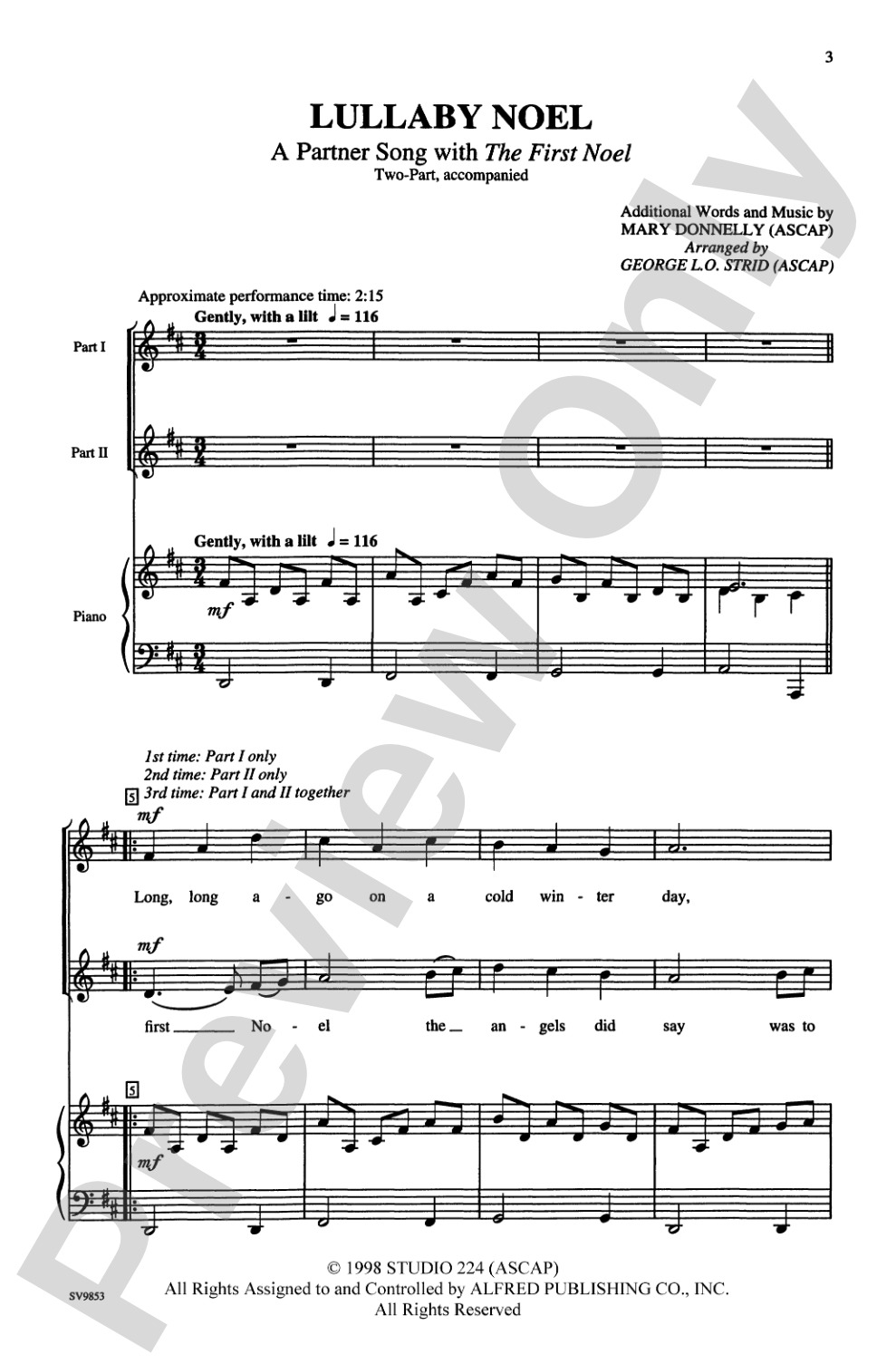

Lullaby Noel: 2-Part Choral Octavo
A Partner Song with "The First Noel"
Additional words and music by Mary Donnelly / arr. George L. O. Strid
Item: 00-PO-0005288
$2.25
Minimum order quantity: 20 copies
Pickup currently not available
Description
The collaboration between Mary Donnelly and George Strid has brought us many delightful choral selections and some highly touted musicals including Blunder Down Under and Knight To Remember. This wonderful piece partners 'First Noel' with a superb original melody to form an absolutely charming holiday concert addition. Your students will ask for this one!


Lullaby Noel: 2-Part Choral Octavo isn't in MakeMusic Cloud just yet...but it could be. Let us know you'd like to see it, and you'll help shape what comes next. In the meantime, start a free trial and dive into thousands of interactive titles your students can play along with today.
Request This Title
Tell us you want it.
Start Your Free Trial
Explore everything that's ready to play right now.
Sample Audio
No sample audio found.
Sample Video
No sample videos found.
Additional Details
Series:
Alfred Archive Edition: Studio PR Catalog
Publisher:
Alfred Music
Page Count:
8
SKU:
00-PO-0005288
More about this title
About the Composer: Mary Donnelly

Mary Donnelly grew up in Reno, Nevada, and studied English and French at the University of Nevada, Reno. While an undergraduate, she founded two children's choruses and discovered her passion for music education, prompting her to earn a Master's Degree in Education from Lesley College in Cambridge, Massachusetts, with a focus on integrating arts across the curriculum.
Donnelly spent three decades teaching general music and choir in elementary and middle schools in the Washoe County School District. In 1985, she began collaborating with George Strid when their principal asked them to compose a musical for Reading Week. That partnership has since produced over two hundred songs and twenty-five musicals. She is an active member of ACDA, NEA, and ASCAP, and currently resides in Reno with her husband.
Why we love this
Donnelly and Strid have a gift for writing melodies that students genuinely enjoy singing, and this pairing of 'First Noel' with an original countermelody feels fresh without losing the carol's familiar warmth. The 2-part texture keeps the piece accessible for mixed-ability choirs while the clever harmonic interaction between the two melodies rewards careful rehearsal and creates a polished sound with minimal forces.
What to expect
Warm and intimate, like discovering a familiar melody reflected in a new light. The original tune has the gentle grace of a lullaby, which creates a tender conversation with 'First Noel' rather than an overtly celebratory carol. It feels nostalgic but not dated, reverent without being heavy.
Who it's for
This piece works beautifully for middle school choirs, elementary school upper grades, and community choruses seeking an accessible yet thoughtfully crafted holiday selection. It suits ensembles that want something more sophisticated than a straightforward carol arrangement but don't have the vocal maturity or size for complex four-part writing.
How to get the most out of it
- Balance the original melody against 'First Noel' by having students sing through both parts separately first, then listen carefully to how the lines weave together before combining them.
- Shape the original melody with gentle phrasing so it complements rather than overshadows the beloved carol; this is a collaboration between the two tunes, not a competition.
- Maintain clarity in the two-part texture by keeping both lines buoyant and forward-moving; resist the urge to drag the tempo or lean too heavily into sentimentality.
How to use it
Program this in the second half of a holiday concert to create a moment of reflective beauty between more spirited seasonal pieces. It pairs naturally with other Donnelly and Strid selections and works equally well as a standalone offering in a mixed repertoire program or as part of a dedicated sacred music set.
Skills your students will build
- Singing in two-part harmony with independent melodic lines
- Balancing and listening to a partner melody while maintaining their own line
- Interpreting a familiar melody in a new harmonic context
- Sustaining lyrical phrasing across longer musical phrases