
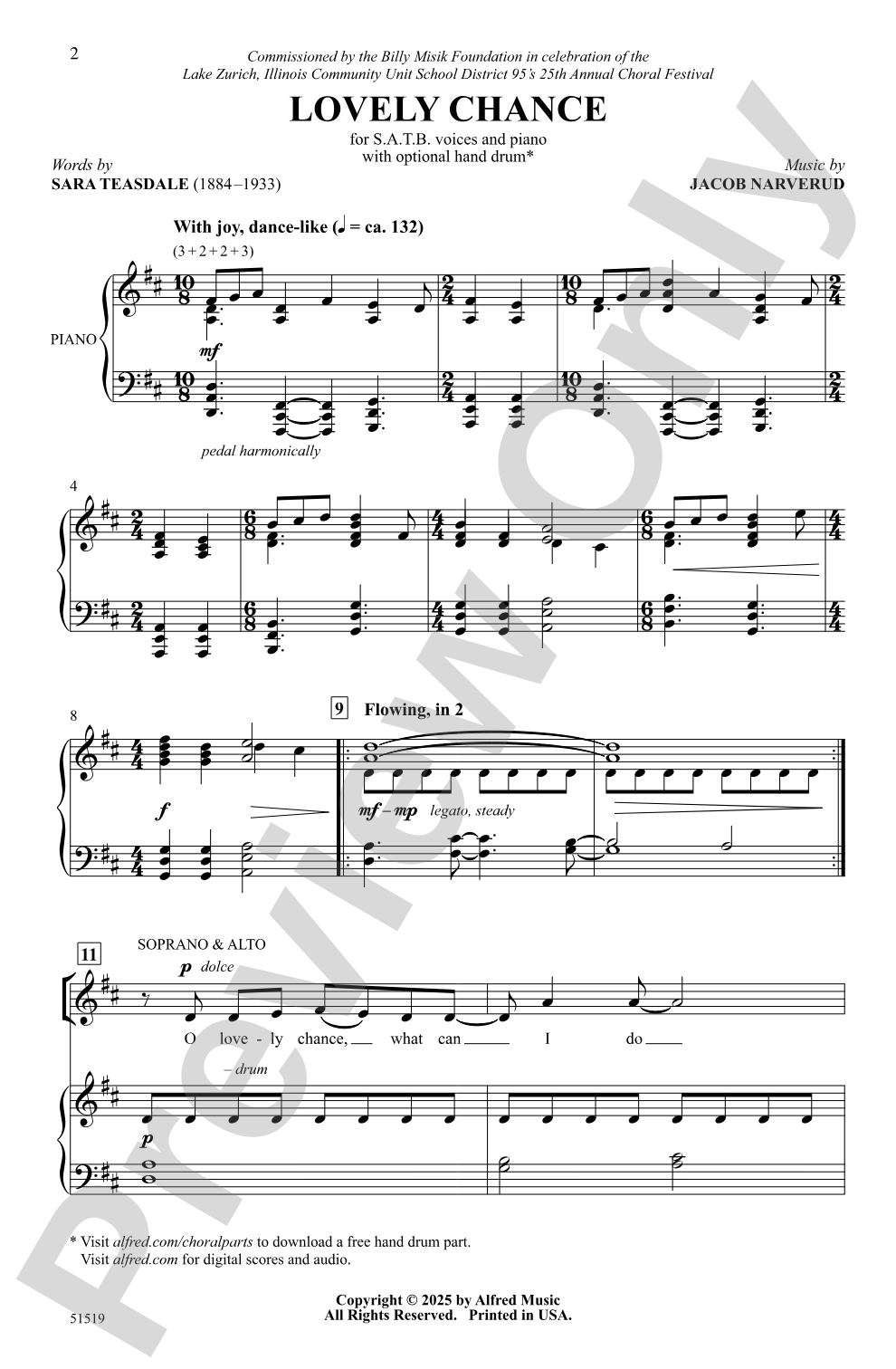
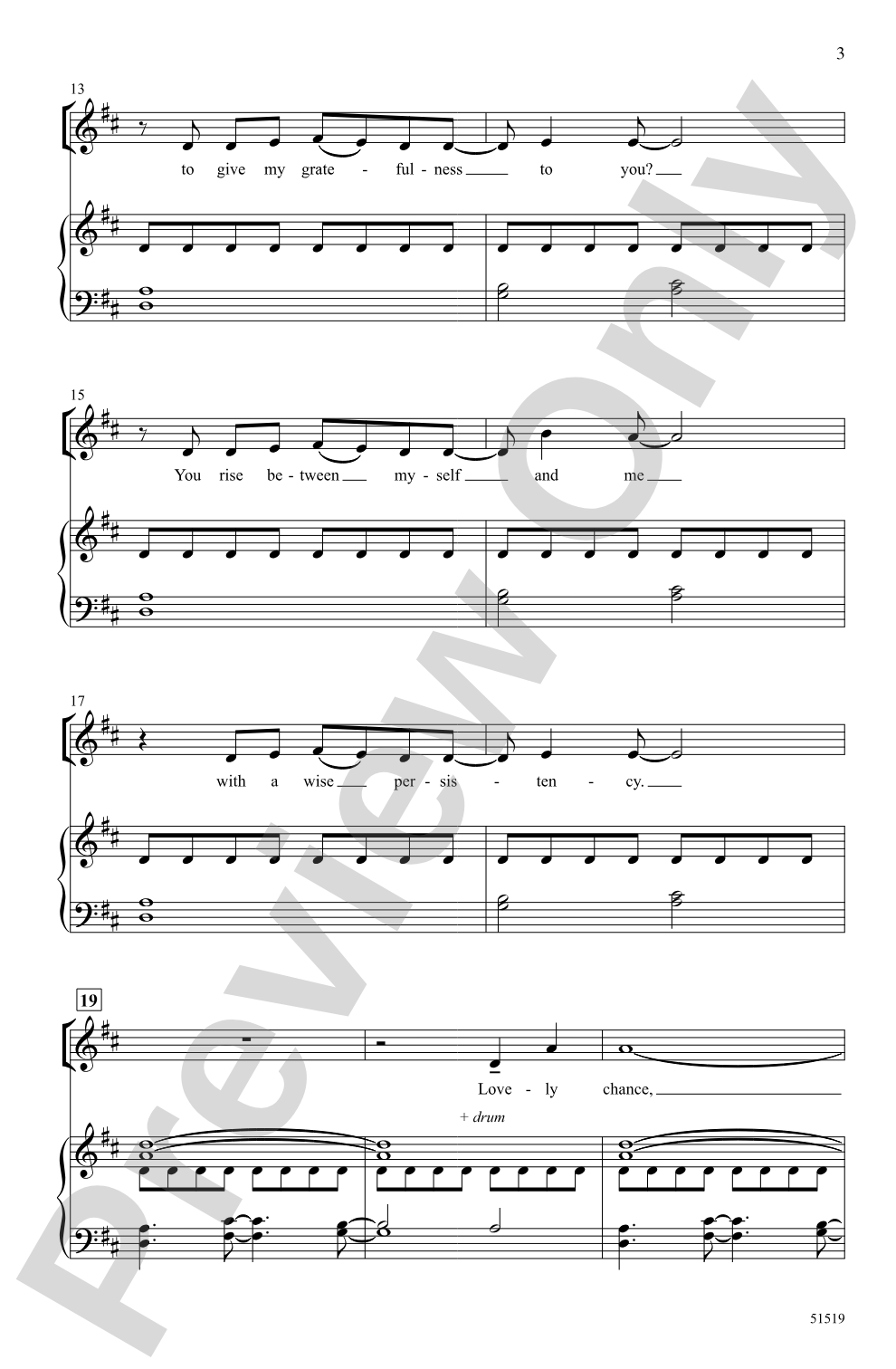
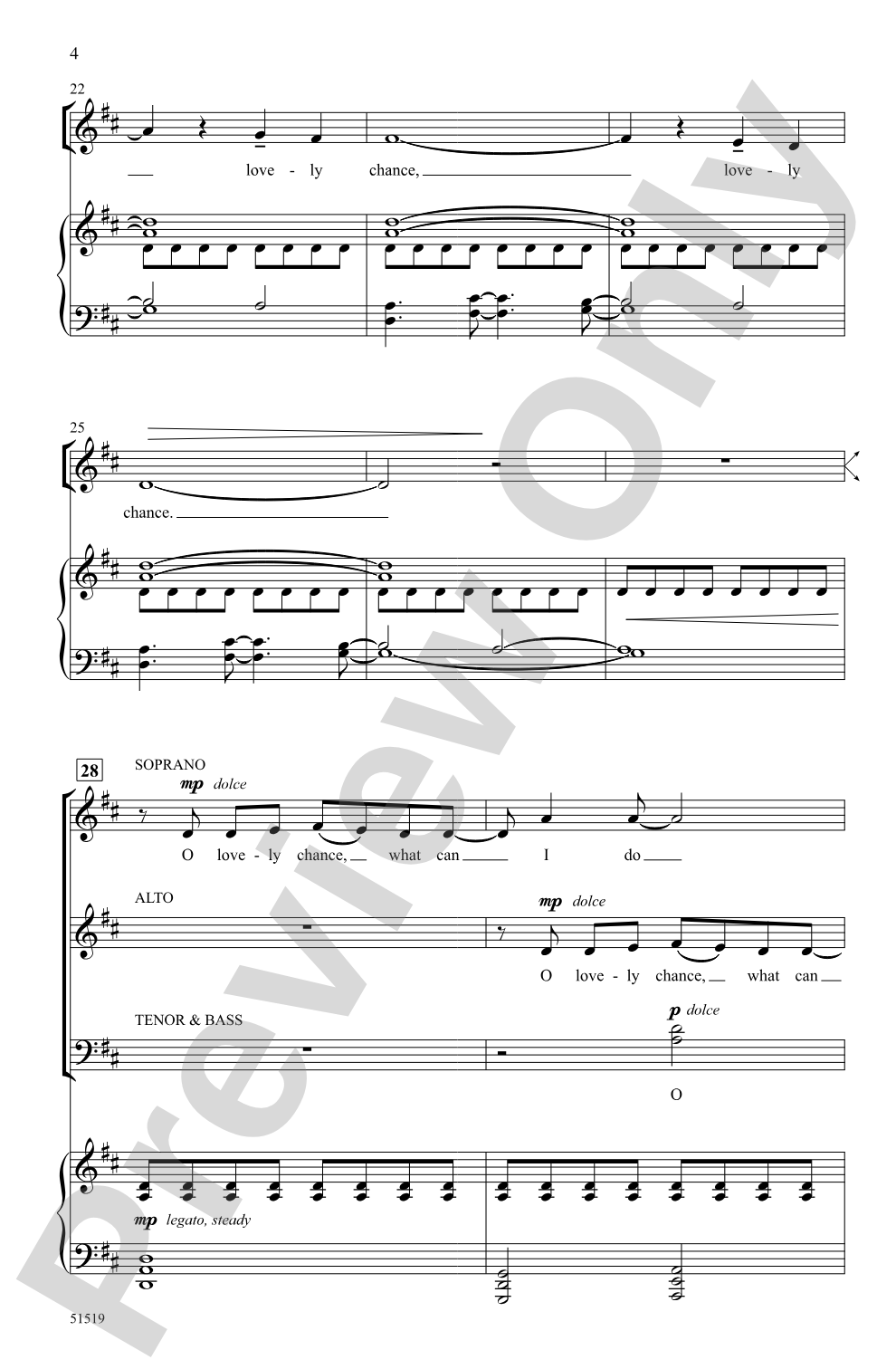

Lovely Chance: SATB Choral Octavo
Words by Sara Teasdale, music by Jacob Narverud
Item: 00-PO-0007474
$2.50
Minimum order quantity: 20 copies
Pickup currently not available
Description
A driving echoed verse bursts into a dancelike, mixed-meter refrain, brilliantly capturing the nature of Sara Teasdale's vivid poetry. Narverud's contrasting B section takes a more contemplative approach, gradually growing to a recapitulation of the spirited main chorus. Accompanied by a vibrant piano and an optional hand drum.


Lovely Chance: SATB Choral Octavo isn't in MakeMusic Cloud just yet...but it could be. Let us know you'd like to see it, and you'll help shape what comes next. In the meantime, start a free trial and dive into thousands of interactive titles your students can play along with today.
Request This Title
Tell us you want it.
Start Your Free Trial
Explore everything that's ready to play right now.
Sample Audio
1
Audio File
--:--
0:00
0:00
Sample Video
Additional Details
Series:
Lawson-Gould
Publisher:
Alfred Music
Page Count:
16
SKU:
00-PO-0007474
More about this title
About the Composer: Jacob Narverud

Jacob Narverud was born in Kansas in 1986 and has become one of the most performed contemporary choral composers in North America. He founded and directs the Tallgrass Chamber Choir, a professional ensemble drawing musicians from across the Great Plains, and serves as Editor of Santa Barbara Music Publishing. His compositional voice has earned commissions from over fifty choral organizations across the United States, Australia, and Japan.
Narverud's works consistently find their way onto contest programs and concert stages worldwide, performed by ensembles ranging from community choirs to professional groups. His catalog demonstrates a gift for setting poetry to music that feels both innovative and immediately singable. You can explore his growing body of work at jnarverud.com, Spotify, and YouTube.
Why we love this
Narverud takes Sara Teasdale's language seriously, matching its vividness with music that shifts between energetic and reflective without ever losing coherence. The mixed-meter refrain is genuinely rhythmic and fun to sing rather than merely complicated, and the optional hand drum adds texture without demanding extra rehearsal time. This is the kind of piece that generates genuine excitement in a choir while holding up to multiple listens in a concert program.
What to expect
The opening has momentum and sparkle, driven by echoes that build energy around Teasdale's words. When the dancelike refrain arrives with its unexpected meters, the piece suddenly feels kinetic and alive, then pivots gracefully into a quieter, more introspective section before the bright energy returns with new weight and maturity.
Who it's for
SATB choirs of solid intermediate ability and above who want contemporary repertoire with real substance and musicality. This piece works equally well for concert programming and festival competition, and it's engaging enough to hold an audience without asking singers to sacrifice musicianship for novelty.
How to get the most out of it
- Lock the mixed-meter refrain as a section before putting it with the ensemble. Clap the pattern together until the rhythm feels natural, then add text and melody.
- The echoed verse benefits from clear articulation and controlled dynamics. Each echo should feel like a conversation, not a repetition.
- If using the optional hand drum, give the percussionist the part early and let them find their entry points during section rehearsals rather than waiting for full ensemble.
- The transition into the B section requires a slight tempo adjustment. Mark it clearly and conduct it with intention so singers know this is a deliberate shift in mood.
How to use it
Pair this with a more traditional or sacred work to create a program that shows choral range and contemporary relevance. Its literary text and concert appeal make it an excellent anchor for a concert devoted to American poetry or modern choral writing. It also performs well as an opener or as the final selection before an intermission, since its rhythmic vitality leaves audiences energized.
Skills your students will build
- Reading and maintaining mixed meters (shifting between triple and quadruple subdivisions)
- Controlling rhythm in echoed passages with precision and clarity
- Blending part independence with ensemble cohesion across a longer sectional form
- Interpreting poetic text through dynamic and timbral choices
- Coordinating with optional percussion while maintaining vocal focus