Love Is Blue Sheet Music Preview

Love Is Blue: Piano/Vocal/Chords

Item: 00-XS-0000074

Digital Download
$4.99

One moment…

Description
Eighty-seven titles including: Bad Moon Rising * Both Sides Now * Can't Get Used to Losing You * Chain of Fools * Dear Heart * Do You Want to Know a Secret? * Everyday People * Hey! Paula * Hold Me, Thrill Me, Kiss Me * I Go to Pieces * I Got You Babe * Little Town Flirt * The Monkey Time * More Than I Can Say * Nice 'n' Easy * People * The Pink Panther * Proud Mary * Put a Little Love in Your Heart * Roses Are Red (My Love) * Runaround Sue * Save the Last Dance for Me * Sealed with a Kiss * Sweets for My Sweet * This Magic Moment * Time Is on My Side * Viva! Las Vegas * To Love Somebody * When a Man Loves a Woman * When I Fall in Love * Wipe Out * Words * and many, many more!

Love Is Blue: Piano/Vocal/Chords isn't in MakeMusic Cloud just yet...but it could be. Let us know you'd like to see it, and you'll help shape what comes next. In the meantime, start a free trial and dive into thousands of interactive titles your students can play along with today.

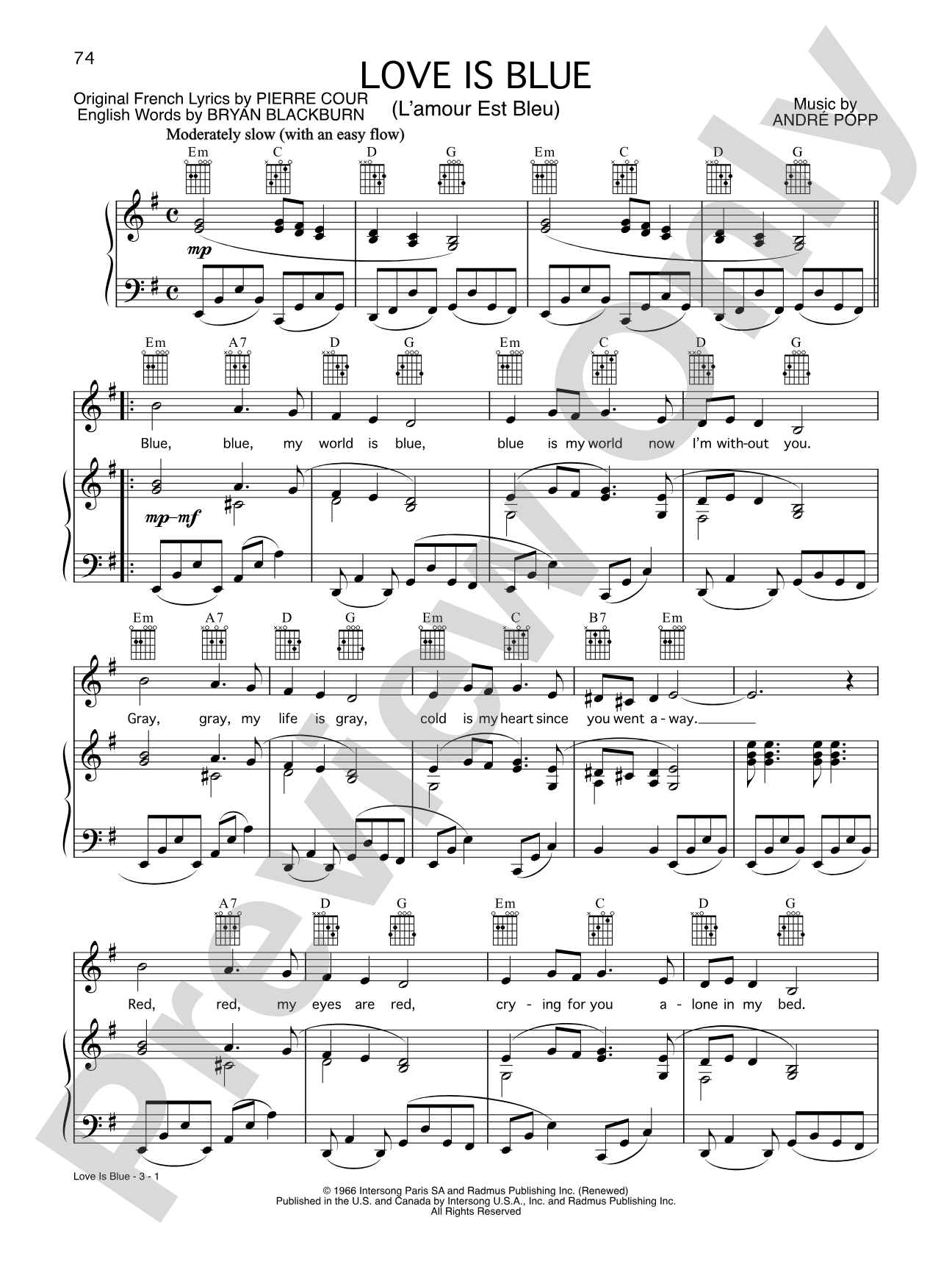
Sample Audio
No sample audio found.
Sample Video
Additional Details
Publisher: Alfred Music
Page Count: 248
SKU: 00-XS-0000074

More about this title

About the Composer: Andre Popp

André Popp (1916-1977) was a French composer and arranger whose gift for melody and sophisticated harmonic sensibility made him one of the most recorded composers of the mid-twentieth century. His work spanned film scores, popular songs, and orchestral arrangements, earning him recognition across multiple musical worlds. Popp's compositions are marked by elegant phrasing and emotional directness, qualities that made his music accessible to performers and audiences alike.

Why we love this

This folio assembles eighty-seven standards and popular songs in a single, performance-ready resource that works equally well for voice and piano teachers, accompanists, and serious amateur pianists. The breadth of material spans decades of popular and film music, giving you flexibility to match repertoire to student interests and skill levels without hunting through multiple books. Each arrangement includes chord symbols for those who want to explore jazz voicings or lead-sheet interpretation alongside traditional notation.

What to expect

These songs embody a golden age of songwriting where craft and sincerity were inseparable. You'll hear clear, memorable melodies paired with thoughtful harmonies that never feel overly sentimental, even in the most romantic moments. The arrangements preserve the intimacy of voice and piano while offering enough harmonic detail to keep the accompaniment engaging.

Who it's for

This collection serves singers preparing audition material, pianist-accompanists building a repertoire of standards, and music teachers seeking accessible yet musically substantial songs for voice lesson contexts. It's equally valuable for pianists who want to expand beyond classical solo work into the richly melodic world of American popular song and film music.

How to get the most out of it

  • Balance the vocal line with chord voicings that support rather than overshadow the melody; these arrangements reward sensitive left-hand accompaniment that breathes with the singer's phrasing.
  • Explore the chord symbols to understand harmonic color; many songs benefit from subtle reharmonization or jazz-inflected comping that goes beyond the printed notation.
  • Use rubato thoughtfully in the quieter, more introspective songs (like 'When I Fall in Love'); the rhythmic freedom makes room for genuine emotional connection.

How to use it

Build a mixed recital around themed selections from this collection, pairing contrasting moods and tempos to create narrative arc across a program. Solo pianists can program individual songs as concert openers or encores, while voice teachers can assign multiple pieces throughout a season to build familiarity with standard repertoire and stylistic conventions of mid-century popular song.

Skills your students will build

  • Reading and interpreting chord symbols in context
  • Phrasing idiomatic to popular song and film music traditions
  • Balancing accompaniment texture with vocal line
  • Understanding harmonic function in diatonic and chromatic contexts
  • Sight-reading across multiple rehearsal and performance materials

You May Also Like