
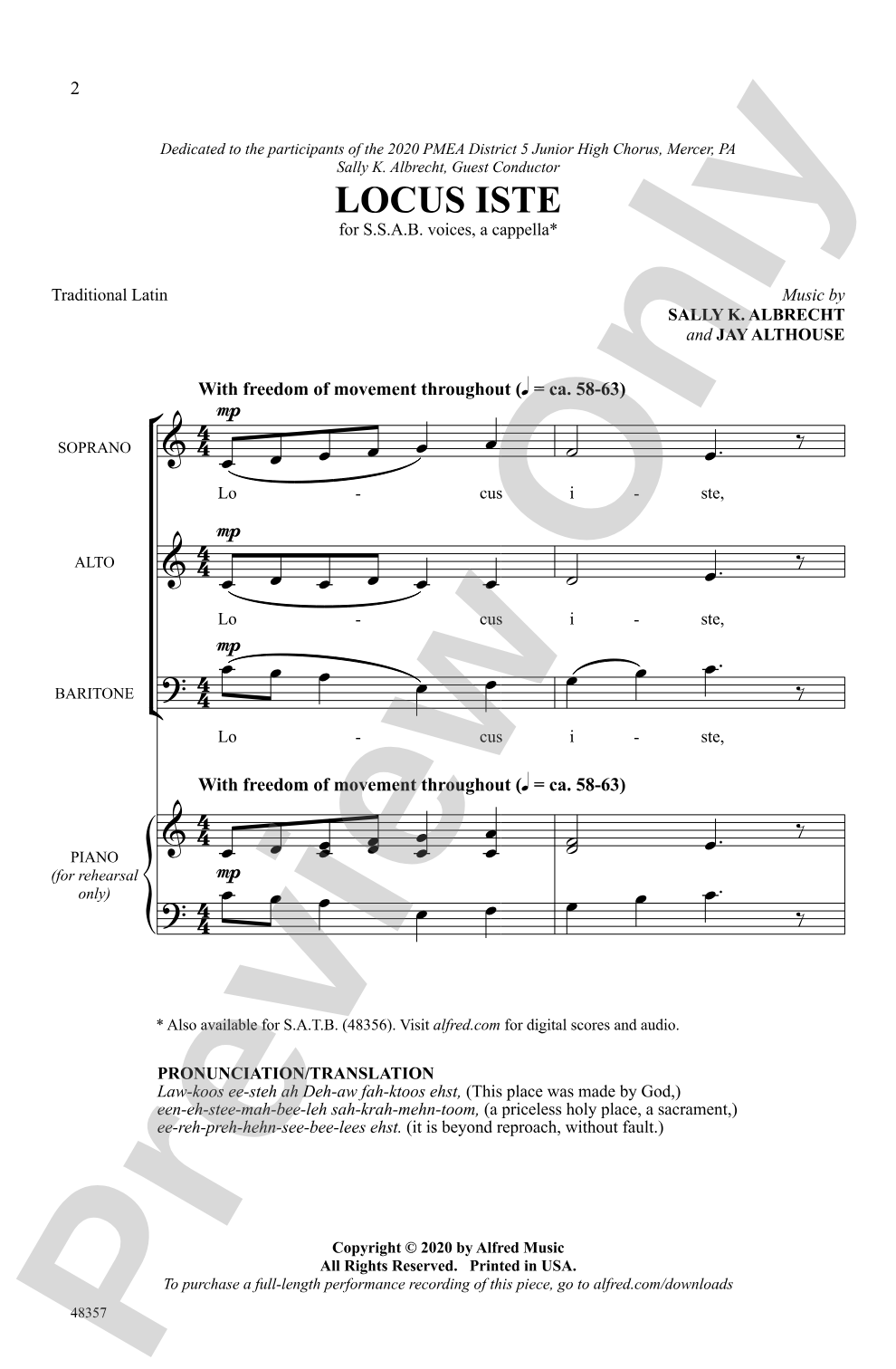

Locus Iste: SSAB, a cappella Choral Octavo
By Sally K. Albrecht and Jay Althouse
Item: 00-PO-0006338
$2.05
Minimum order quantity: 20 copies
Pickup currently not available
Description
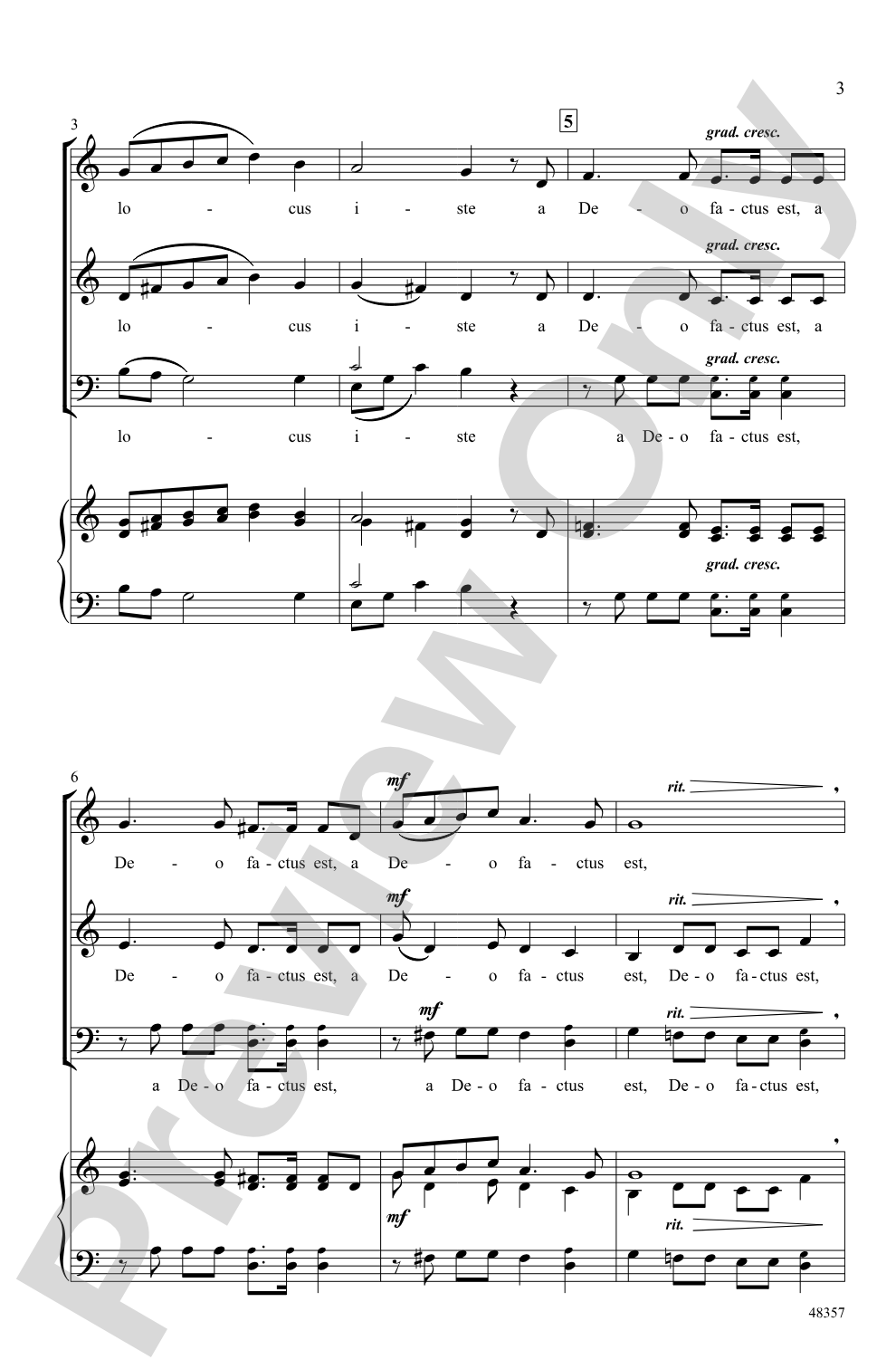
This regal a cappella Latin setting begins on a unison pitch that quickly blossoms into resplendent four-part harmony. Sensible voice leading and conservative intervals encourage good intonation even when we briefly shift to the relative minor key. Short in length but packed with worthwhile teaching moments, including occasional optional divisi in both voicings.


Locus Iste: SSAB, a cappella Choral Octavo isn't in MakeMusic Cloud just yet...but it could be. Let us know you'd like to see it, and you'll help shape what comes next. In the meantime, start a free trial and dive into thousands of interactive titles your students can play along with today.
Request This Title
Tell us you want it.
Start Your Free Trial
Explore everything that's ready to play right now.
Sample Audio
1
Audio File
--:--
0:00
0:00
Sample Video
Additional Details
Series:
Alfred Choral Designs
Publisher:
Alfred Music
Page Count:
8
SKU:
00-PO-0006338
More about this title
About the Composer: Sally K. Albrecht

Sally K. Albrecht brings three decades of publishing expertise and conducting experience to her prolific output as a choral composer. Since 1987, she has received the ASCAP Special Music Award annually and published over 600 choral works alongside 75 larger musicals and songbooks. She has guest-conducted honor choirs at prestigious venues including Lincoln Center, Carnegie Hall, and The Kennedy Center, and served as Director of School Choral, Vocal, and Elementary Publications for major educational music publishers, including Alfred Music.
Albrecht holds degrees from Rollins College (B.A. in Music and Theater, 1976), the University of Miami (M.A. in Drama, 1977; M.M. in Accompanying, 1979), and has taught at Oakland University, Jersey City State College, and Meredith College. Her work is particularly recognized for integrating choral movement into performance. She chairs the Board of Trustees for the Omicron Delta Kappa National Leadership Honor Society and received the Distinguished Alumna Award from both the University of Miami Frost School of Music and Rollins College in 2021. She lives in Wake Forest, North Carolina, with her husband, composer and arranger Jay Althouse.
Why we love this
The opening unison passage gives every singer an immediate foothold before the harmonic architecture unfolds into rich, accessible four-part writing. Albrecht and Althouse use conservative intervals and clear voice leading to maintain intonation stability, particularly through the relative minor excursion, making this a genuinely educational choice for developing ensembles without sacrificing musical substance.
What to expect
Regal and luminous. The piece unfolds like sunlight entering a cathedral space, moving from a single bright note into shimmering harmonic layers that feel both intimate and grand. The brief venture into relative minor adds gentle sophistication without disrupting the overall sense of reverence.
Who it's for
Three-part mixed choirs and treble-voiced ensembles seeking sacred repertoire that combines accessibility with musical depth. This works equally well for developing high school choirs, community groups, and advanced middle school programs looking for concert or festival material with genuine pedagogical reward.
How to get the most out of it
- Begin with the unison pitch as your anchor; ensure the entire ensemble locks onto this single line before expanding into harmony, which sets the foundation for clean intonation throughout.
- When approaching the relative minor section, have singers mark the chromatic inflections in rehearsal so the shift feels intentional rather than accidental.
- Use the optional divisi passages as opportunities to explore texture and blend; experiment with balancing divided and unison voicings to discover what serves the piece's regal character.
- Attend to the text setting throughout; Latin diction should remain clear even as voices multiply, so articulation rehearsal focused on consonants will pay dividends.
How to use it
Program this on a sacred concert or ecumenical service alongside other Latin texts to build thematic cohesion. Its concise length makes it ideal for opening a set or bridging sections of larger programs, and its concert and festival designation means it serves dual purposes in both performance and competition settings.
Skills your students will build
- Singing from a unison starting point into multi-part harmony
- Sustaining intonation through conservative interval relationships
- Navigating key modulation to the relative minor
- Balancing divided and unison voicings
- Maintaining Latin text clarity across expanded harmonic texture