
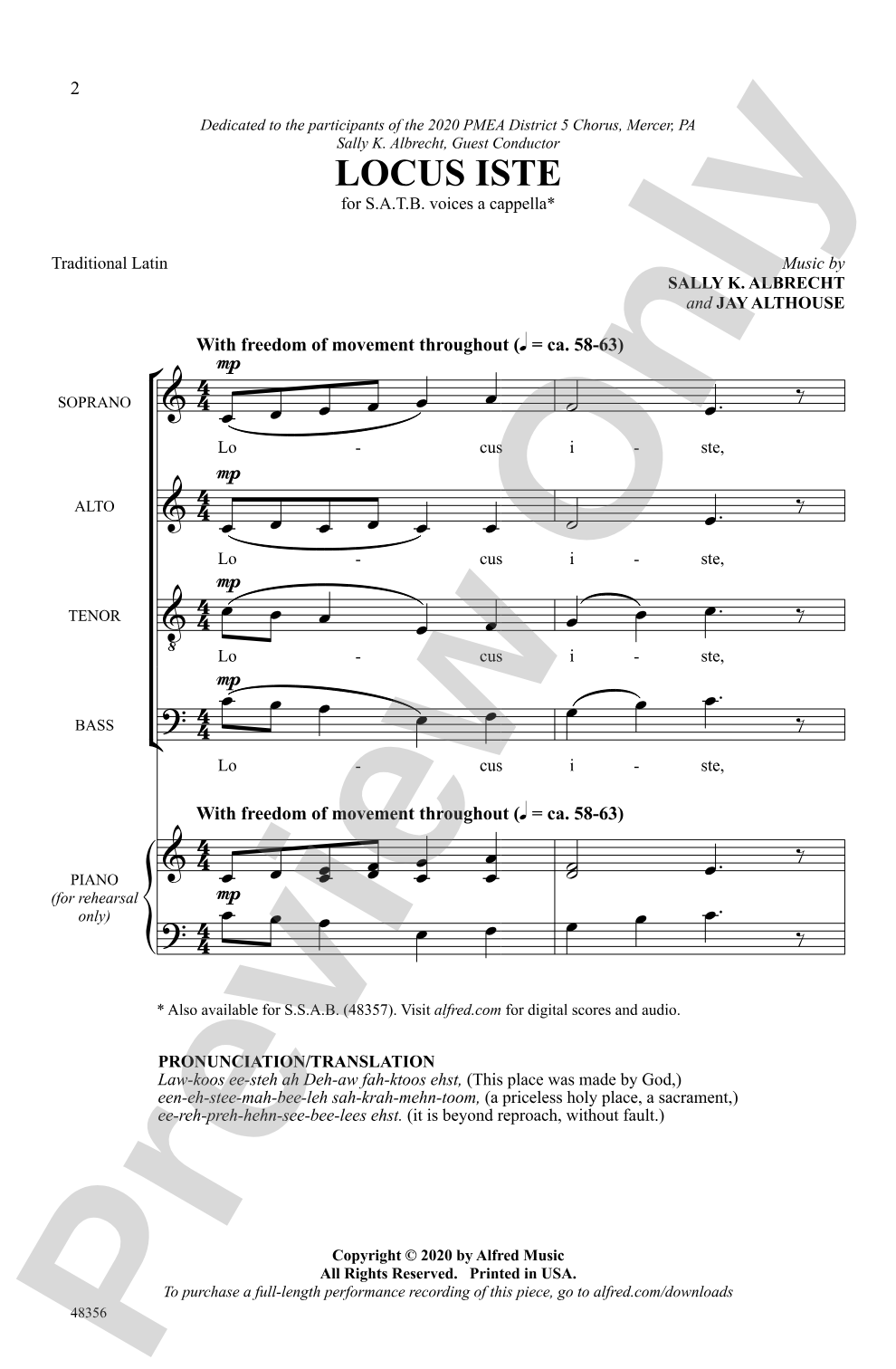

Locus Iste: SATB a cappella Choral Octavo
By Sally K. Albrecht and Jay Althouse
Item: 00-PO-0006337
$2.05
Minimum order quantity: 20 copies
Pickup currently not available
Description
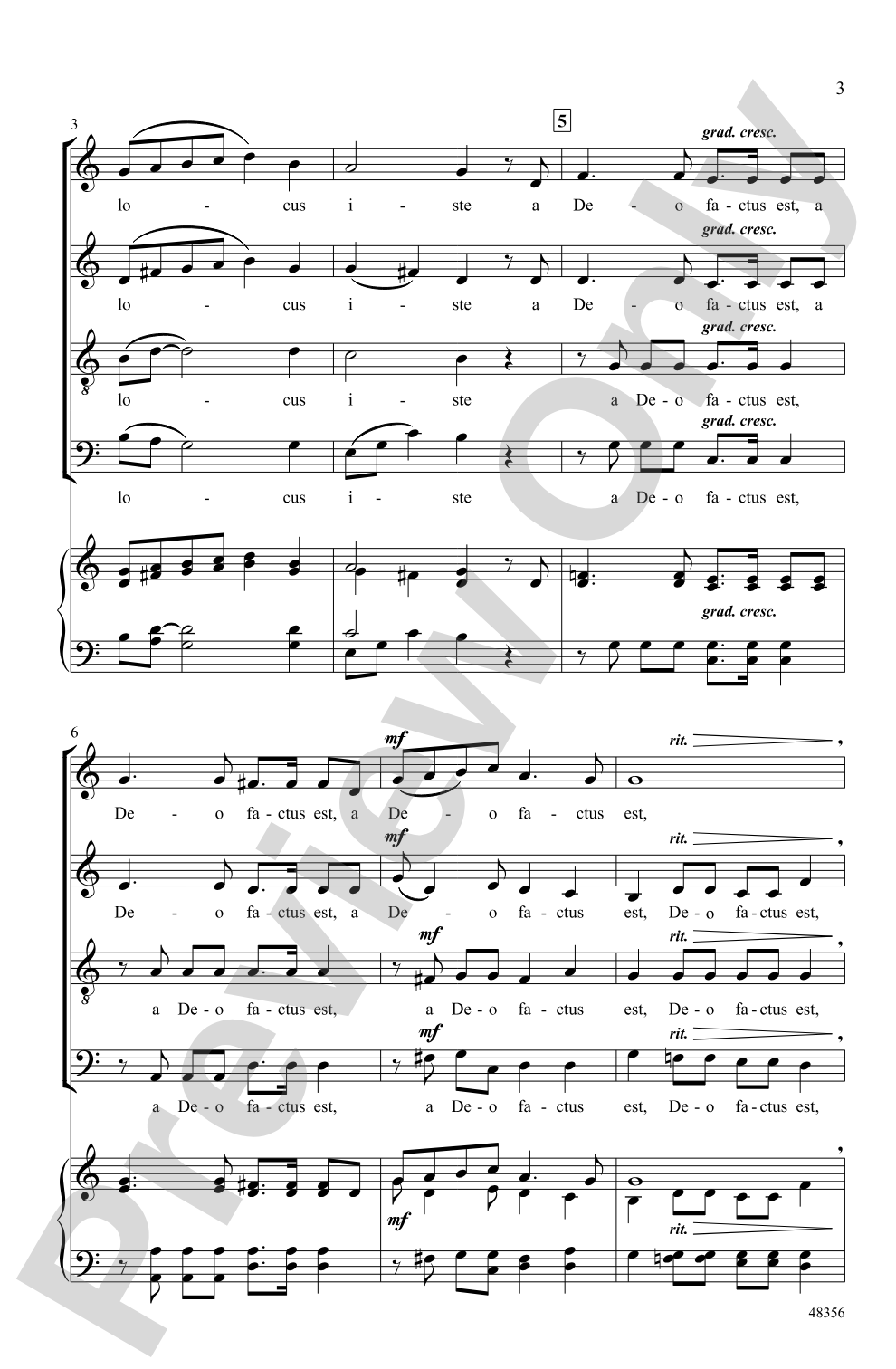
This regal a cappella Latin setting begins on a unison pitch that quickly blossoms into resplendent four-part harmony. Sensible voice leading and conservative intervals encourage good intonation even when we briefly shift to the relative minor key. Short in length but packed with worthwhile teaching moments, including occasional optional divisi in both voicings.


Locus Iste: SATB a cappella Choral Octavo isn't in MakeMusic Cloud just yet...but it could be. Let us know you'd like to see it, and you'll help shape what comes next. In the meantime, start a free trial and dive into thousands of interactive titles your students can play along with today.
Request This Title
Tell us you want it.
Start Your Free Trial
Explore everything that's ready to play right now.
Sample Audio
1
Audio File
--:--
0:00
0:00
Sample Video
1 / 2
Additional Details
Series:
Alfred Choral Designs
Publisher:
Alfred Music
Page Count:
8
SKU:
00-PO-0006337
More about this title
About the Composer: Sally K. Albrecht

Sally K. Albrecht has shaped American choral music for over three decades, earning ASCAP Special Music Awards annually since 1987 and publishing more than 600 choral works alongside 75 larger musicals and songbooks. Her influence extends across the country through conducting at prestigious venues including Lincoln Center, Carnegie Hall, and The Kennedy Center, and through her long tenure as Director of School Choral, Vocal, and Elementary Publications at major educational publishers, most notably Alfred Music.
Albrecht holds degrees from Rollins College (B.A. in Music and Theater, 1976), the University of Miami (M.A. in Drama, 1977, and M.M. in Accompanying, 1979), and has taught in music departments at Oakland University, Jersey City State College, and Meredith College. She is particularly recognized for her innovative integration of movement into choral performance. A Cleveland native now based in North Carolina with her husband and composer Jay Althouse, she serves on the Board of Trustees at Rollins College and has received the Distinguished Alumna Award from both Rollins and the University of Miami Frost School of Music.
Why we love this
The unison opening is a gift for building confidence before the choir expands into four-part writing, making this accessible without feeling simplistic. Albrecht and Althouse have engineered the voice leading with real care for intonation; singers will feel supported by the harmonic choices even during the shift to the relative minor. At eight pages, this piece delivers substantial musicality and teaching value without overstaying its welcome in rehearsal or performance.
What to expect
Locus Iste unfolds with quiet dignity, beginning in unison before blossoming into rich, sustained harmony that feels both spacious and intimate. The shift into the relative minor adds gentle shadow and introspection, creating a moment of musical depth that rewards focused listening and attentive singing.
Who it's for
Directors working with intermediate to advanced SATB choirs seeking repertoire that combines liturgical elegance with pedagogical purpose. This piece suits both concert programming and festival competition, and works equally well with high school choirs building confidence in a cappella singing and college or community ensembles seeking shorter, impactful sacred works.
How to get the most out of it
- Spend time on the unison section to establish a centered, supported tone. The ensemble sound here sets expectations for blend and vowel consistency throughout the piece.
- Approach the transition to four-part harmony as a gradual opening rather than an abrupt expansion. Slight attention to balance in the inner voices will let the progression feel organic.
- When navigating the relative minor key shift, remind singers that Albrecht's conservative intervals are intentional safeguards for tuning. Trust the voice leading; it will not pull them off pitch.
- The optional divisi passages allow flexibility depending on your section strength. Use them as an opportunity to adjust texture and reinforce individual voice independence without requiring additional rehearsal time.
How to use it
Program this as an opening or closing statement in a concert built around sacred music, where its brevity allows room for longer works or contrasting pieces. It serves equally well as a festival offering, where the clear voice leading and accessible difficulty level showcase musicianship without excessive technical demands.
Skills your students will build
- Singing in unison with precise intonation and blend before transitioning to four-part harmony
- Voice leading awareness through observing conservative intervals in major and relative minor keys
- A cappella ensemble balance and blend across SATB voicing
- Reading and performing optional divisi passages with flexibility
- Latin diction and vowel consistency in sacred repertoire