
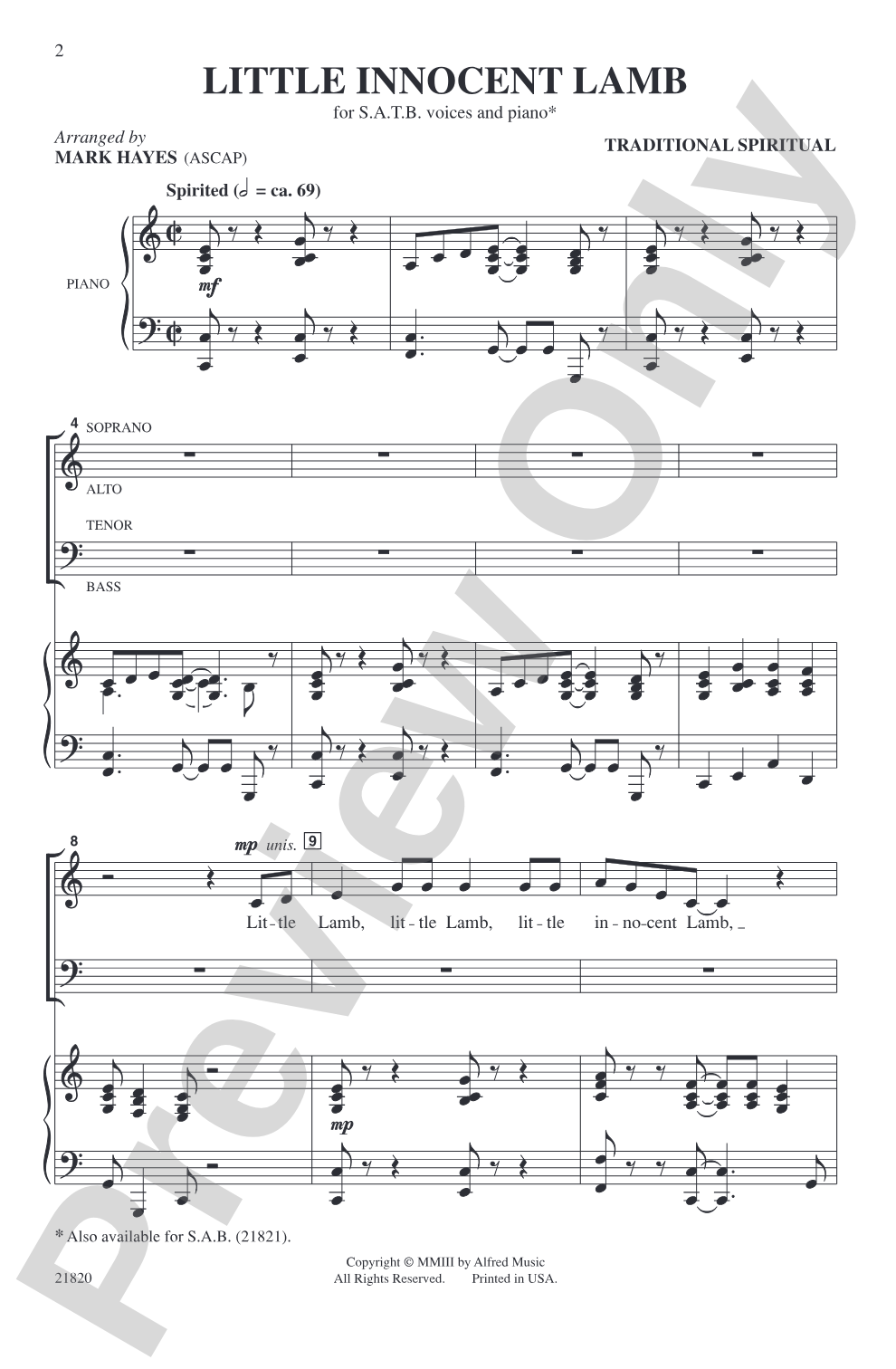
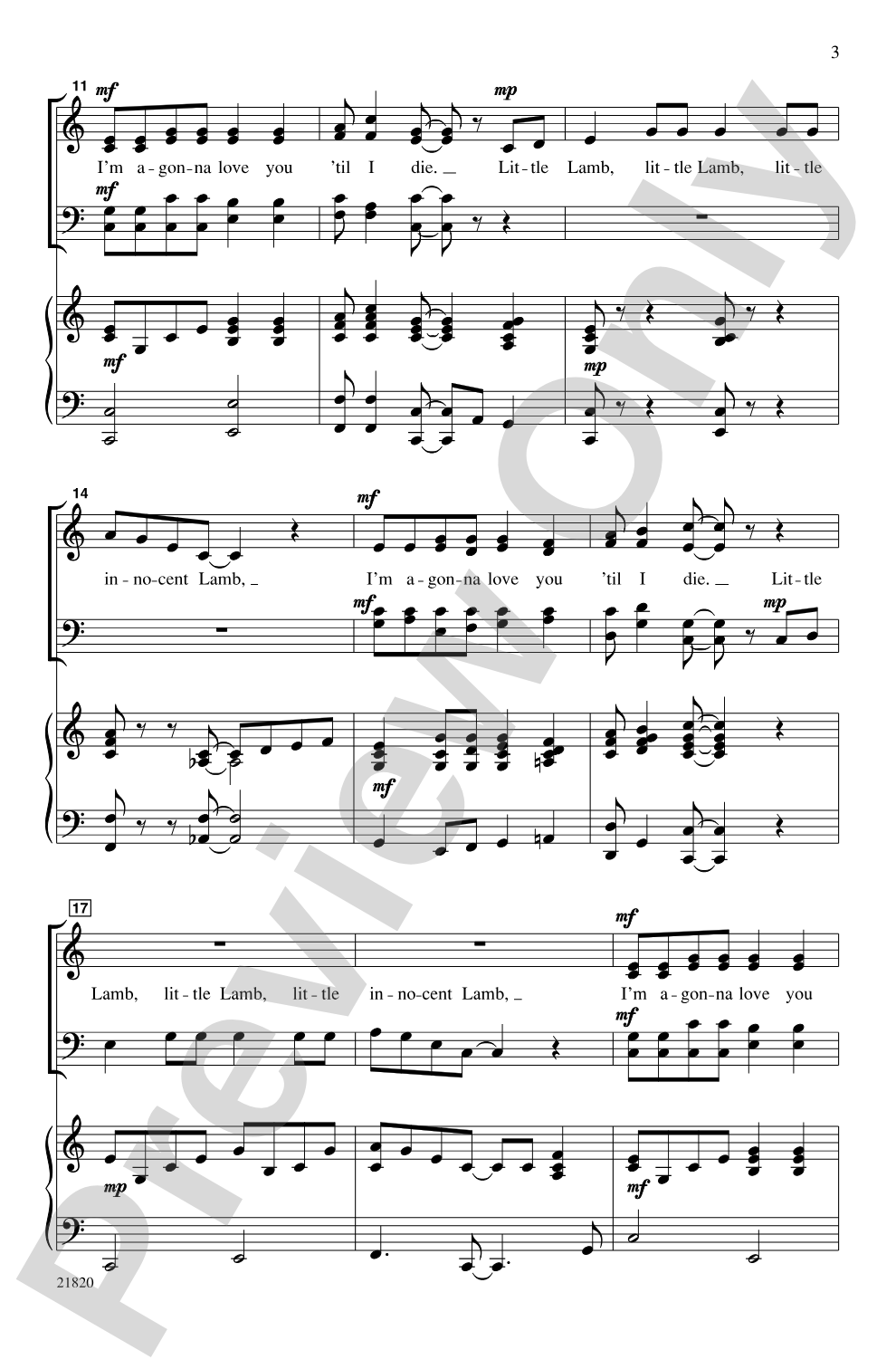
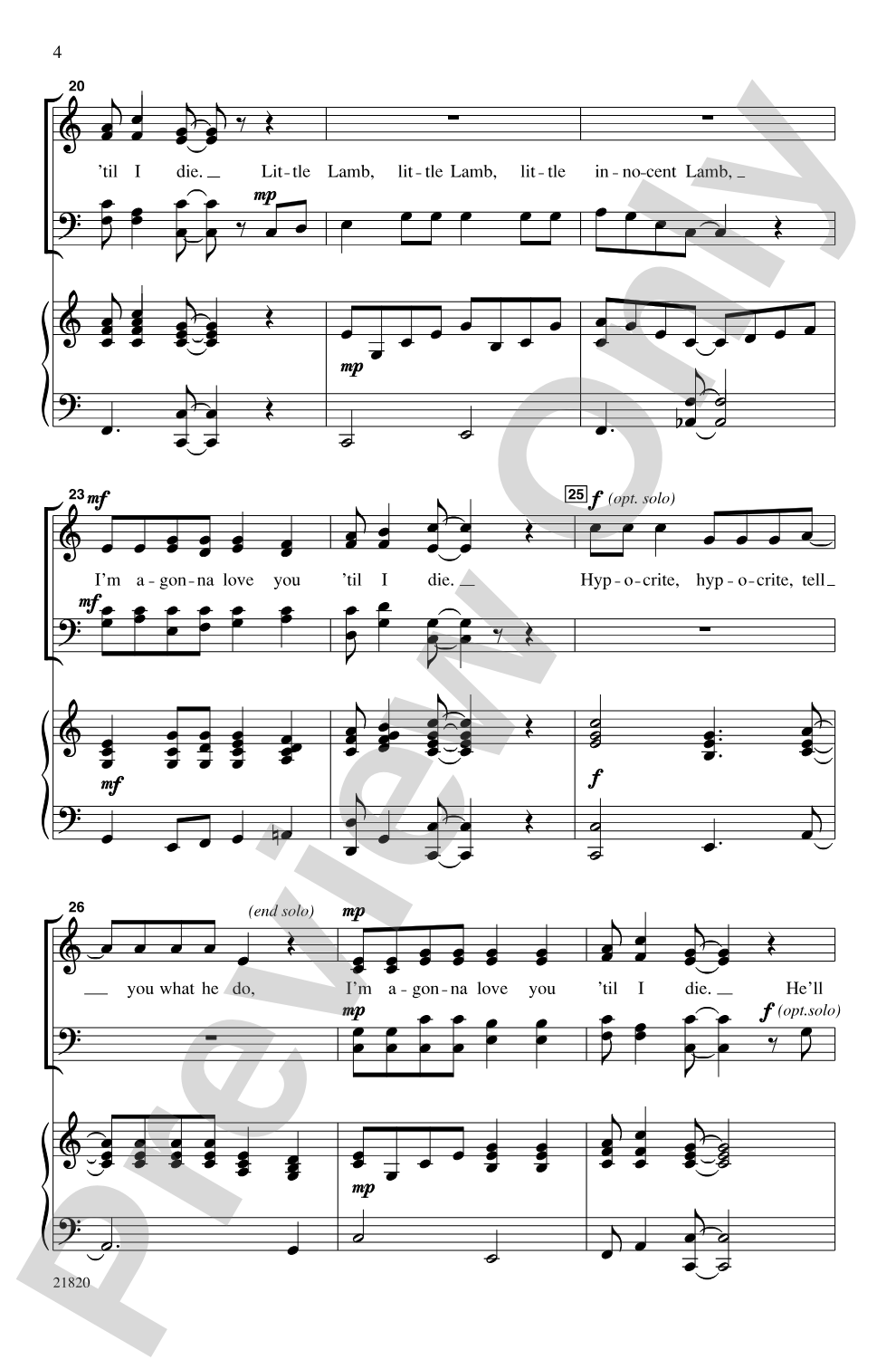

Little Innocent Lamb: SATB Choral Octavo
Arr. Mark Hayes
Item: 00-PO-0004297
$2.95
Minimum order quantity: 20 copies
Pickup currently not available
Description
You're gonna love this manageable and fun version of the famous spiritual Little Innocent Lamb by Mark Hayes. Primarily a unison call and choral response arrangement, this American favorite is revitalized with fresh harmonies and varied textures. A charming piano part accompanies your three or four part mixed choir as they proclaim, "I'm a-gonna love you 'til I die" in new chords at the cadence of every phrase. Appropriate all year long.


Little Innocent Lamb: SATB Choral Octavo isn't in MakeMusic Cloud just yet...but it could be. Let us know you'd like to see it, and you'll help shape what comes next. In the meantime, start a free trial and dive into thousands of interactive titles your students can play along with today.
Request This Title
Tell us you want it.
Start Your Free Trial
Explore everything that's ready to play right now.
Sample Audio
1
Audio File
--:--
0:00
0:00
Sample Video
No sample videos found.
Additional Details
Series:
Alfred Archive Edition: Alfred Choral Designs
Publisher:
Alfred Music
Page Count:
16
SKU:
00-PO-0004297
More about this title
About the Arranger: Mark Hayes
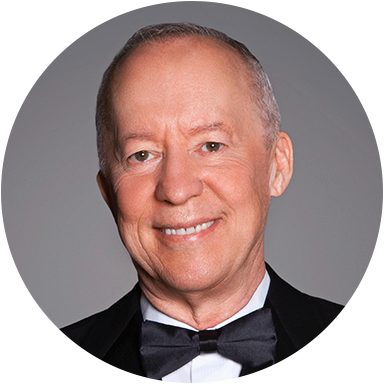
Mark Hayes stands among the most prolific composers and arrangers in American sacred and secular music, with more than 1,750 published works to his name. A concert pianist and conductor trained at Baylor University, Hayes has guest conducted at Lincoln Center, the National Cathedral, and Carnegie Hall, while his compositions (including his Requiem, Te Deum, and Magnificat) have been performed at major venues worldwide. In 2010, Baylor University honored him with the Award for Exemplary Leadership in Christian Music, and his work has extended beyond concert halls to orchestration for musicals and film.
Hayes's catalog spans gospel, classical, jazz, and Broadway idioms, with over 100 piano publications reflecting his deep commitment to the instrument. Whether composing at his home in Kansas City or conducting premieres across the globe, his mission remains rooted in creating music that serves both the performer and the listener with craftsmanship and accessibility.
Why we love this
Hayes takes the familiar spiritual and strips away any staleness by framing it as a conversation between soloist (or section) and full choir. The new harmonic language at phrase cadences keeps singers engaged, and the unison sections give less confident voices a secure place to land while building momentum toward fuller textures. This is exactly the kind of arrangement that reminds singers why they love this tune in the first place.
What to expect
Warm, earnest, and full of gentle surprises. The unison passages feel like a familiar hymn, but the moment the harmonies shift, you sense Hayes has found new emotional territory within an old song. There's joy in the simplicity and grace in the restraint.
Who it's for
This octavo works for volunteer and chamber choirs at all levels of experience, from beginning mixed ensembles to community and church choirs seeking accessible yet artistically rewarding sacred music. Directors looking for spirituals that feel contemporary without sacrificing authenticity will find this version refreshing and immediately singable.
How to get the most out of it
- Emphasize the call-and-response dialogue by having the soloist or small group own the opening phrases with confidence, then invite the choir to answer with warmth rather than volume.
- Let the varied textures breathe naturally; don't rush transitions between unison and SATB sections, as the contrast itself carries the emotional weight.
- Work the final cadence of each phrase carefully with the piano part, since that's where the fresh harmonic language lives. Make sure all four voice parts hear and lock onto those new chords so the moment lands cleanly.
- Balance the piano part so it supports but never overwhelms; this arrangement trusts the choir to carry the story.
How to use it
Program this as a centerpiece for a spirituals set, or use it to anchor a mixed sacred program where you need something grounded and singable between longer, more complex works. The 16-page length makes it ideal for concerts celebrating American choral traditions or as a bridge piece between seasons in church services.
Skills your students will build
- Voice independence in SATB writing, particularly navigating between unison and four-part textures
- Listening to harmony changes at phrase endings and responding with accurate intonation
- Ensemble blend and balance when moving from solo or small-group statements to full choir response
- Interpretation of spiritual idiom and call-and-response tradition within a contemporary harmonic framework