
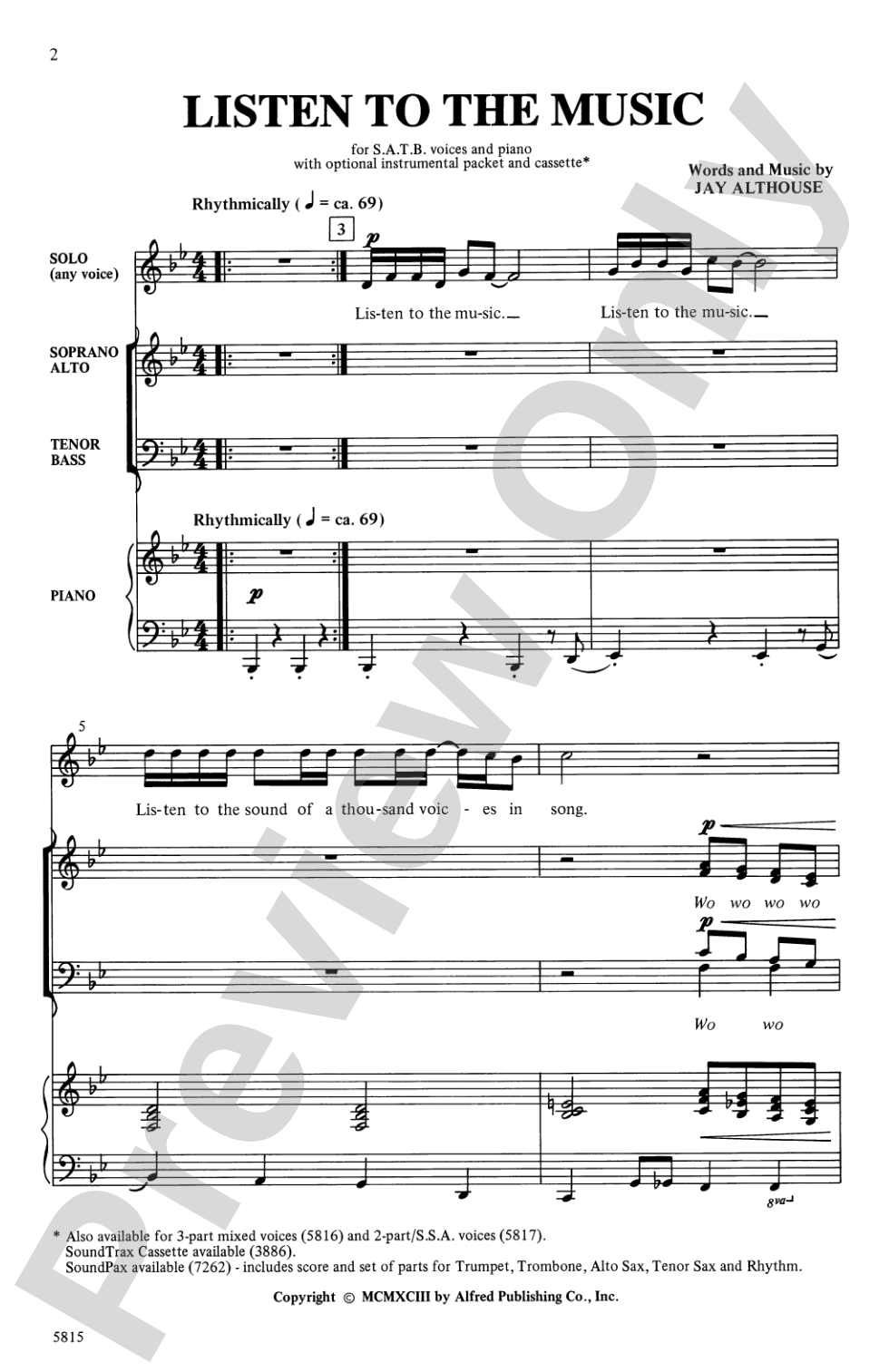
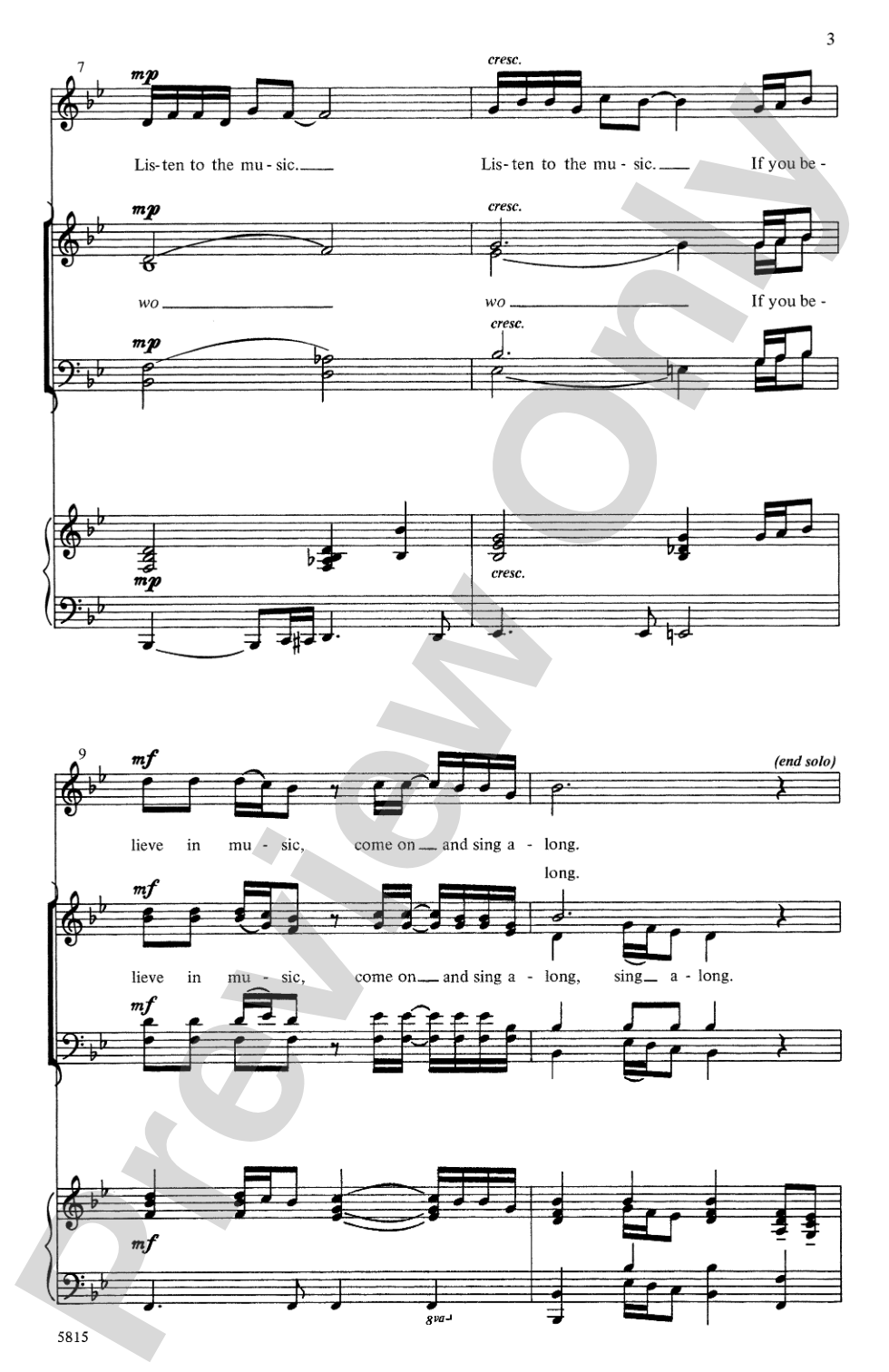
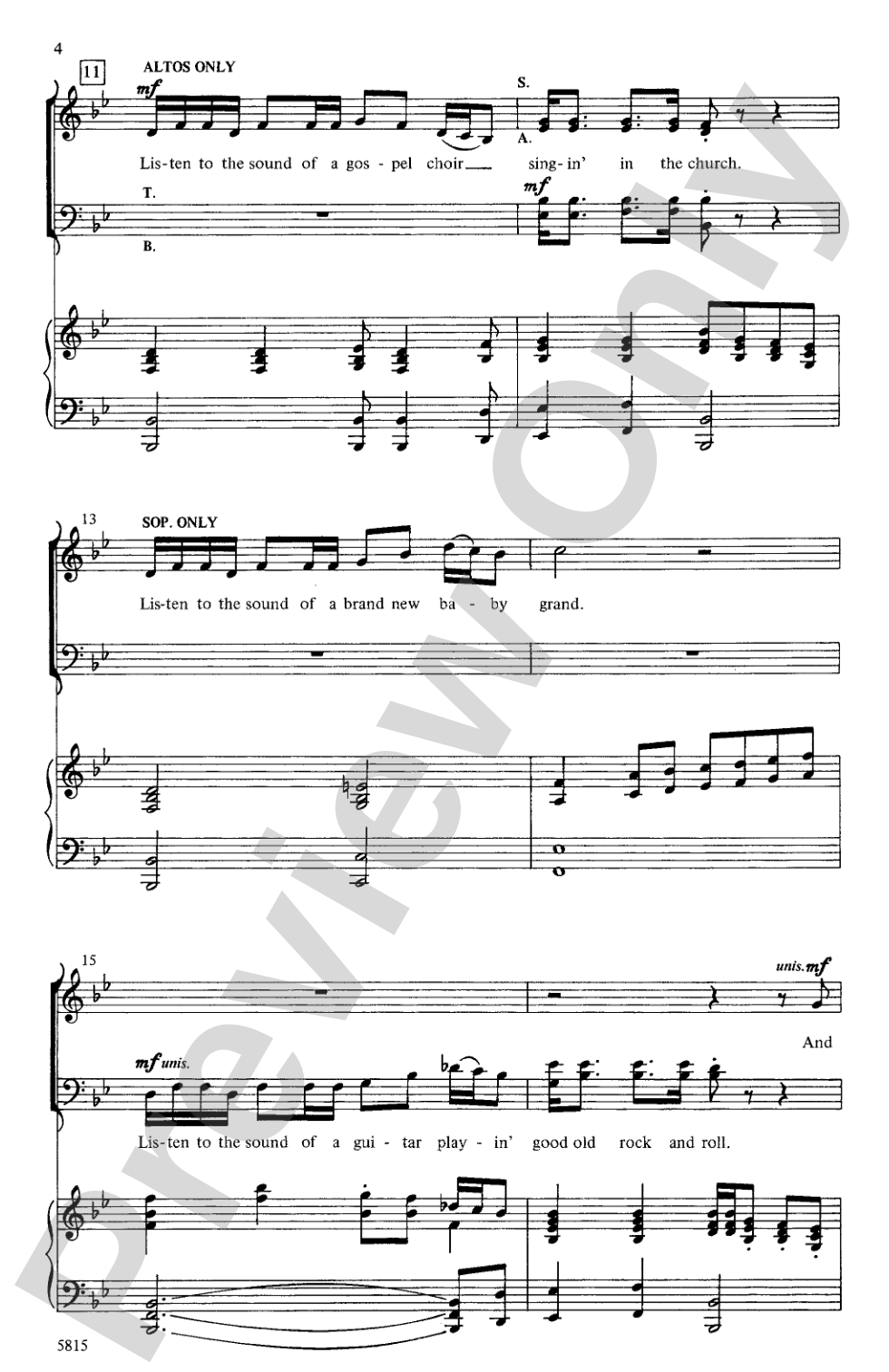

Listen to the Music: SATB Choral Octavo
Music by Jay Althouse
Item: 00-PO-0006733
$2.25
Minimum order quantity: 20 copies
Pickup currently not available
Related Items
Listen to the Music: SATB Choral Octavo |
$2.25
|
View |
Description
One of the best "music" songs we've heard in years, Listen to the Music illustrates how music is all around us. "Listen to the sound of a brand new baby grand" or a "big, brass, Dixieland band." It's all here, from "the rhythm of the city" to "the sound of a thousand voices in song." Optional treble trio on the final chorus. Ideal for Music In Our Schools Week or as a "theme" for any concert.


Listen to the Music: SATB Choral Octavo isn't in MakeMusic Cloud just yet...but it could be. Let us know you'd like to see it, and you'll help shape what comes next. In the meantime, start a free trial and dive into thousands of interactive titles your students can play along with today.
Request This Title
Tell us you want it.
Start Your Free Trial
Explore everything that's ready to play right now.
Sample Audio
No sample audio found.
Sample Video
No sample videos found.
Additional Details
Series:
Alfred Archive Edition: Alfred Choral Designs
Publisher:
Alfred Music
Page Count:
12
SKU:
00-PO-0006733
More about this title
About the Composer: Jay Althouse

Jay Althouse holds degrees in Music Education and Music from Indiana University of Pennsylvania, where he was later honored as a Distinguished Alumnus. Early in his career, he spent eight years managing rights and licenses for a major educational music publisher and served on the Executive Board of the Music Publishers Association of America. His work as a composer has resulted in over 800 published choral pieces performed regularly across the English-speaking world, earning him consistent recognition through ASCAP awards for excellence in standard music composition.
Beyond composing, Althouse has shaped music education through numerous publications: co-authored choral warm-up resources and composer study guides, compiled respected vocal solo collections, and created classroom-ready materials on music literacy and assessment. He collaborated with his wife, Sally K. Albrecht, on children's musicals and on "I Hear America Singing," a choral work performed by the San Francisco Girls and Boys Choirs at President Obama's inauguration in 2009. Currently residing in North Carolina, he serves on the National Advisory Board of the Folk Art Society of America and contributes regularly to its publications.
Why we love this
Althouse captures something genuine about why we value music in the first place. Rather than celebrating music in abstract terms, this piece catalogs the real sounds students actually hear: a baby grand, a brass band, the rhythm of the city, voices singing together. The optional treble trio on the final chorus gives directors a flexible staging option that feels earned rather than gimmicky, and the piece works equally well as a concert opener, a Music In Our Schools Week anchor, or a thematic statement about your program's identity.
What to expect
Listen to the Music radiates warmth and recognition. The text invites singers and listeners alike to pause and notice the music already surrounding them, creating an immediate sense of connection. There's genuine joy in the harmonic movement and in the way the piece celebrates human musicality in all its forms, from concert halls to city streets.
Who it's for
This piece works for treble choirs learning to blend four-part harmony, as well as for mixed ensembles at the secondary or adult level. It's especially valuable for programs seeking accessible, meaningful repertoire that resonates with students who may be encountering SATB voicing for the first time.
How to get the most out of it
- Encourage singers to visualize the specific sounds the text references (a grand piano, a Dixieland band, city rhythms, a choir in full voice). These mental images will naturally shape phrasing and tone color.
- If you're using movement or staging, keep it grounded and purposeful rather than overly choreographed. The song's strength lies in its authentic celebration of music itself.
- Balance the SATB sections carefully so that when the treble trio enters on the final chorus, it sounds like a genuine addition rather than a layer on top. Consider how the full ensemble can support that moment.
- Recorded accompaniments are available separately; using one can help with intonation and ensemble cohesion, particularly if this is a piece your choir learns quickly for a specific event.
How to use it
Open a concert with this piece to set a reflective, celebratory tone about why your program exists. It's also a natural fit for Music In Our Schools Week performances or as a finale that bookends a concert's thematic arc. The optional treble trio makes it flexible for programs mixing SATB and SSA/treble repertoire on the same program.
Skills your students will build
- SATB voice independence and blend
- Interpretive phrasing tied to text imagery
- Optional: staging and movement coordination with singing
- Ensemble intonation across four parts