Leap Frog - Piano Solo Sheet Music Preview

Leap Frog - Piano Solo: Piano

By Kathy Holmes

Level: Early Elementary

Item: 00-PB-0000776

Digital Download
$3.50
Description
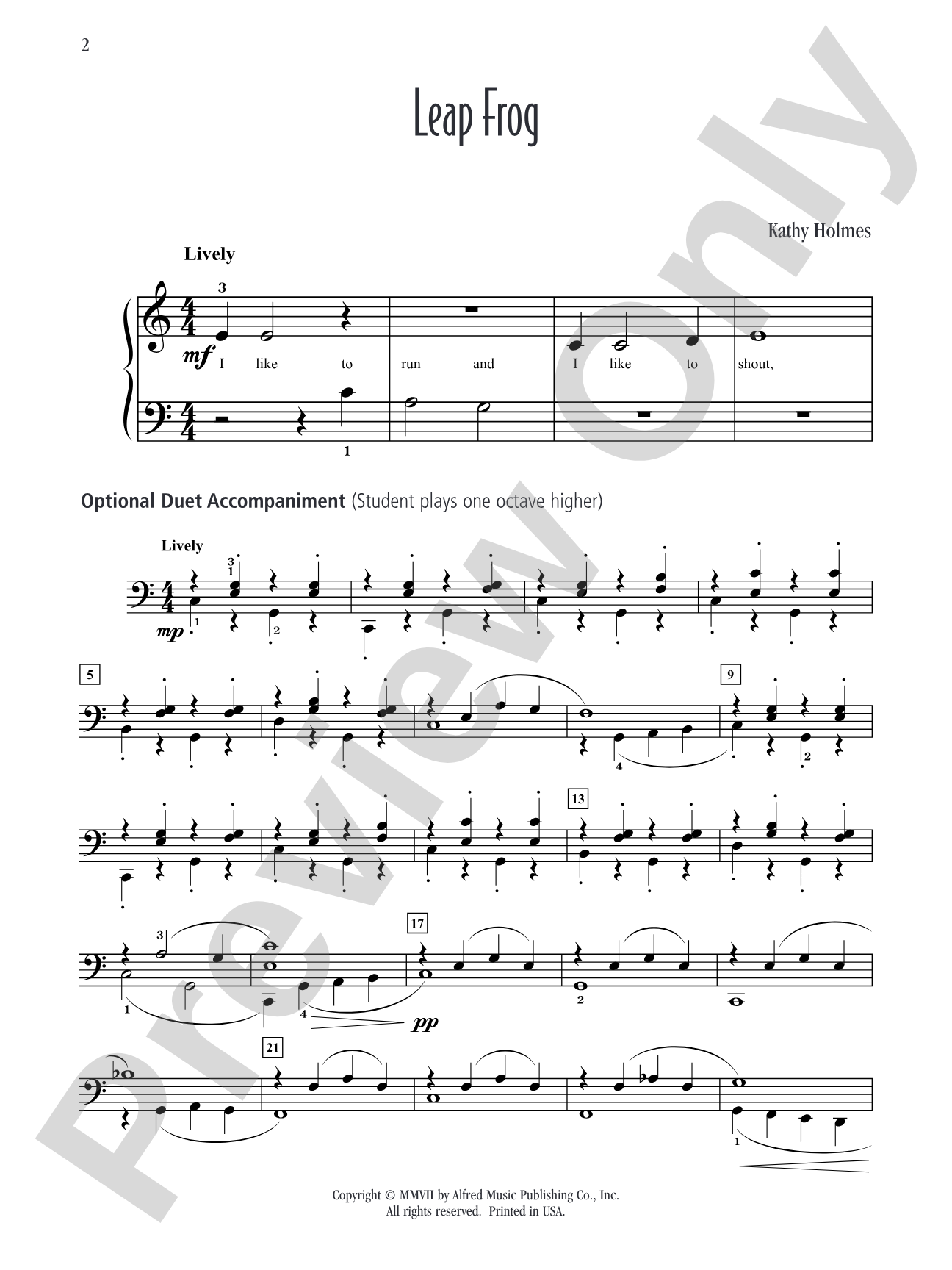
Young piano students are sure to have fun with this beginning piano solo written in 4/4 meter and Middle C position. The childhood game of "Leap Frog" is depicted in both the lyrics and the music. The melody is divided between both hands and features an easy syncopated rhythm pattern that is repeated throughout the solo. An optional duet accompaniment creates an energetic harmonic background. A Federation Festivals 2016-2020 selection. A Federation Festivals 2020-2024 selection.

Leap Frog - Piano Solo: Piano isn't in MakeMusic Cloud just yet...but it could be. Let us know you'd like to see it, and you'll help shape what comes next. In the meantime, start a free trial and dive into thousands of interactive titles your students can play along with today.

Sample Audio
No sample audio found.
Sample Video
Additional Details
Series: Signature Series
Publisher: Alfred Music
Page Count: 4
SKU: 00-PB-0000776

More about this title

About the Composer: Kathy Holmes

Kathy Holmes

Kathy Holmes discovered the piano early in childhood and has woven it into every phase of her life. After earning a degree in Early Childhood Education from Cabrillo College in California, she devoted two decades to raising her three children. Once her youngest entered school, she began her second career path in her forties, pursuing formal music training at Hiram College in Ohio while simultaneously starting to compose and teach piano.

Now an active member of The Western Reserve Piano Teachers in the greater Cleveland area, Holmes brings both pedagogical insight and compositional skill to her work. Her professional community of piano educators fuels her commitment to writing music that resonates with young students and teachers alike.

Why we love this

Holmes captures the playful spirit of the childhood game while respecting the early elementary student's technical boundaries. The repeated syncopated rhythm pattern gives students something tangible to master, and the optional duet accompaniment transforms practice into a genuine musical partnership rather than a solitary exercise.

What to expect

Playful and slightly mischievous, like watching children dart across a playground. The melody bounces between the hands with a gentle swagger, and the syncopated rhythm gives the music a lighthearted, almost comedic energy that invites students to smile while they play.

Who it's for

Beginning piano students who need repertoire that matches their technical level while keeping them genuinely engaged. This solo works equally well as a recital piece or as a confidence builder during lessons when students are transitioning from method book material to independent repertoire.

How to get the most out of it

  • Anchor the syncopated pattern by tapping it separately before integrating it into the full piece. Once it feels natural, the leaping motion between hands will emerge organically.
  • If performing with the duet accompaniment, rehearse together early so the student hears how the melody rides over the harmonic foundation rather than floating independently.
  • Keep the tempo steady and energetic without rushing. Young students often accelerate when excited; a metronome helps them feel the consistent pulse that makes the syncopation land clearly.
  • Encourage hand position awareness since the piece stays in Middle C position. Proper alignment reduces tension and allows the student to focus on rhythm and musical phrasing rather than technical scrambling.

How to use it

Include this in a spring or early-summer recital as a lighter moment that appeals to family audiences and younger listeners. It also works well in a progressive recital program where it sits comfortably between other early elementary selections, giving students at that level visible representation on the stage.

Skills your students will build

  • Playing melody between both hands while maintaining hand position
  • Reading and executing syncopated rhythm patterns
  • Coordinating with an accompanist (optional duet version)
  • Maintaining steady tempo and pulse in a repeating rhythmic figure
  • Building confidence with recognized, playful repertoire at an early level

You May Also Like