
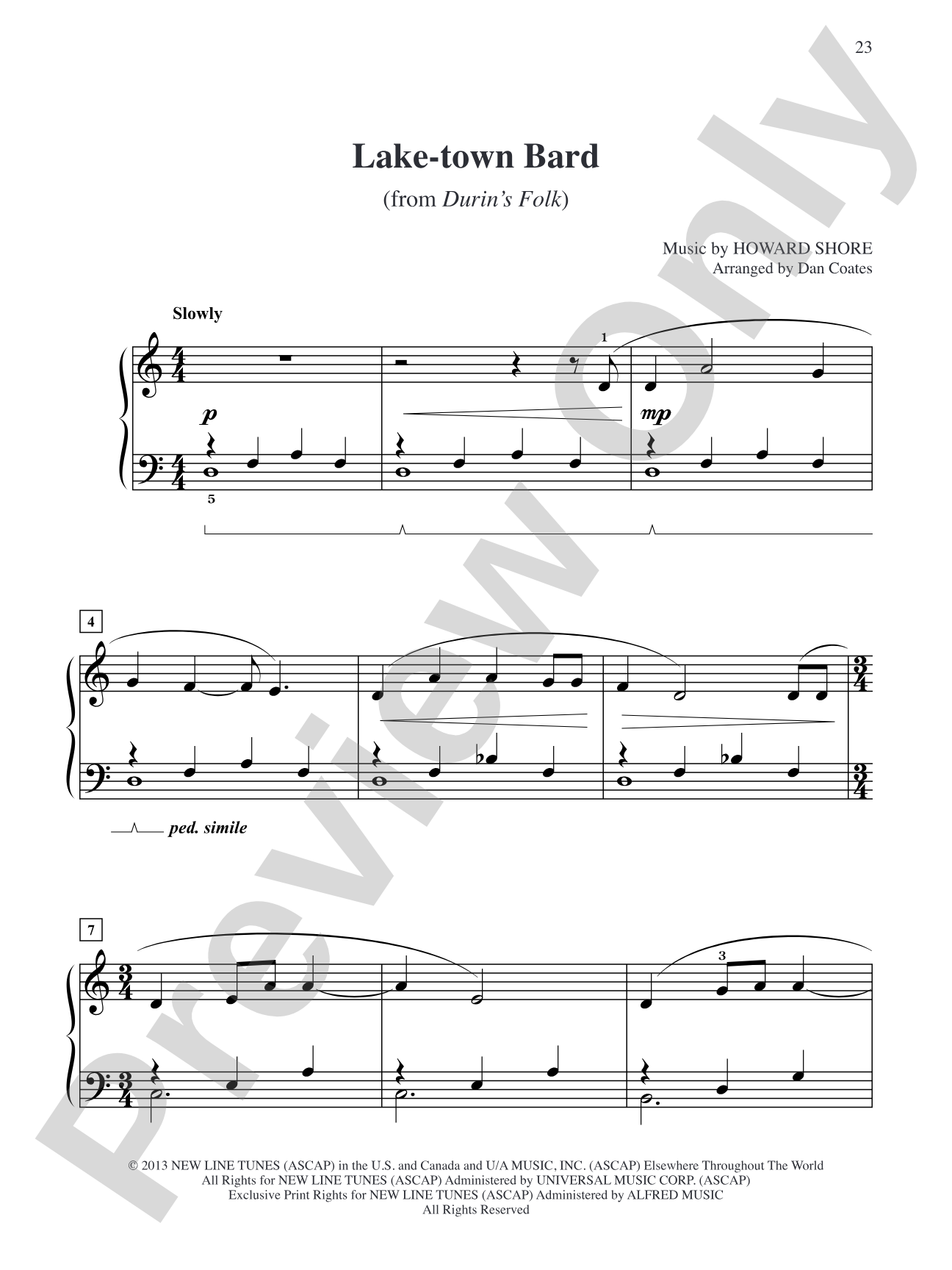

Lake-town Bard (from The Hobbit: The Desolation of Smaug): Easy Piano
Easy Piano Selections from the Original Motion Picture Soundtrack
By Howard Shore / arr. Dan Coates
Level: Easy Piano
Item: 00-PS-0015935
$4.99
One moment…
Related Items
Beyond the Forest (from The Hobbit: The Desolation of Smaug): Easy Piano |
$4.99
|
View | |
Erebor (from The Hobbit: The Desolation of Smaug): Easy Piano |
$5.99
|
View | |
Bree (from The Hobbit: The Desolation of Smaug): Easy Piano |
$4.99
|
View | |
Beorn (from The Hobbit: The Desolation of Smaug): Easy Piano |
$4.99
|
View | |
Bard A Man of Lake-town (from The Hobbit: The Desolation of Smaug): Easy Piano |
$4.99
|
View | |
Bard and Family (from The Hobbit: The Desolation of Smaug): Easy Piano |
$4.99
|
View | |
Lake-town (from The Hobbit: The Desolation of Smaug): Easy Piano |
$4.99
|
View | |
Girion Lord of Dale (from The Hobbit: The Desolation of Smaug): Easy Piano |
$4.99
|
View | |
House of Durin (from The Hobbit: The Desolation of Smaug): Easy Piano |
$4.99
|
View | |
Smaug (from The Hobbit: The Desolation of Smaug): Easy Piano |
$4.99
|
View | |
I See Fire (from The Hobbit: The Desolation of Smaug): Easy Piano |
$4.99
|
View | |
The Hobbit: The Desolation of Smaug: Piano Book |
$15.99
|
View |
Description
With The Hobbit: The Desolation of Smaug, audiences worldwide were transported back to Middle-earth for more thrills and adventure. 12 pieces from Howard Shore's brilliant score have been arranged for Easy Piano. Pianists will have both classic and new themes from the epic journey right at their fingertips as they play. In addition to the piano arrangements, this beautifully produced souvenir folio features an array of colorful photos from the film. Titles: Erebor * Bree * Beorn * Bard, A Man of Lake-town * Bard and Family * Lake-town * Girion, Lord of Dale * Lake-town Bard * House of Durin * Smaug * I See Fire * Beyond the Forest.


Lake-town Bard (from The Hobbit: The Desolation of Smaug): Easy Piano isn't in MakeMusic Cloud just yet...but it could be. Let us know you'd like to see it, and you'll help shape what comes next. In the meantime, start a free trial and dive into thousands of interactive titles your students can play along with today.
Request This Title
Tell us you want it.
Start Your Free Trial
Explore everything that's ready to play right now.
Sample Audio
No sample audio found.
Sample Video
No sample videos found.
Additional Details
Publisher:
Alfred Music
Page Count:
40
SKU:
00-PS-0015935
More about this title
About the Composer: Howard Shore
Howard Shore is a film composer whose orchestral scores have defined the sound of modern fantasy cinema. His work on Peter Jackson's adaptations of J.R.R. Tolkien's Middle-earth stories earned him three Academy Awards and established him as a master of large-scale, thematically rich composition.
For music educators, Shore's legacy lies in the accessibility and emotional clarity of his melodies. Even when simplified for piano students, his themes retain their narrative power and harmonic sophistication, making them ideal vehicles for developing both technical skill and musical storytelling.
Why we love this
These arrangements capture the sweep and character of Shore's score without demanding advanced technique, letting pianists explore film music composition at their level. The collection spans intimate character themes and grand adventure moments, giving you genuine variety within a cohesive musical world. Pairing the music with the film stills in the folio creates a natural bridge between listening and playing, deepening students' investment in both the material and the score itself.
What to expect
Playing these arrangements brings the wonder and danger of Middle-earth into the practice room. You move between moments of quiet reflection, scenes of action and peril, and celebrations of fellowship, all while your fingers stay within a comfortable range. The music feels immediate and cinematic, yet shaped by classical compositional craft.
Who it's for
This collection serves pianists in the early-intermediate range who want to engage with film scoring and thematic development. It works equally well for private studio students seeking repertoire that feels contemporary and connected to popular culture, and for students in group piano settings who benefit from material that sustains motivation across multiple pieces.
How to get the most out of it
- Attend to the harmonic movement beneath the melody; Shore's orchestral writing often carries emotional weight in the accompaniment patterns that this arrangement preserves.
- Take time with tempo markings rather than rushing. These pieces benefit from the breathing space that a measured approach creates.
- Explore the dynamic contrasts within individual pieces. A theme introduced softly might bloom with fuller voicing later, and noticing this arc helps shape the performance.
- Reference recordings of the original film score to internalize phrasing and character. Shore's orchestral interpretation offers a model for how these melodies can sing.
How to use it
Program individual pieces strategically throughout a recital to vary mood and tempo rather than playing them as a block. A student performing a Baroque sonatina and a contemporary classical work might bookend with a Shore piece to create narrative flow. You can also use these as supplementary material for students learning about film scoring and the ways themes return and transform across a larger work.
Skills your students will build
- Reading repeated harmonic patterns and recognizing accompaniment textures across multiple pages
- Balancing melody and accompaniment to allow thematic material to emerge clearly
- Connecting musical phrasing to cinematic storytelling and emotional arc
- Sustaining longer pieces and managing section transitions within a multi-movement collection
- Interpreting dynamic markings and tempo indications to shape character and atmosphere