
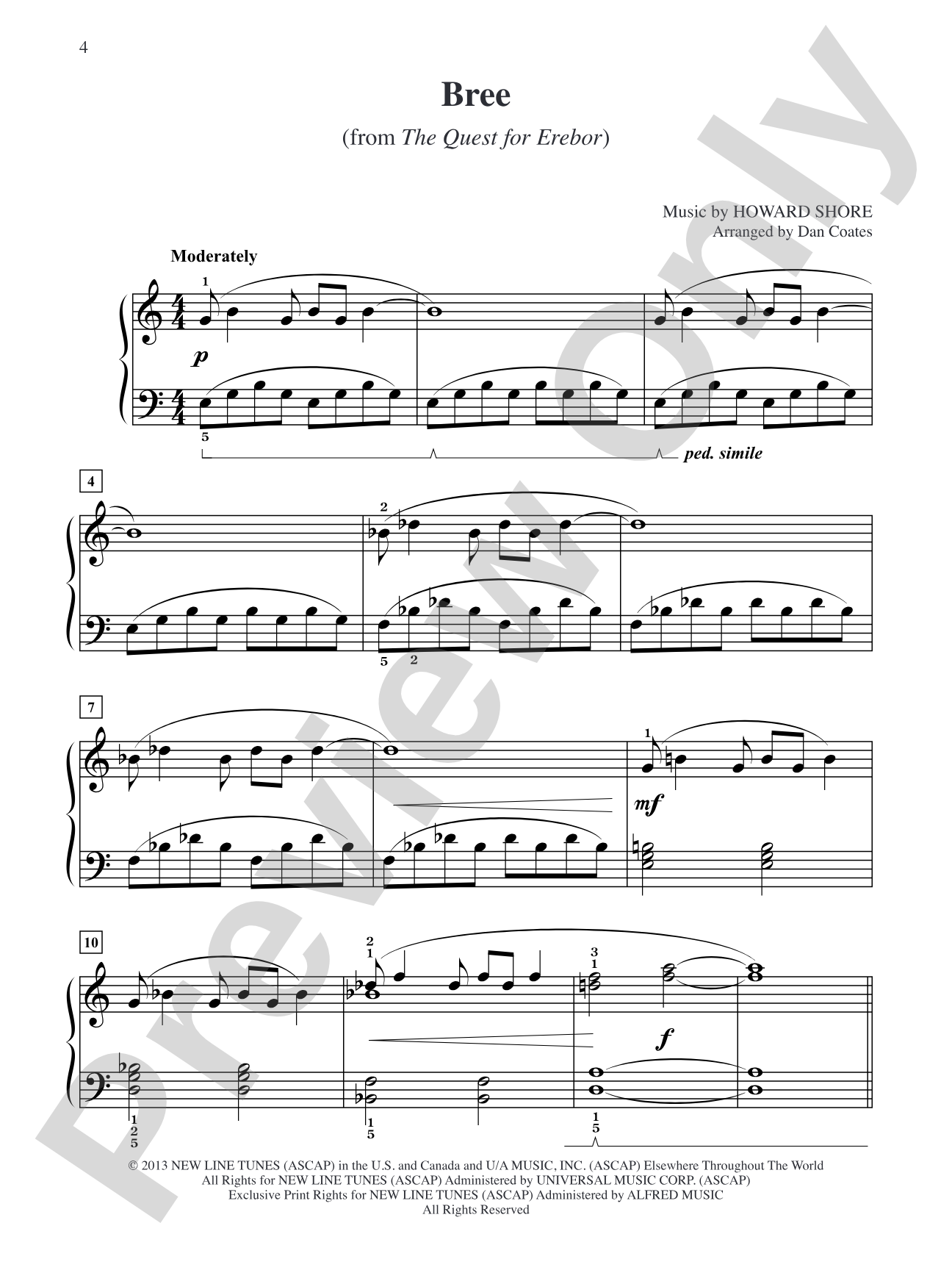

Bree (from The Hobbit: The Desolation of Smaug): Easy Piano
Easy Piano Selections from the Original Motion Picture Soundtrack
By Howard Shore / arr. Dan Coates
Level: Easy Piano
Item: 00-PS-0015929
$4.99
One moment…
Related Items
Beyond the Forest (from The Hobbit: The Desolation of Smaug): Easy Piano |
$4.99
|
View | |
Erebor (from The Hobbit: The Desolation of Smaug): Easy Piano |
$5.99
|
View | |
Beorn (from The Hobbit: The Desolation of Smaug): Easy Piano |
$4.99
|
View | |
Bard A Man of Lake-town (from The Hobbit: The Desolation of Smaug): Easy Piano |
$4.99
|
View | |
Bard and Family (from The Hobbit: The Desolation of Smaug): Easy Piano |
$4.99
|
View | |
Lake-town (from The Hobbit: The Desolation of Smaug): Easy Piano |
$4.99
|
View | |
Girion Lord of Dale (from The Hobbit: The Desolation of Smaug): Easy Piano |
$4.99
|
View | |
Lake-town Bard (from The Hobbit: The Desolation of Smaug): Easy Piano |
$4.99
|
View | |
House of Durin (from The Hobbit: The Desolation of Smaug): Easy Piano |
$4.99
|
View | |
Smaug (from The Hobbit: The Desolation of Smaug): Easy Piano |
$4.99
|
View | |
I See Fire (from The Hobbit: The Desolation of Smaug): Easy Piano |
$4.99
|
View | |
The Hobbit: The Desolation of Smaug: Piano Book |
$15.99
|
View |
Description
With The Hobbit: The Desolation of Smaug, audiences worldwide were transported back to Middle-earth for more thrills and adventure. 12 pieces from Howard Shore's brilliant score have been arranged for Easy Piano. Pianists will have both classic and new themes from the epic journey right at their fingertips as they play. In addition to the piano arrangements, this beautifully produced souvenir folio features an array of colorful photos from the film. Titles: Erebor * Bree * Beorn * Bard, A Man of Lake-town * Bard and Family * Lake-town * Girion, Lord of Dale * Lake-town Bard * House of Durin * Smaug * I See Fire * Beyond the Forest.


Bree (from The Hobbit: The Desolation of Smaug): Easy Piano isn't in MakeMusic Cloud just yet...but it could be. Let us know you'd like to see it, and you'll help shape what comes next. In the meantime, start a free trial and dive into thousands of interactive titles your students can play along with today.
Request This Title
Tell us you want it.
Start Your Free Trial
Explore everything that's ready to play right now.
Sample Audio
No sample audio found.
Sample Video
No sample videos found.
Additional Details
Publisher:
Alfred Music
Page Count:
40
SKU:
00-PS-0015929
More about this title
About the Composer: Howard Shore
Howard Shore has composed music for some of cinema's most expansive worlds, from The Lord of the Rings trilogy to The Hobbit series and beyond. His orchestral scores are known for their sweeping themes, intricate counterpoint, and ability to capture both the grandeur and intimacy of epic storytelling. Shore's work demonstrates how thematic material can develop across an entire film while remaining memorable and singable, a quality that makes his arrangements particularly rewarding for student pianists.
Why we love this
Shore's melodies for Middle-earth are instantly recognizable and emotionally direct, which means students at the Easy Piano level can experience genuine musical accomplishment without struggling against dense harmonic writing. The collection spans a range of moods (from the ominous opening of Erebor to the lyrical I See Fire), giving pianists variety within a single book and preventing the repertoire from feeling one-note. Pairing these arrangements with film clips or stills creates a natural bridge between music and narrative that motivates continued practice.
What to expect
These pieces carry the weight and wonder of Middle-earth in miniature. Melodies unfold with cinematic pacing: sometimes grand and processional, sometimes intimate and searching. You'll feel the restraint in Shore's orchestral thinking translated to the keyboard, where a simple left-hand pattern can evoke an entire landscape, and a well-placed harmonic shift suggests danger or beauty without fanfare.
Who it's for
This collection serves pianists in their early-to-intermediate years who want to explore film music without technical barriers. It's ideal for students who respond to narrative and visual storytelling, and for teachers building programs that connect classical training to popular culture. These arrangements also work well for recitals, informal performances, or as motivation for students who might otherwise lose interest in standard classical repertoire.
How to get the most out of it
- Balance the melody against accompaniment patterns in pieces like Bree by letting the tune breathe over steady supporting figures; resist the urge to play everything at a uniform dynamic level.
- Pay attention to tempo markings and the harmonic rhythm beneath the melody. Many of Shore's themes work best when the harmonic support stays conversational rather than ponderous.
- Use the colorful photos included in the folio as visual anchors before you play. Picturing the scene (Laketown's bustling market, Smaug's lair) will guide your phrasing and tone choices.
- In pieces with repeated sections, vary your touch and voicing slightly on the repeat to maintain listener engagement without altering the basic harmonic structure.
How to use it
Assign individual pieces from this collection as performance repertoire for studio recitals, where they'll appeal to families and younger listeners familiar with the films. The thematic variety makes it possible to program a mini-suite of three or four pieces that move from one mood to another, creating narrative arc without requiring a student to tackle an entire multi-movement sonata. You might also use selections as supplementary material alongside standard method books to reinforce specific technical patterns (Alberti bass, scale passages, hand independence) in a context that feels relevant and engaging.
Skills your students will build
- Sustaining legato melody lines over repetitive accompaniment patterns
- Reading and playing moderate dynamic shaping and expression marking
- Coordinating hands independently (melody separate from steady supporting figures)
- Maintaining rhythmic consistency in pieces with simple but steady harmonic motion
- Recognizing and executing basic film score arranging principles (economy of means, clarity of theme)