
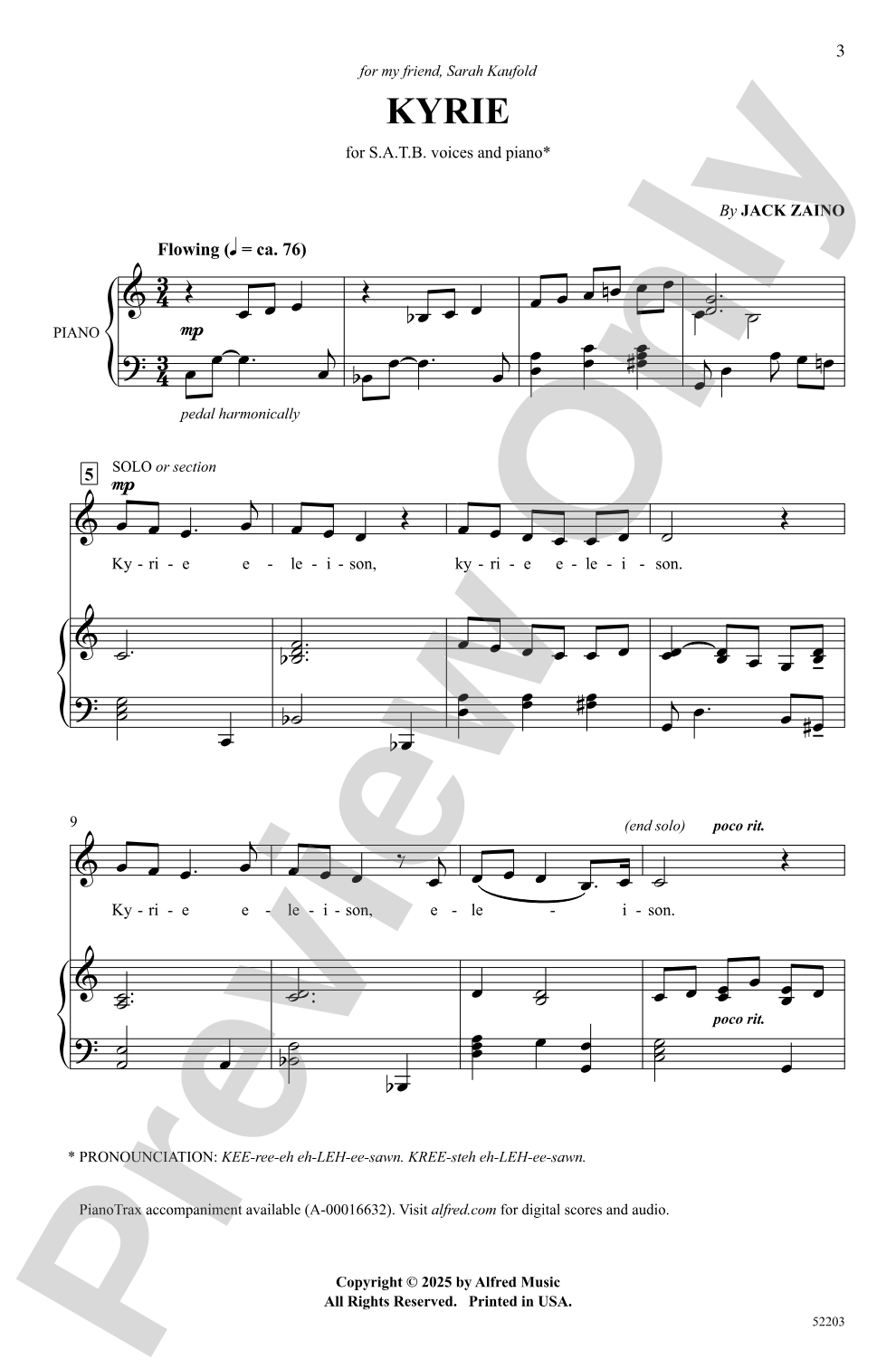

Kyrie: SATB Choral Octavo
By Jack Zaino
Item: 00-PO-0007590
$2.20
Minimum order quantity: 20 copies
Pickup currently not available
Description
This flowing and melismatic Latin setting offers every voice part something satisfying to sing. After a brief opening solo and presentation of the main theme, a minor-key section creates striking contrast before the A section is restated. The sensitive piano accompaniment beautifully supports the voices without doubling their parts. Equally effective on the concert stage or in the church sanctuary.


Kyrie: SATB Choral Octavo isn't in MakeMusic Cloud just yet...but it could be. Let us know you'd like to see it, and you'll help shape what comes next. In the meantime, start a free trial and dive into thousands of interactive titles your students can play along with today.
Request This Title
Tell us you want it.
Start Your Free Trial
Explore everything that's ready to play right now.
Sample Audio
1
Audio File
--:--
0:00
0:00
Sample Video
Additional Details
Series:
Alfred Choral Designs
Publisher:
Alfred Music
Page Count:
8
SKU:
00-PO-0007590
More about this title
About the Composer: Jack Zaino

Jack Zaino brings together his classroom experience and his deep engagement with contemporary choral writing to create music that feels both accessible and artistically rewarding. A New England educator who holds degrees in voice and music education from the University of Connecticut, he taught middle school music in Connecticut's public schools before moving into his current role as a choral editor and clinician at Alfred Music. His work as a clinician and his service on Connecticut ACDA's repertoire committee have shaped his understanding of what singers at all levels need from their music.
Zaino's arrangements and compositions draw from the artists and styles that matter to today's singers, from Kacey Musgraves to Lizzo. His commitment to the choral art extends beyond his published work; he remains an active performer in the Connecticut choral community and serves as composition chair on the repertoire and resources committee for Connecticut ACDA. In 2020, he received recognition as Connecticut's Young Choral Director of the Year.
Why we love this
Zaino constructs this Kyrie with real compositional sophistication while keeping the writing singable and idiomatic for SATB voices. The melismatic lines breathe naturally, the minor-key shift lands with genuine dramatic impact, and the piano accompaniment shows restraint—it supports without shadowing the choir's work. Directors will appreciate a piece that sounds more complex than it is to learn and that translates convincingly in either concert or liturgical settings.
What to expect
This setting unfolds with lyrical warmth, the text carried on long, singing lines that invite the voices to move generously through the harmonic landscape. The minor-key turn brings shadow and weight, creating a moment of introspection before the return to the brighter A section feels genuinely hopeful. The result is a Kyrie that honors the liturgical gravity of the text while letting singers feel the beauty in their own sound.
Who it's for
Any SATB choir with solid basic musicianship will find this piece rewarding to learn and perform. It works equally well for high school and community choirs, as well as college ensembles looking for a shorter sacred work with real substance.
How to get the most out of it
- Shape the opening solo line with clear phrasing and allow the voices to settle before the full choir enters on the main theme; this establishes the piece's flowing character.
- Balance the transition into the minor-key section by bringing down the overall dynamic slightly before the contrast registers fully.
- Let the restatement of the A section feel fresh rather than exact; subtle variations in breath placement and vowel color can renew the familiar material without overdoing it.
- Work with your pianist to ensure the accompaniment stays buoyant and doesn't anchor the choral lines; the piano's independence from the vocal parts is part of what makes the texture work.
How to use it
This piece fits naturally into a concert of sacred choral music or as part of a liturgical service where reflective, well-crafted settings are valued. Its eight-page length makes it ideal as a substantive single work on a longer program or as the anchor for a thematic set of Latin pieces exploring different harmonic and textural approaches.
Skills your students will build
- Singing melismatic lines with clear articulation and connected phrasing
- Identifying and executing harmonic shifts between major and minor tonalities
- Balancing ensemble blend while maintaining individual line integrity
- Responding to subtle accompaniment changes and maintaining independence from piano textures