
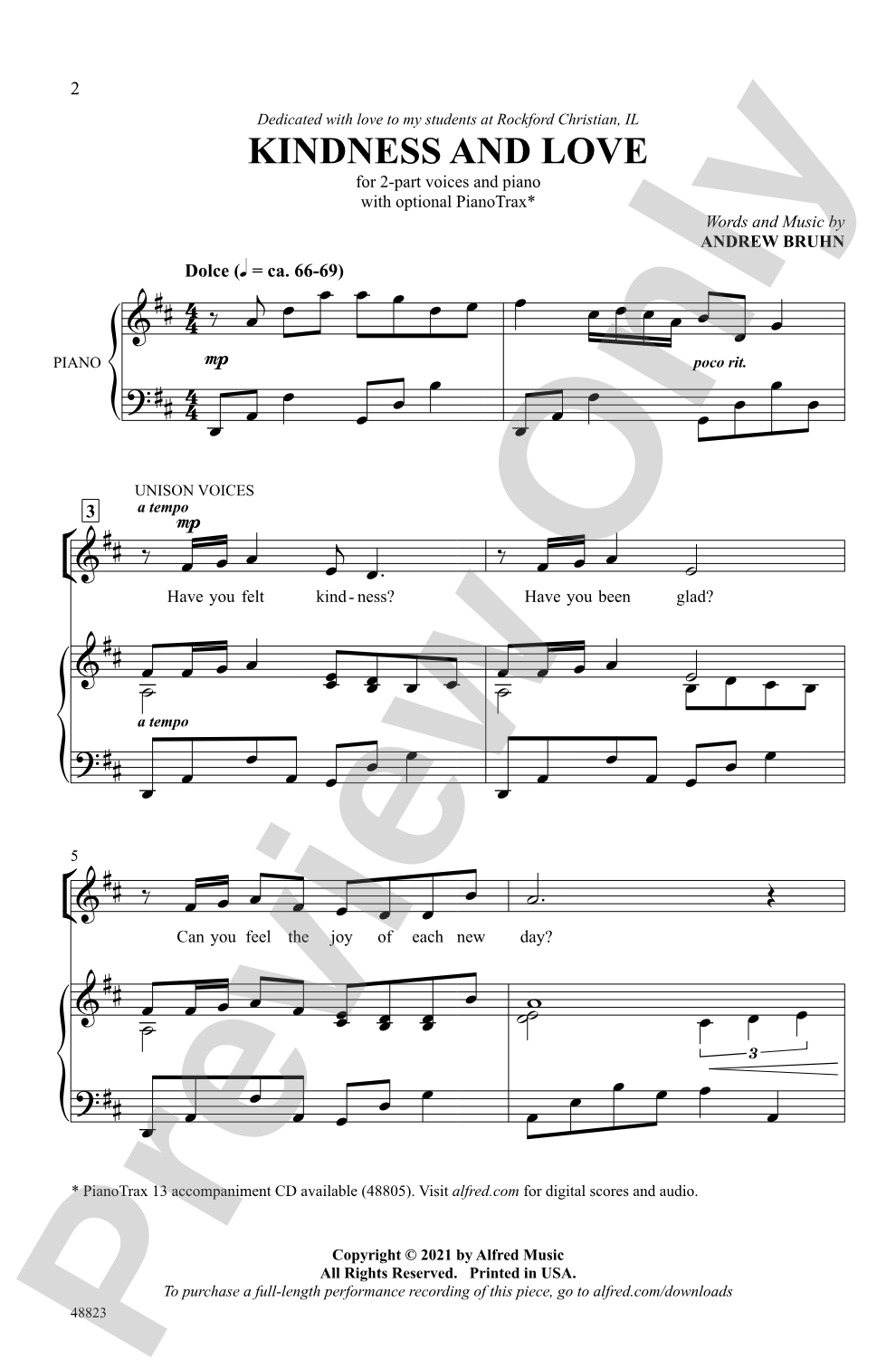

Kindness and Love: 2-Part Choral Octavo
Words and music by Andrew Bruhn
Item: 00-PO-0006627
$2.05
Minimum order quantity: 20 copies
Pickup currently not available
Description
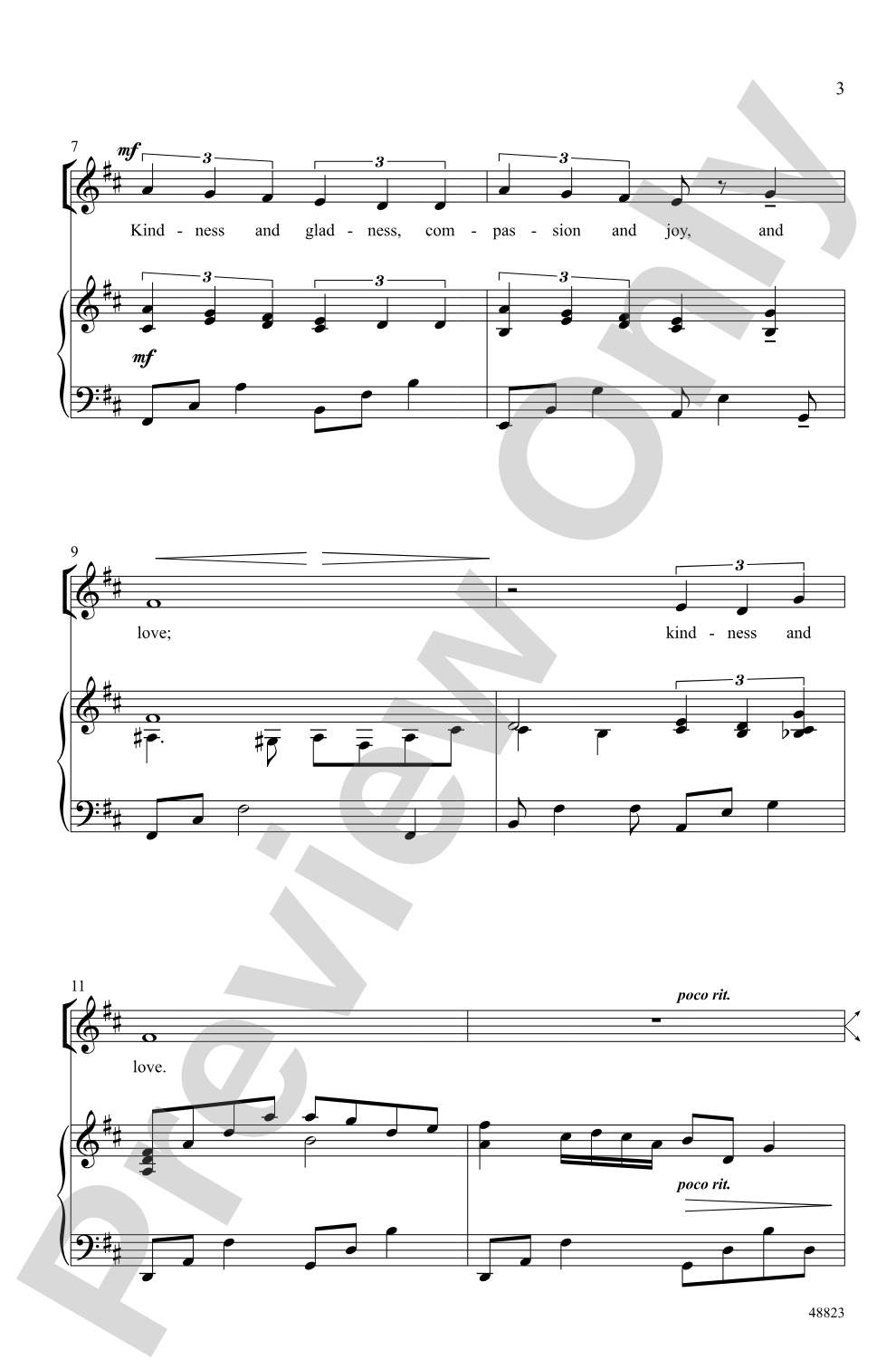
Inspired by the music and philosophy of Mr. Rogers, this tender song is a gift from the composer to his students. Heartfelt verses pose questions to singers about their feelings and lead to five important virtues: "kindness and gladness, compassion and joy, and love." The dolce tempo marking requests a sweet tone from the voices and a delicate touch at the piano. There's a lot to be learned here, both musically and emotionally.


Kindness and Love: 2-Part Choral Octavo isn't in MakeMusic Cloud just yet...but it could be. Let us know you'd like to see it, and you'll help shape what comes next. In the meantime, start a free trial and dive into thousands of interactive titles your students can play along with today.
Request This Title
Tell us you want it.
Start Your Free Trial
Explore everything that's ready to play right now.
Sample Audio
1
Audio File
--:--
0:00
0:00
Sample Video
1 / 2
Additional Details
Series:
Alfred Choral Designs
Publisher:
Alfred Music
Page Count:
8
SKU:
00-PO-0006627
More about this title
About the Composer: Andrew Bruhn

Andrew Bruhn combines work as a choral conductor, composer, and trumpeter across multiple institutions in Illinois and beyond. He serves as Director of Choral Music at Rockford Christian Schools, where he teaches secondary choirs and music theory, and directs choirs at Westminster Presbyterian Church in Rockford. His graduate training in choral conducting at Luther Seminary and St. Olaf College included study with conductors Anton Armstrong, Christopher Aspaas, and Mark Stover, while his compositional voice developed under David Cherwien and Alice Parker.
Bruhn's contributions to choral music education have been recognized by the American Choral Directors Association and National Association for Music Education through published articles on vocal pedagogy. His students have earned superior ratings in state competitions and performed at the Illinois Music Education Conference; his own compositions have won the 2017 Illinois ACDA Composition Contest and earned recognition as J.W. Pepper Editors' Choice selections. His works appear with major publishers including GIA, Alfred Music, Choristers Guild, Carl Fischer, and Concordia, and are performed by ensembles ranging from elementary through university level.
Why we love this
Bruhn's gift to his own students became this piece, and that generosity of spirit comes through in every measure. The song asks real questions about feelings and virtue rather than simply declaring them, inviting your singers into genuine reflection. A dolce marking paired with Mr. Rogers' philosophy creates space for emotional authenticity without sentimentality, making this a rare piece that strengthens both musicianship and character.
What to expect
The piece unfolds like a quiet conversation, asking listeners to pause and consider what matters most. Tender and genuine, it avoids the trap of being cloying by grounding itself in real questions about kindness, compassion, and love rather than announcing those virtues from on high.
Who it's for
This piece fits middle and high school choirs seeking meaningful repertoire that speaks to both mind and heart. It works equally well for concert programming and festival competition, and its accessibility makes it ideal for groups still developing their two-part writing skills.
How to get the most out of it
- Establish the sweet, conversational tone early by asking singers to imagine speaking these questions directly to someone they care about rather than projecting to an audience.
- Attend closely to the piano part; its delicate touch sets the emotional temperature for the entire piece, so conductor and pianist should rehearse together from the start.
- Shape the five virtues ('kindness and gladness, compassion and joy, and love') as a building arc rather than five separate statements, allowing the message to gather emotional weight.
- Let the dolce marking guide your tempo choice; rushing this piece erases the reflective quality that makes it work.
How to use it
Program this as an anchor piece on a concert built around character education or values; it pairs naturally with peace and brotherhood themes. Its gentle emotional weight makes it an effective closer to a first half, or a reflective moment within a longer set.
Skills your students will build
- Singing with a warm, relaxed tone in the passaggio register
- Sustaining a lyrical line without forcing volume
- Responding to dynamic and textual cues that shape emotional meaning
- Interpreting Italian tempo and style markings (dolce) through listening and tone production
- Balancing ensemble blend in two-part texture while maintaining individual voice clarity