
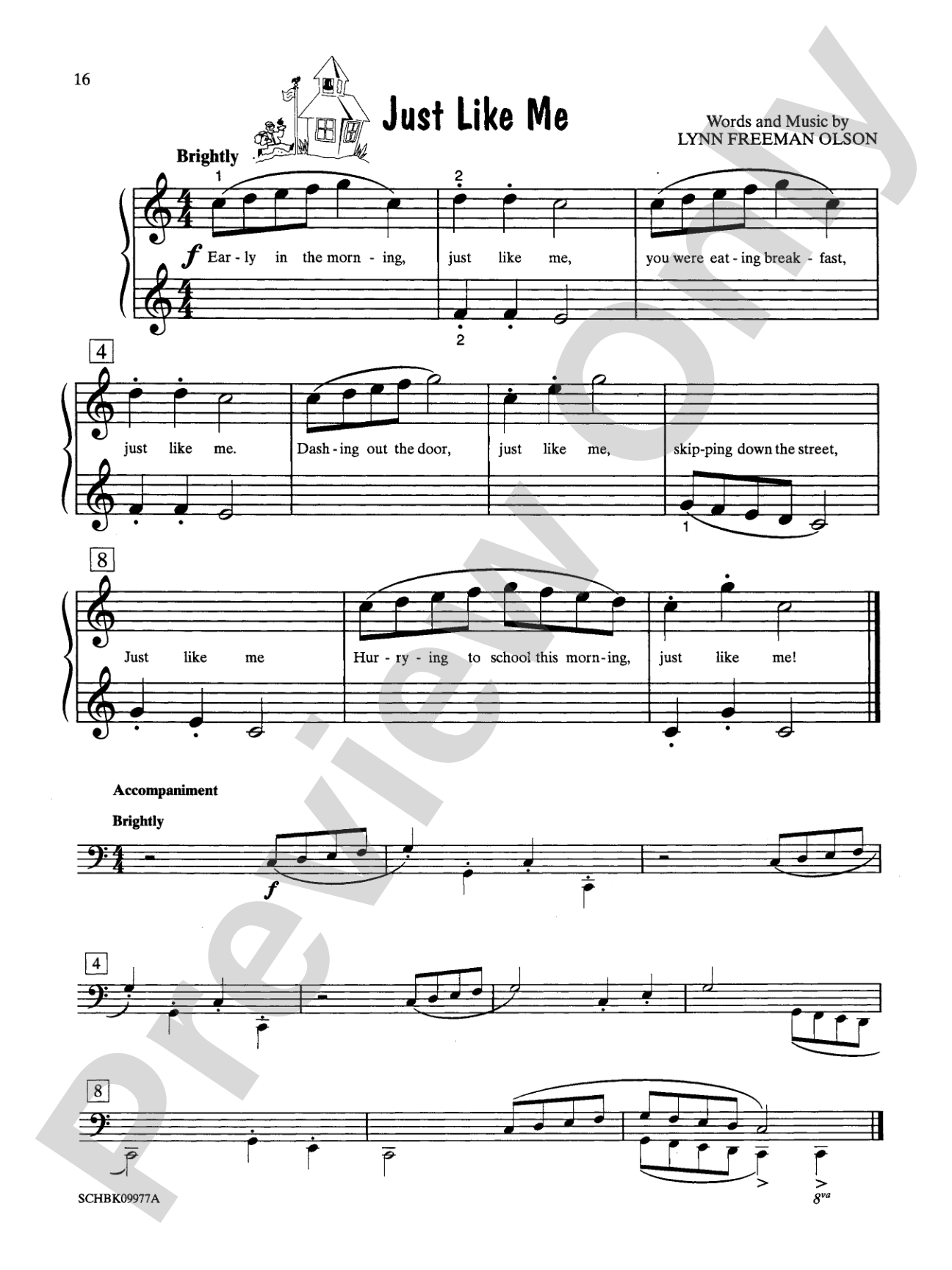

Just Like Me - Piano Solo with Lyrics (with Optional Duet Accompaniments): Piano Solo with Lyrics
13 Early-Level Piano Solos with Words
By Lynn Freeman Olson
Level: Early Elementary
Item: 00-PS-0017505
$4.99
Pickup currently not available
Related Items
Butterfly - Piano Solo with Lyrics (with Optional Duet Accompaniments): Piano Solo with Lyrics |
$4.99
|
View | |
Danny Dolphin - Piano Solo with Lyrics (with Optional Duet Accompaniments): Piano Solo with Lyrics |
$4.99
|
View | |
Ebeneezer Sneezer - Piano Solo with Lyrics (with Optional Duet Accompaniments): Piano Solo with Lyrics |
$4.99
|
View | |
Halloween - Piano Solo with Lyrics (with Optional Duet Accompaniments): Piano Solo with Lyrics |
$4.99
|
View | |
Hiking Song - Piano Solo with Lyrics (with Optional Duet Accompaniments): Piano Solo with Lyrics |
$4.99
|
View | |
I Made a Valentine - Piano Solo with Lyrics (with Optional Duet Accompaniments): Piano Solo with Lyrics |
$4.99
|
View | |
It's Twilight Time - Piano Solo with Lyrics (with Optional Duet Accompaniments): Piano Solo with Lyrics |
$4.99
|
View | |
My Pony - Piano Solo with Lyrics (with Optional Duet Accompaniments): Piano Solo with Lyrics |
$4.99
|
View | |
Pogostick - Piano Solo with Lyrics (with Optional Duet Accompaniments): Piano Solo with Lyrics |
$4.99
|
View | |
Popping Corn - Piano Solo with Lyrics (with Optional Duet Accompaniments): Piano Solo with Lyrics |
$4.99
|
View | |
Summer Nights - Piano Solo with Lyrics (with Optional Duet Accompaniments): Piano Solo with Lyrics |
$4.99
|
View | |
Tiptoe, Tiptoe - Piano Solo with Lyrics (with Optional Duet Accompaniments): Piano Solo with Lyrics |
$5.99
|
View | |
Our Small World: Piano Book |
$5.99
|
View |
Description
This collection of 13 songs offers variety, humor, and charm for the early elementary pianist. The songs reinforce note recognition using different stationary hand positions. Teacher duets are included for every piece. Rests are minimally used to increase student awareness of melodic shaping. Captivating selections include Popping Corn * Hiking Song * Danny Dolphin * My Pony * Summer Nights * Butterfly * I Made a Valentine and more. A Federation Festivals 2024-2028 selection.


Just Like Me - Piano Solo with Lyrics (with Optional Duet Accompaniments): Piano Solo with Lyrics isn't in MakeMusic Cloud just yet...but it could be. Let us know you'd like to see it, and you'll help shape what comes next. In the meantime, start a free trial and dive into thousands of interactive titles your students can play along with today.
Request This Title
Tell us you want it.
Start Your Free Trial
Explore everything that's ready to play right now.
Sample Audio
No sample audio found.
Sample Video
No sample videos found.
Additional Details
Publisher:
Alfred Music
Page Count:
16
SKU:
00-PS-0017505
More about this title
About the Composer: Lynn Freeman Olson
Lynn Freeman Olson built her reputation on understanding what early elementary students need: music that engages their imaginations while teaching real musical fundamentals. Her compositions consistently balance pedagogical clarity with genuine melodic interest, giving young pianists something they actually want to play.
Olson's approach to beginner repertoire prioritizes student agency and musical thinking from day one. By writing pieces that reinforce hand positions through exploration rather than drilling, she demonstrates that technique and musicality develop together, not sequentially.
Why we love this
Olson writes pieces that students genuinely enjoy playing, which changes everything about practice motivation. The variety here prevents the collection from feeling like a method book, and the thematic titles give young pianists clear imagery to shape their phrasing without you having to explain interpretive concepts they're not ready for yet.
What to expect
Lighthearted and playful. Each piece captures a specific moment or image, popping corn, a summer night, a dolphin playing, giving students concrete stories to animate their playing. The melodies sit naturally under the hand and move with a natural conversational rhythm.
Who it's for
Early elementary piano students who have basic note-reading skills and hand position awareness. Teachers looking for supplementary repertoire that reinforces technical concepts through engaging melodies rather than isolated exercises.
How to get the most out of it
- Encourage students to hum or sing the melody before playing it. The lyrics anchor the shape of each phrase in their minds, making the connection between text and music explicit.
- Use the teacher duets to demonstrate what the piece should sound like. Playing the accompaniment underneath their solo version provides both security and a musical goal.
- Ask students to identify the hand position for each piece before they start. Naming the starting note and hand shape takes 10 seconds and builds awareness of how position changes create new melodies.
- Play with the minimal rests as intentional breath points. Silence is as musical as sound, and these pieces show students that rests shape melody.
How to use it
Include these in student recitals to give early elementary performers a strong sense of accomplishment; the variety means you can choose pieces that match different students' comfort levels and interests. They also work well as warm-up material in group lessons, where the lyrics create a natural communal element.
Skills your students will build
- Note recognition across multiple hand positions on the staff
- Reading melodies with minimal rests to develop phrasing awareness
- Hand position shifts and navigation of the keyboard
- Connecting text to musical shape and expression
- Sight-reading fluency through repeated exposure to varied melodic patterns