
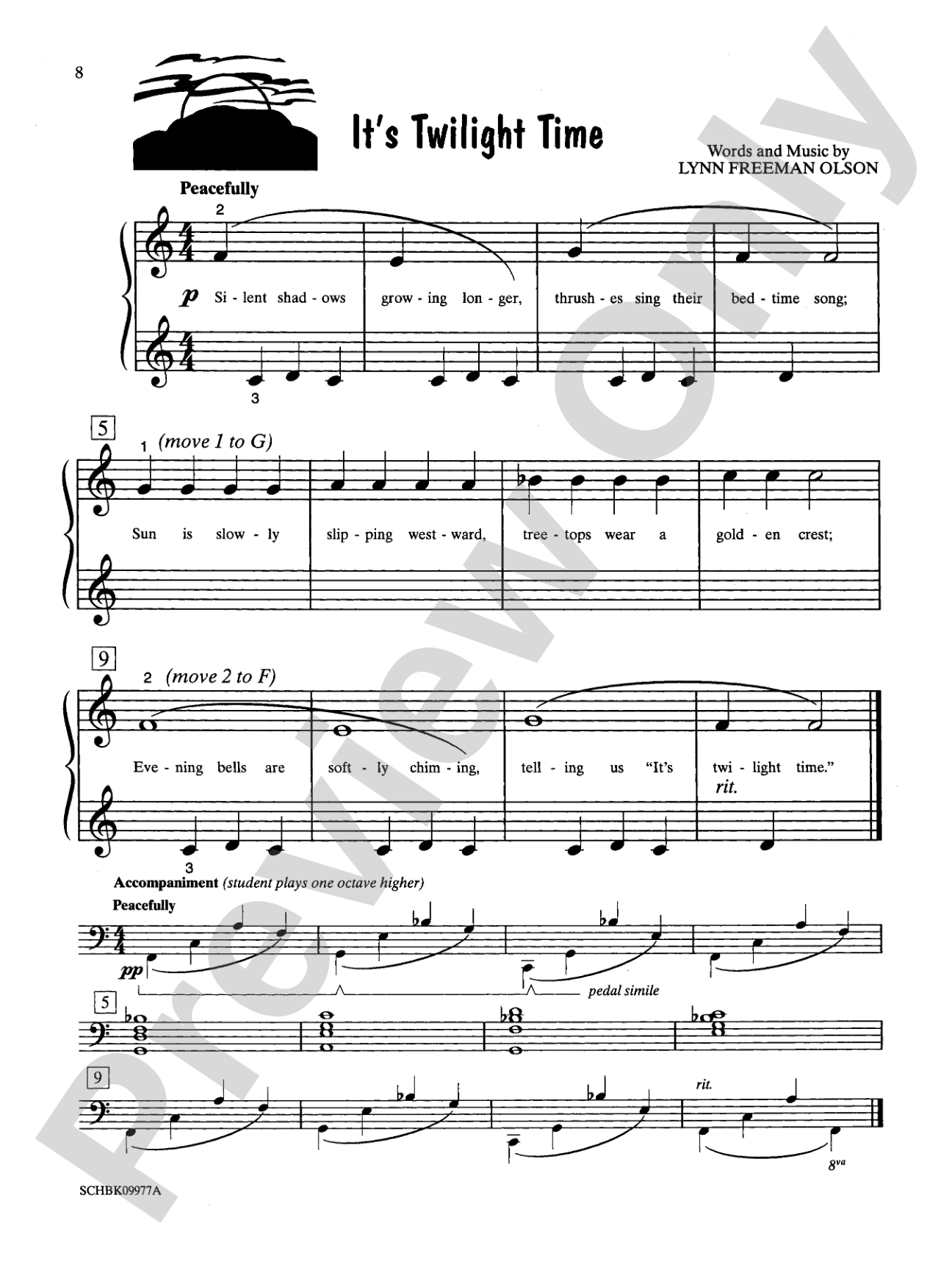

It's Twilight Time - Piano Solo with Lyrics (with Optional Duet Accompaniments): Piano Solo with Lyrics
13 Early-Level Piano Solos with Words
By Lynn Freeman Olson
Level: Early Elementary
Item: 00-PS-0017504
$4.99
Pickup currently not available
Related Items
Butterfly - Piano Solo with Lyrics (with Optional Duet Accompaniments): Piano Solo with Lyrics |
$4.99
|
View | |
Danny Dolphin - Piano Solo with Lyrics (with Optional Duet Accompaniments): Piano Solo with Lyrics |
$4.99
|
View | |
Ebeneezer Sneezer - Piano Solo with Lyrics (with Optional Duet Accompaniments): Piano Solo with Lyrics |
$4.99
|
View | |
Halloween - Piano Solo with Lyrics (with Optional Duet Accompaniments): Piano Solo with Lyrics |
$4.99
|
View | |
Hiking Song - Piano Solo with Lyrics (with Optional Duet Accompaniments): Piano Solo with Lyrics |
$4.99
|
View | |
I Made a Valentine - Piano Solo with Lyrics (with Optional Duet Accompaniments): Piano Solo with Lyrics |
$4.99
|
View | |
Just Like Me - Piano Solo with Lyrics (with Optional Duet Accompaniments): Piano Solo with Lyrics |
$4.99
|
View | |
My Pony - Piano Solo with Lyrics (with Optional Duet Accompaniments): Piano Solo with Lyrics |
$4.99
|
View | |
Pogostick - Piano Solo with Lyrics (with Optional Duet Accompaniments): Piano Solo with Lyrics |
$4.99
|
View | |
Popping Corn - Piano Solo with Lyrics (with Optional Duet Accompaniments): Piano Solo with Lyrics |
$4.99
|
View | |
Summer Nights - Piano Solo with Lyrics (with Optional Duet Accompaniments): Piano Solo with Lyrics |
$4.99
|
View | |
Tiptoe, Tiptoe - Piano Solo with Lyrics (with Optional Duet Accompaniments): Piano Solo with Lyrics |
$5.99
|
View | |
Our Small World: Piano Book |
$5.99
|
View |
Description
This collection of 13 songs offers variety, humor, and charm for the early elementary pianist. The songs reinforce note recognition using different stationary hand positions. Teacher duets are included for every piece. Rests are minimally used to increase student awareness of melodic shaping. Captivating selections include Popping Corn * Hiking Song * Danny Dolphin * My Pony * Summer Nights * Butterfly * I Made a Valentine and more. A Federation Festivals 2024-2028 selection.


It's Twilight Time - Piano Solo with Lyrics (with Optional Duet Accompaniments): Piano Solo with Lyrics isn't in MakeMusic Cloud just yet...but it could be. Let us know you'd like to see it, and you'll help shape what comes next. In the meantime, start a free trial and dive into thousands of interactive titles your students can play along with today.
Request This Title
Tell us you want it.
Start Your Free Trial
Explore everything that's ready to play right now.
Sample Audio
No sample audio found.
Sample Video
No sample videos found.
Additional Details
Publisher:
Alfred Music
Page Count:
16
SKU:
00-PS-0017504
More about this title
About the Composer: Lynn Freeman Olson
Lynn Freeman Olson has spent decades writing music that meets young pianists exactly where they are developmentally. Her approach prioritizes melodic musicality and solid technique without overwhelming beginners with unnecessary complexity.
Olson's catalog reflects a deep understanding of what makes early elementary students engaged: pieces with character, humor, and clear narrative appeal. Her teacher duet arrangements extend the teaching possibilities of every piece, turning solo practice into collaborative music-making.
Why we love this
Olson's deliberate approach to hand position reinforcement transforms what could feel like a technical drill into genuine musical exploration. Each piece maintains a distinct character while serving a pedagogical goal, and the inclusion of teacher duets means every student piece becomes an opportunity for ensemble experience and aural learning. The minimal use of rests pushes early learners toward phrasing rather than note-by-note playing.
What to expect
This collection captures the humor and wonder of childhood observation. From dolphins diving to ponies trotting to the satisfying pop of kernels, each piece invites students into a small, vivid moment. The music is unpretentious and joyful, never talking down to young players.
Who it's for
Early elementary piano students building foundational note recognition and hand position independence. Also ideal for teachers seeking varied, engaging material that reinforces technique without sacrificing musical integrity.
How to get the most out of it
- Encourage students to sing through the lyrics while playing, which naturally reinforces melodic shaping and helps them avoid the note-by-note attack common at this level.
- Use the teacher duet actively during lessons. Even a brief run-through transforms how the student hears the piece and their sense of musical partnership.
- Help students observe which hand stays stationary in each piece, making it a game of discovery rather than a rule imposed from above.
- Connect each piece's title and storyline to physical playing choices. 'Popping Corn' might suggest lighter, quicker articulation while 'Summer Nights' invites a more sustained, singing quality.
How to use it
Select individual pieces as recital vehicles throughout the year, pairing them with teacher duets for a collaborative performance. The varied titles and characters make this collection strong for thematic programs or student showcases where young pianists benefit from performing multiple short pieces rather than one longer work.
Skills your students will build
- Note recognition within specific hand positions
- Melodic shaping through sustained phrasing
- Hand position independence (stationary vs. moving hand)
- Rhythm reading and note grouping without excessive rest notation
- Ensemble listening and coordination through teacher duet experience