
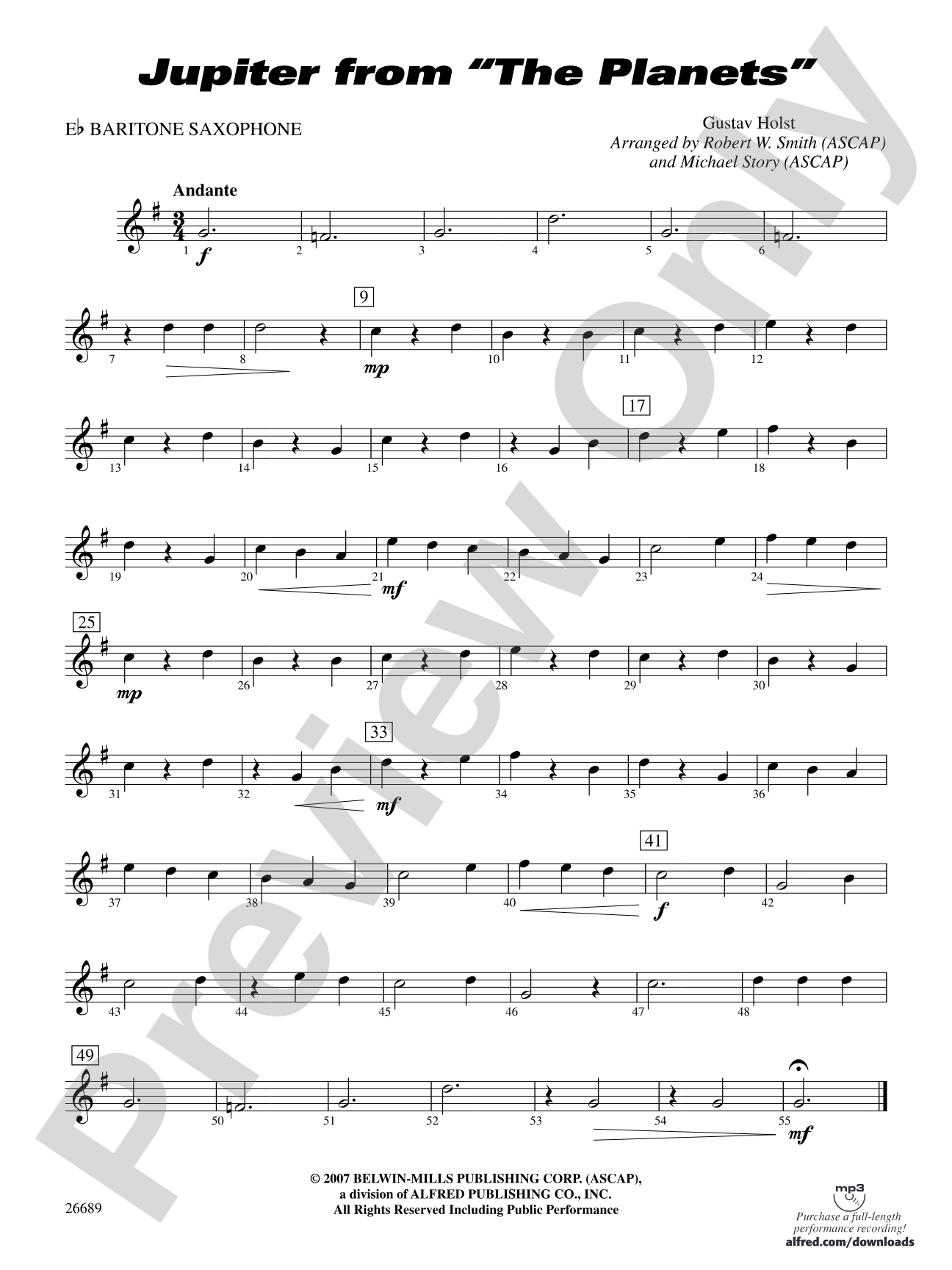

Jupiter (from The Planets): E-flat Baritone Saxophone
By Gustav Holst / arr. Robert W. Smith and Michael Story
Grade: 1 (Very Easy)
Item: 00-PC-0001171_BTX
$3.00
Pickup currently not available
Description
Based on the lovely melody from the fourth movement of Holst's most performed work, Jupiter has been carefully prepared for your beginners concert at the end of their first year. Although scored to compliment the end of Band Expressions™ Book One, this classic work would work well with any beginning class on their concluding program. A worthy teaching and performance choice. This title is available in MakeMusic Cloud.


Don't just read it, hear it, play along with it, and watch your students grow with it. In MakeMusic Cloud, Jupiter (from The Planets): E-flat Baritone Saxophone comes alive with professional accompaniment, adjustable tempo, and built-in practice tools that turn solo practice into real progress.
Open in the Player
Jump straight in and assign it today.
Start Your Free Trial
Open this title and explore the full library in minutes.
Sample Audio
1
Audio File
--:--
0:00
0:00
Sample Video
No sample videos found.
Additional Details
Series:
Band Expressions
Publisher:
Alfred Music
Page Count:
66
SKU:
00-PC-0001171_BTX
More about this title
About the Composer: Gustav Holst
Gustav Holst (1874–1934) was an English composer whose orchestral suite The Planets stands as one of the most performed and beloved works of the early twentieth century. Deeply committed to music education, Holst taught composition, conducted ensembles, and wrote extensively for amateur and student musicians, believing that accessible music could be both artistically serious and genuinely enjoyable to perform.
Holst's gift for memorable melody and his skill at orchestration made his work instantly appealing to performers at every level. The Planets in particular demonstrates his ability to paint vivid musical pictures while maintaining structural clarity, qualities that have made it a cornerstone of both professional and educational concert programming for over a century.
Why we love this
Robert W. Smith and Michael Story have distilled the essence of Holst's Jupiter into an arrangement that respects the original's grandeur while remaining genuinely playable for first-year students. The familiar, noble melody is front and center, allowing young musicians to experience the joy of performing a real masterwork without the technical obstacles that would otherwise stand in their way. This is the kind of arrangement that builds confidence and genuine musical memory in developing ensembles.
What to expect
Stately and dignified, with the bearing of a ceremonial march or regal processional. The famous Jupiter melody carries an almost hymn-like quality, warm and unhurried, inviting younger musicians to discover what it feels like to play with breadth and purpose rather than speed. There is nobility here without pretension, something students can feel in their hands and hear in their ears.
Who it's for
First-year concert band students who are ready to step beyond exercises and into the realm of actual repertoire. Directors closing out a beginning band year will find this arrangement offers students a meaningful capstone experience while staying within their technical grasp. This work suits any beginning class looking for an accessible yet genuinely musical addition to their final program.
How to get the most out of it
- Shape the main melody with a clear arc from the opening through the climax; even at a modest tempo, this tune needs to breathe and build toward its peak moments rather than stay flat.
- Balance the tutti passages so that the melody line remains audible; younger ensembles often pile weight into harmony parts, which can bury the tune that makes this arrangement work.
- Establish a steady, confident tempo early and maintain it throughout; Jupiter's stateliness depends on rhythmic stability, and any rushing or dragging will undermine the music's natural dignity.
- Use the conductor score to identify which sections carry the primary melodic interest at any given moment, and rehearse those voices separately before bringing the full band together.
How to use it
This is an ideal finale or major work on a first-year band concert, offering genuine musical substance that audiences recognize and respect. Pair it with other accessible arrangements or short original works at the Grade 1 level to showcase how much your students have accomplished in their first year. The work also fits naturally into a year-end or spring concert where you want to celebrate both progress and the beauty of established classical music.
Skills your students will build
- Sustaining long melodic lines with control and direction
- Balance between melody and harmonic accompaniment
- Consistent tempo maintenance across multiple sections
- Dynamic shaping and phrasing in a slow to moderate tempo
- Ensemble blend in tutti passages with mixed articulations