
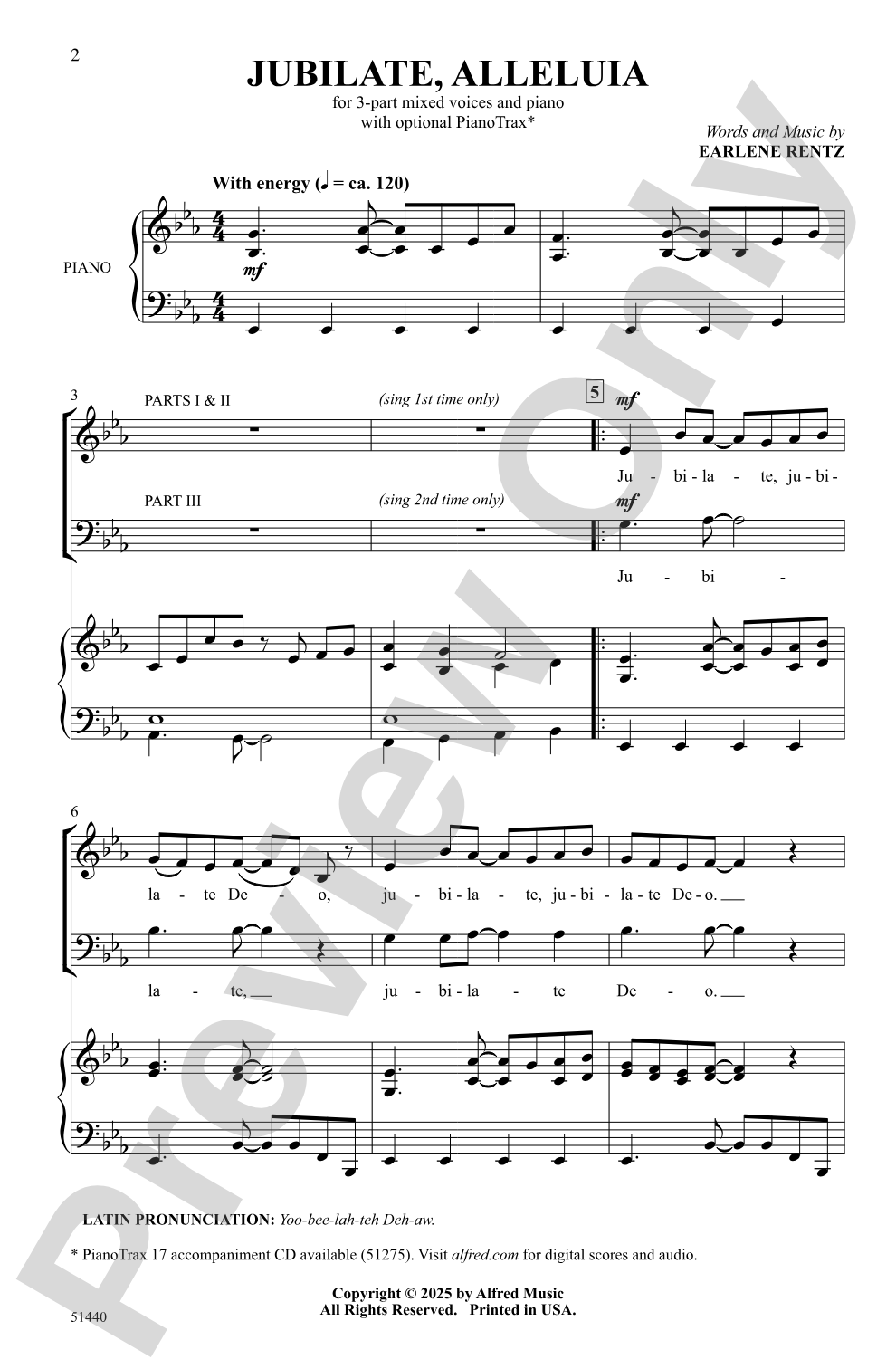
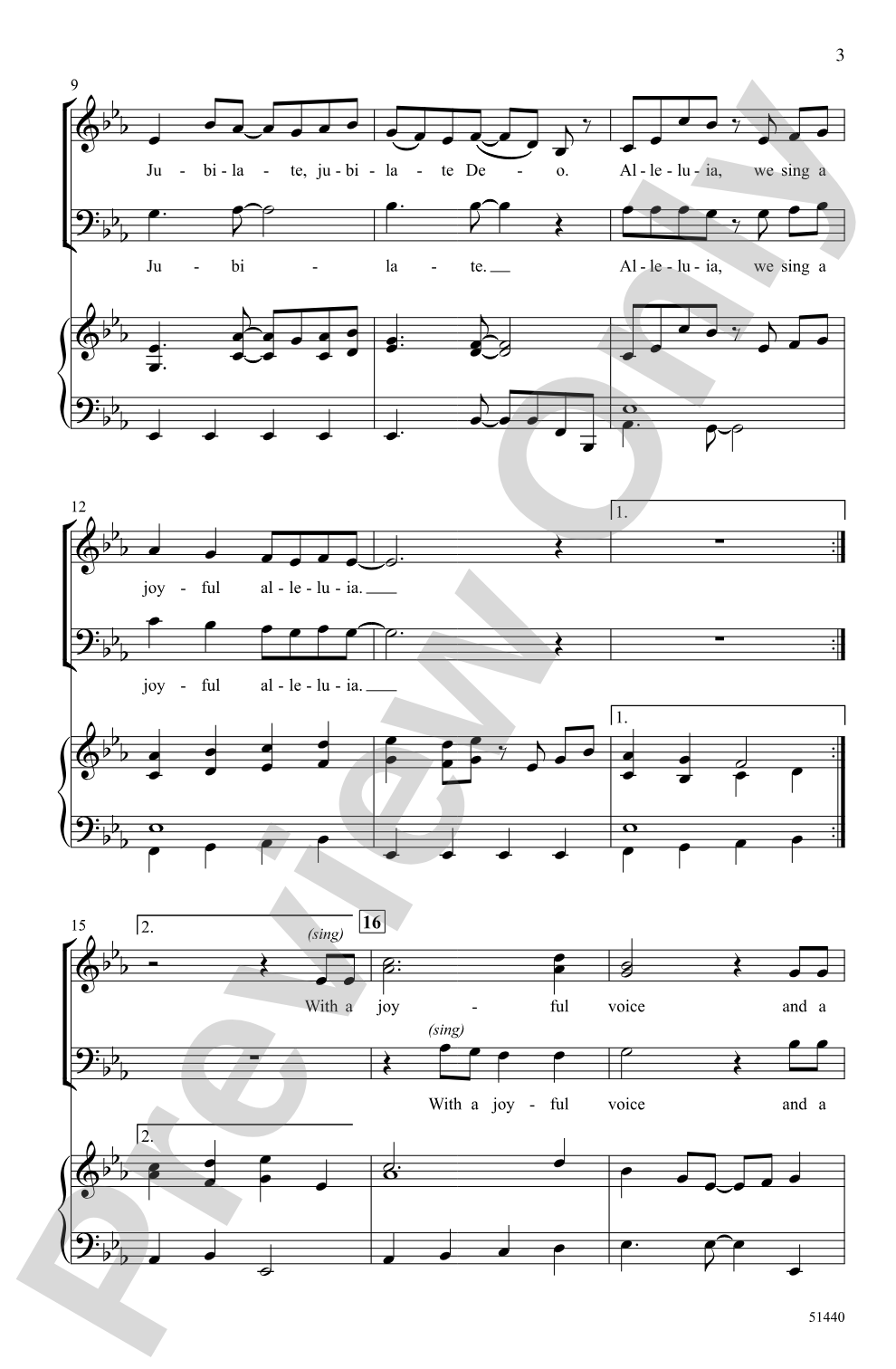

Jubilate, Alleluia: 3-Part Mixed Choral Octavo
Words and music by Earlene Rentz
Item: 00-PO-0007456
$2.20
Minimum order quantity: 20 copies
Pickup currently not available
Description
Here's a jubilant concert and contest selection that's just right for 3-part mixed choirs (with a conservative F-D range for Part III). Based on a single Latin phrase and one in English, the dance-like opening theme is restated in a variety of keys and textures, revealing a rondo form. A glorious descant tops the last A-section, bringing the two-minute piece to a rousing finish.


Discover MakeMusic Cloud: thousands of interactive titles your students can play along with today.
Sample Audio
1
Audio File
--:--
0:00
0:00
Sample Video
Additional Details
Series:
Alfred Choral Designs
Publisher:
Alfred Music
Page Count:
8
SKU:
00-PO-0007456
More about this title
About the Composer: Earlene Rentz

Earlene Rentz brings decades of classroom and choral experience to her compositions. She spent seven years teaching choral music across elementary, junior high, and high school levels in public schools, then moved into higher education where she taught choral music education courses for twelve years. She has guest conducted All-State Choirs in Georgia, Florida, Kentucky, and Alabama, and currently lives in North Carolina.
With over 700 published choral works across 17 different publishers, Rentz has established herself as a prolific voice in choral composition. Her extensive background in both secondary and higher education informs her approach to writing repertoire that works in real classrooms and rehearsal rooms.
Why we love this
The rondo form gives this piece clear structural identity without demanding advanced music theory analysis from singers. Rentz's choice to restate the theme in multiple keys keeps the energy fresh across the two-minute runtime, and the descant entrance in the final A-section delivers the climactic moment your choir will want to rehearse. This is the kind of contest piece that leaves judges noting musicianship and joy rather than technical scrambling.
What to expect
Jubilate, Alleluia carries the brightness of its Latin and English text. The dance-like opening feels immediate and unpretentious, inviting rather than ceremonial. When the descant arrives in the final section, the piece suddenly expands into something grander, turning celebration into a moment of genuine musical power.
Who it's for
Three-part mixed choirs at the middle school through early high school level will find this piece accessible and rewarding. The conservative range on Part III (F-D) ensures that singers with limited upper range can participate fully without strain. Directors preparing for concert or festival settings will appreciate a selection that sounds bigger than its modest scoring.
How to get the most out of it
- Establish the dance-like character of the opening theme from the first rehearsal. This rhythmic confidence will carry through each key change and make the rondo structure audible to listeners.
- Balance the descant carefully in the final A-section. It should soar above the lower voices without drowning them out; the effect is cumulative, not solo.
- Use the recorded accompaniment to lock in entrances across the key modulations. The harmonic shifts can sound uncertain if the ensemble is relying only on internal listening.
How to use it
This works well as a second-half opener in a concert, where its energy and shorter length bridge between heavier repertoire and lighter closing pieces. In a festival or contest setting, it demonstrates musical maturity and arranging craft without requiring soloists or extended preparation time. Consider pairing it with works that share its jubilant character.
Skills your students will build
- Singing in multiple keys without losing pitch security
- Understanding rondo form through performance
- Balancing ensemble texture when descants or solos are added
- Maintaining rhythmic precision in dance-like material across modulations