

Jubilate!: 2-Part Choral Octavo
Words and music by Victor C. Johnson
Item: 00-PO-0007885
$2.50
Minimum order quantity: 20 copies
Pickup currently not available
Description
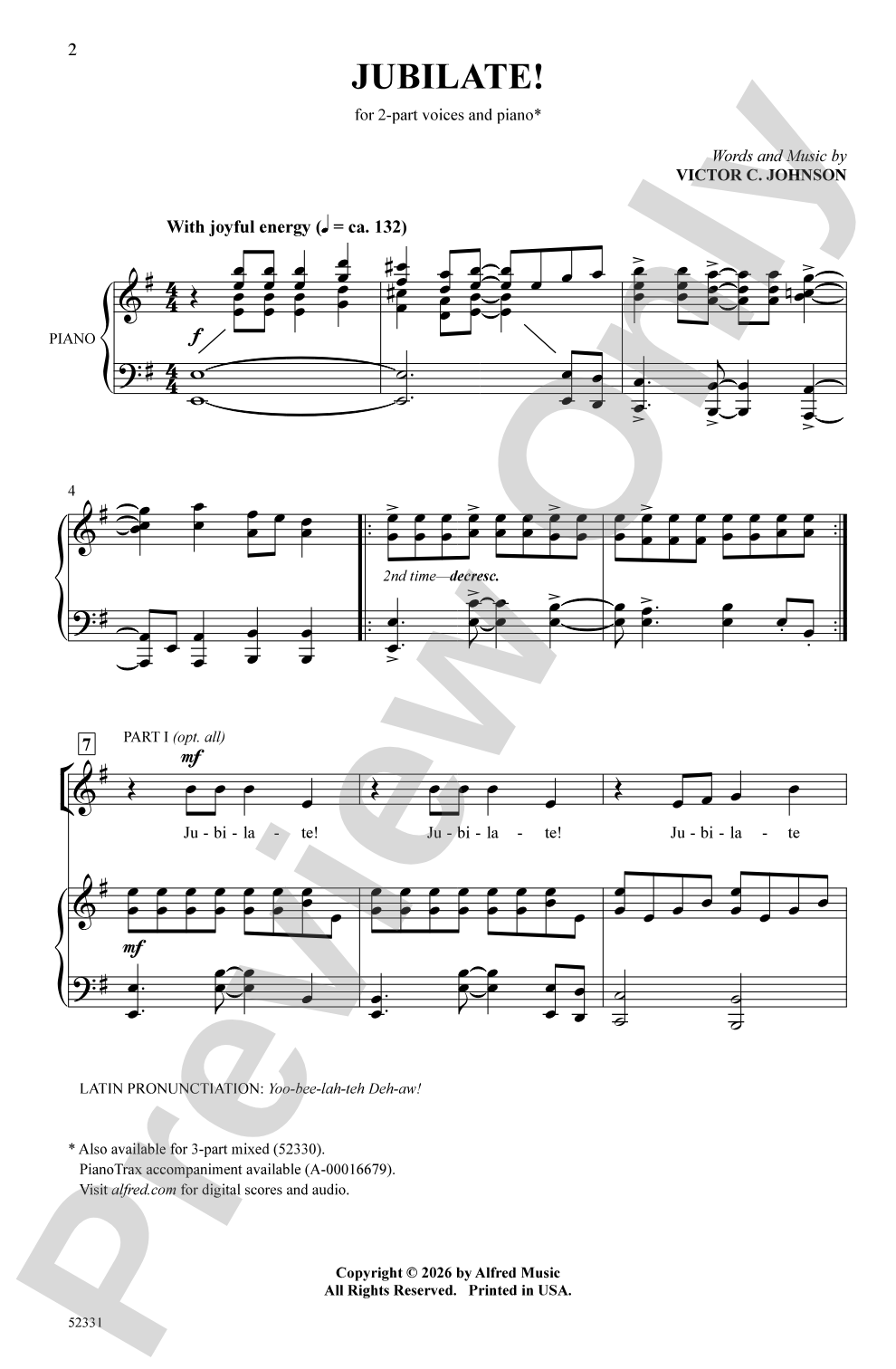
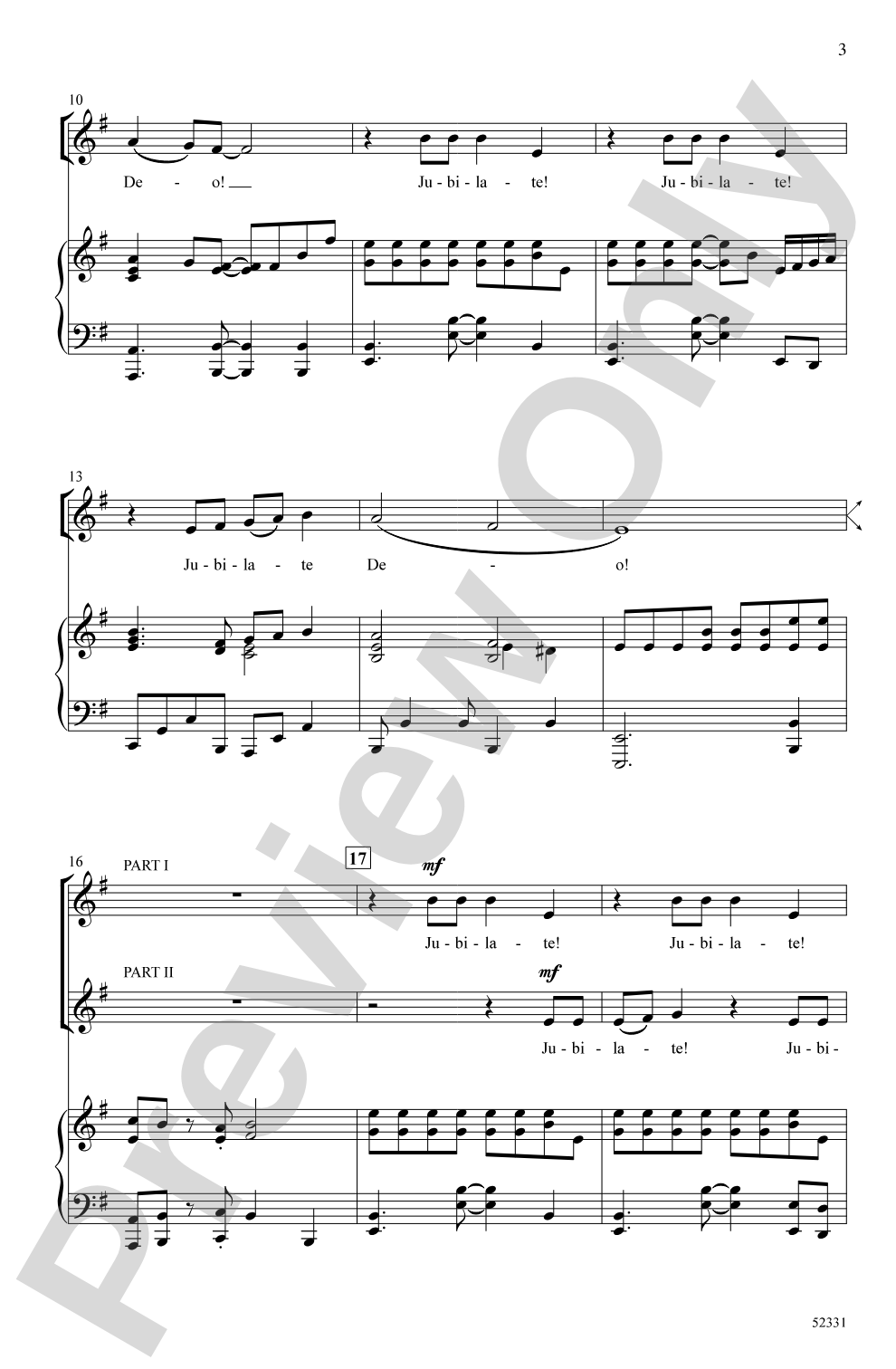
Here's a joyful, syncopated celebration that maintains its driving tempo from start to finish. This dynamic minor-key opener introduces a "Jubilate Deo" theme in unison, then develops it further with a complementary counterline texture. Contrasting English-language sections unfold with some stacked harmony, propelling the piece to a majestic modulation and a final descant-topped refrain. Uncomplicated in rehearsal, impressive in concert.


Jubilate!: 2-Part Choral Octavo isn't in MakeMusic Cloud just yet...but it could be. Let us know you'd like to see it, and you'll help shape what comes next. In the meantime, start a free trial and dive into thousands of interactive titles your students can play along with today.
Request This Title
Tell us you want it.
Start Your Free Trial
Explore everything that's ready to play right now.
Sample Audio
1
Audio File
--:--
0:00
0:00
Sample Video
Additional Details
Series:
Alfred Choral Designs
Publisher:
Alfred Music
Page Count:
12
SKU:
00-PO-0007885
More about this title
About the Composer: Victor C. Johnson

Victor C. Johnson has established himself as a major voice in choral music education, with over 500 published works spanning choral compositions, vocal solos, and keyboard collections. Based in Dallas, Texas, he serves as School Choral Editor for Sing!, the educational publishing division of Choristers Guild, where he shapes resources for teachers and students nationwide.
Johnson's background as a choral director at Ft. Worth Academy of Fine Arts (2000-2018) gave him direct experience with the repertoire needs of young singers across multiple ensemble levels. He has conducted the Dallas Symphony Children's Chorus Mixed Ensemble since 2022, working with advanced high school singers. His professional leadership includes memberships in the American Choral Directors Association, Texas Music Educators Association, National Association for Music Education, and ASCAP.
Why we love this
Johnson writes choral music that sounds far more complex than it actually is to prepare. The syncopated rhythms and unison-to-counterline architecture here give singers real textural variety to shape without requiring weeks of sectional rehearsals, making it ideal for groups that want concert impact without rehearsal exhaustion.
What to expect
Jubilate! radiates infectious joy from its opening moments, the minor key giving it a modern sophistication rather than darkness. The driving tempo and layered textures propel the piece forward with constant momentum, building toward moments of genuine majesty before settling into a celebratory close.
Who it's for
This works beautifully for middle school through adult choirs seeking a piece with contemporary energy and harmonic sophistication. Two-part voicing makes it accessible for developing singers, while the syncopated rhythms and textural contrast keep more experienced ensembles engaged.
How to get the most out of it
- Establish the syncopated drive in the opening "Jubilate Deo" unison section through consistent pulse work; any wavering on the rhythmic figures will undermine the piece's energy.
- Bring out the complementary counterline texture once it enters; this interplay between parts is what creates the piece's sense of forward motion and should feel conversational rather than rigid.
- Shape the English-language sections with attention to the stacked harmony layers. Each harmonic moment has weight, so let the tonal shifts breathe slightly before the modulation.
- Reserve your fullest sound for the final descant-topped refrain. The majestic modulation leading into it should feel like a natural peak, not a sudden jump in volume.
How to use it
Program this as an opening number or as a contrast piece alongside more traditional sacred or classical repertoire. Its concert-ready shine and contest-appropriate polish make it equally at home in a spring concert or festival competition, and the modest page count means it won't crowd a balanced program.
Skills your students will build
- Reading syncopated rhythms in a minor-key context
- Sustaining ensemble blend across unison and two-part textures
- Navigating modulation and tonal shift through harmonic changes
- Executing counterline independence while maintaining metric cohesion
- Shaping dynamic arcs across extended phrases with layered harmony